From Scudi to Lira to Euro: The Historical Story of Malta's Currency


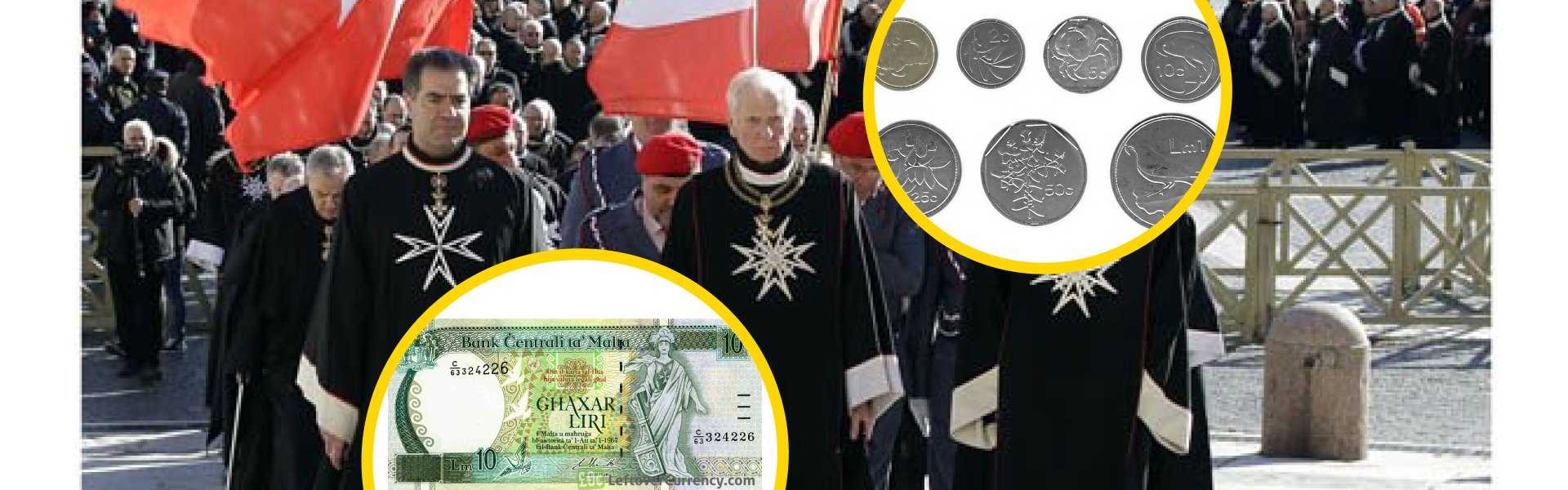
Reach into your pocket in Malta today and you will pull out euros, the same coins and notes used from Lisbon to Helsinki. But for most of Malta's history, the money that passed through Maltese hands was a precise mirror of who ruled the island. The coins changed when the rulers changed. Trace Malta's currency backwards; euro, lira, pound, scudo, and you trace the island's whole modern history: the Knights of St John, the British Empire, Independence, and finally membership of the European Union.
This is the story of Malta's money: the scudi of the Knights, the British pound, the Maltese lira that became one of the most valuable currency units on earth, and the euro that replaced it in 2008.
The Scudo of the Knights: Tarì, Grani and Piccioli

When the Knights of St John arrived in Malta in 1530, they brought their currency with them: the scudo (plural scudi). The scudo had first been minted by the Order on the island of Rhodes in 1318 and was first struck in Malta during the reign of Grand Master Piero de Ponte (1534–1535), who succeeded the Order's first Grand Master in Malta, Philippe Villiers de l'Isle-Adam.
The scudo was not a decimal currency, it used the older, more intricate subdivisions common before the modern era. One scudo was divided into 12 tarì; each tarì into 20 grani; and each grano into 6 piccioli. That makes one scudo equal to 240 grani, or 1,440 piccioli. The names tell their own story of the central Mediterranean: tarì derives from an Arabic word and was a unit used across Sicily and southern Italy, while scudo ('shield') was the Italian term for a whole family of European coins.
The coins themselves were, by the standards of the day, beautiful. By 1500 the Order's coins bore a cross and the coats of arms of the Order and the reigning Grand Master on one side, and the head of St John the Baptist, the Order's patron saint, on the other. The minting reached its artistic peak in the early 18th century under Grand Master António Manoel de Vilhena. The coinage ran the full range from humble copper piccioli and grani, through silver tarì and scudi, up to gold coins of 5, 10 and 20 scudi. (To give a sense of the scale of the gold pieces' value to collectors today: a single gold coin of Vilhena, minted in 1725, sold at auction in 2011 for around US$340,000.)
What was a scudo worth in ordinary life? The historical record gives a vivid answer. Around the beginning of the 1800s, the daily wage of a Maltese farm labourer was about 6¾ (old) pence. Since one scudo was worth roughly 20 pence, a farm labourer had to work about three days to earn a single scudo. Money was hard, and a scudo was a meaningful sum, which is why it appears in Maltese proverbs to this day. One runs: "Aħjar skud fil-but minn mija fis-senduq", 'Better one scudo in your pocket than a hundred in the chest', the Maltese equivalent of 'a bird in the hand is worth two in the bush'.
Malta's money was never entirely closed off, though. At various times, foreign coins were allowed to circulate alongside the scudo, Spanish dollars, Venetian lira, the French louis d'or and others, reflecting Malta's position as a trading and corsairing hub at the crossroads of the Mediterranean.
The French Interlude: Melting The Church Silver
The end of the Order's rule produced one of the strangest episodes in the history of Maltese money.
When Napoleon Bonaparte seized Malta in June 1798, expelling the Knights, the French occupation that followed was chronically short of cash. To raise funds, the French authorities melted down silver taken from Malta's churches and struck it into coins, 15 and 30 tarì pieces, using the 1798 dies of the last Grand Master, Ferdinand von Hompesch. It was a literal conversion of sacred treasure into hard currency, and it was one of the grievances that helped provoke the Maltese uprising against French rule.
During the subsequent rebellion and the blockade of the French garrison (1798–1800), the Maltese insurgents and the besieged French alike improvised. Gold and silver ingots were stamped with face values in grani, tarì and scudi, and these briefly circulated as emergency coinage in Valletta and the surrounding area, money created on the spot, out of bullion, because the normal system had broken down.
The British Pound: and the unique one-third-farthing

The British took control of Malta in the early 1800s (formalised as a Crown Colony in 1813), but the scudo and other coins kept circulating for years. The decisive change came in 1825, when an imperial order-in-council introduced British sterling coinage to Malta, replacing the patchwork of currencies, including the Order's scudo, that had circulated until then.
The conversion rate was set at £1 sterling = 12 scudi (so one scudo was worth 1 shilling and 8 pence, or 20 old pence). This particular exchange rate produced one of the most charming curiosities in the history of British colonial money. The smallest Maltese coin, the grano, worked out at exactly one-third of a farthing (the farthing being a quarter of a penny, and itself the smallest regular British coin). To allow the Maltese to keep using prices and amounts inherited from the scudo system, Britain therefore struck special one-third-farthing coins, and Malta was the only British colony in the entire Empire to use this denomination. These tiny coins continued to be issued for Malta right up until 1913.
Some scudi lingered in circulation even after 1825, and the last of the Order's coins were not formally withdrawn and demonetised until November 1886. For most of the British period, then, Malta usedordinary pounds, shillings and pence, the pound divided into 20 shillings, each of 12 pence, each of 4 farthings, exactly as in Britain.
Malta's money did begin to acquire a distinct local identity during the two World Wars. During the First World War, between 1914 and 1918, the Maltese government issued wartime emergency paper money. With the outbreak of the Second World War, legislation passed on 13 September 1939 authorised the Maltese government to issue its own banknotes, and a series of notes (in denominations such as 2 shillings 6 pence, 5 shillings, 10 shillings and £1) was put into circulation through the early 1940s, local money for a colony under siege.
Independence, The Central Bank, and Decimalisation
Malta gained its independence from Britain on the 21st of September 1964, but, as is often the way with money, the currency took longer to change than the flag.
A crucial institutional step came even before independence in the practical sense: the Central Bank of Malta was established by the Central Bank Act of 1967 and began operating on the 17th of April 1968, taking over the currency functions previously handled by a colonial-era currency board. From this point, Malta had its own central bank issuing its own national money, even though that money was still, for the moment, called the pound and still tied to sterling.
The next big change was decimalisation. Britain decimalised its own currency in 1971, abolishing the old shillings-and-pence system. Malta, although it used British coins, did not decimalise at the same time; it waited a year, decimalising in May 1972. (For nearly a year, therefore, the old pre-decimal British coins kept circulating in Malta after they had already been withdrawn in the UK.)
Maltese decimalisation used a distinctive system. Rather than simply copying the British model, Malta adopted the so-called 'pound and mil' system: the pound was divided into 100 cents, and each cent into 10 mils, so there were 1,000 mils to the pound. The first decimal coins, introduced in May 1972, were designed by Christopher Ironside, the English artist who had also designed Britain's own new decimal coins. A 25-cent coin was added in 1975. The mil-denominated coins were eventually withdrawn from circulation in 1994.
The Maltese Lira: The World's Second Most Valuable Currenc

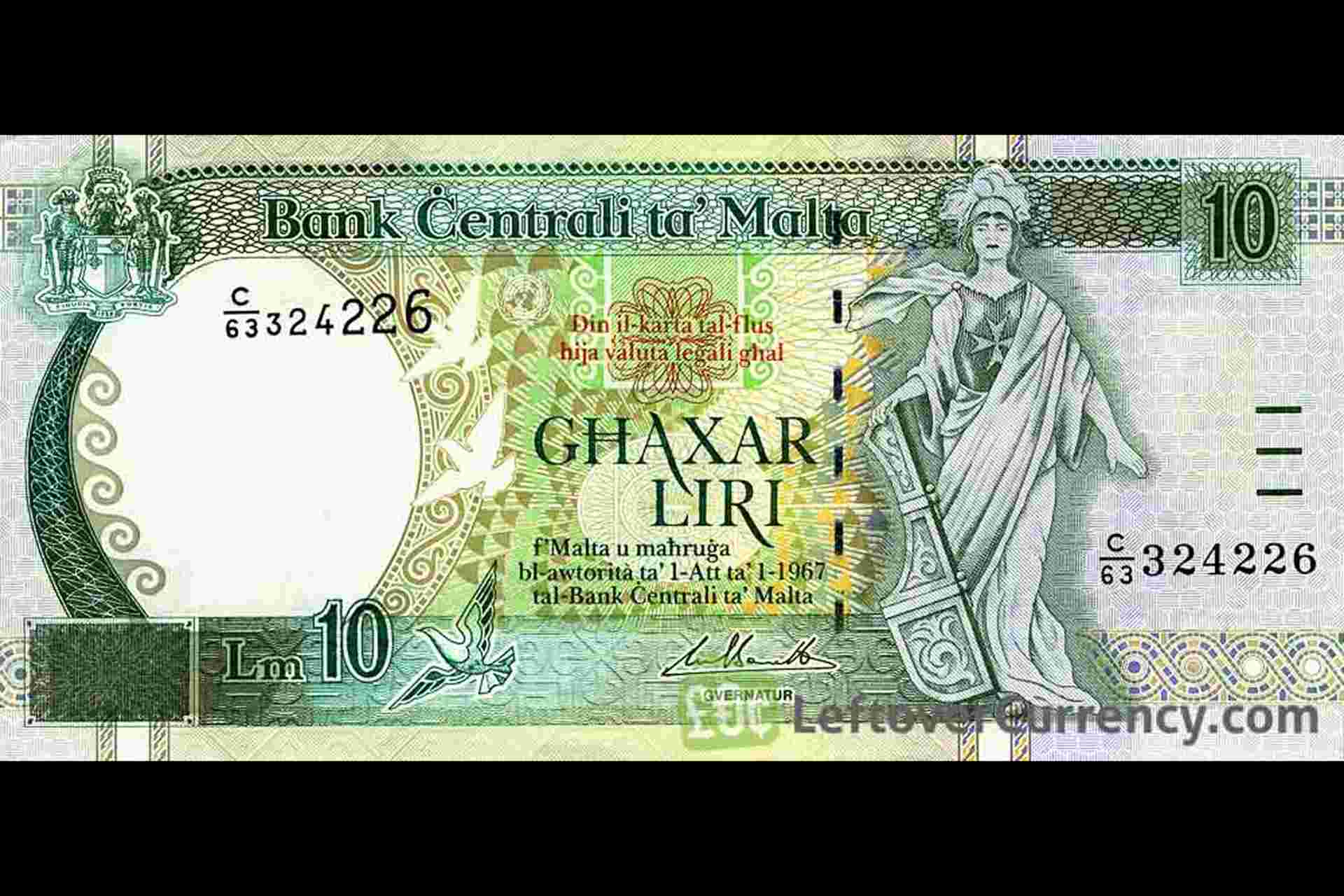
Here the story gets pleasantly confusing, because the currency had two names at once. In Maltese it was the lira (plural liri); in English it was officially still called the pound. When the Central Bank introduced a new series of banknotes on the 15th of January 1973, the notes were denominated in liri on one side and in pounds on the other. The two names were used side by side until 1986, when lira finally became the sole official name of the currency in both languages. Even then, many English-speakers in Malta went on calling it 'the pound' out of habit. The currency's symbol was Lm (from lira Maltija), and its international code was MTL.
The most remarkable thing about the Maltese lira was its sheer value. The Maltese pound had been exactly equal to the British pound (a 1:1 parity) as long as it was treated as a local issue of sterling, a relationship that held until the 13th of December 1971. After that, the Maltese currency was allowed to float, anchored to a basket of major reserve currencies, and it strengthened considerably. By the 2000s, one Maltese lira was worth well over one US dollar, around US$3.16 in April 2007. This made the Maltese lira, by the time it was retired, the second most valuable currency unit in the world, behind only the Kuwaiti dinar.
This high value was a frequent source of confusion for tourists, who would arrive expecting a small Mediterranean island to have a 'cheap' currency, and discover instead that a single Maltese lira cost them more than two euros or three dollars. It is one of the quirks of monetary history that one of the EU's smallest nations, for a few decades, carried one of its most valuable units of money.
The lira's banknotes were, like coins everywhere, small canvases of national identity. Successive series carried images of Maltese history and symbolism: President Agatha Barbara (Malta's first female head of state) on the fourth series, and on the final series the allegorical female figure of Melita, the Sette Giugno monument, the 1964 Independence flag-raising, and the statesman George Borg Olivier who led Malta to independence.
The Euro: 1st January 2008

When Malta joined the European Union on the 1st of May 2004, it committed, as new members do, to eventually adopting the euro. The process was deliberate and tightly choreographed.
On the 2nd of May 2005, the Maltese lira entered ERM II, the European Exchange Rate Mechanism that serves as the 'waiting room' for euro membership, at a central parity rate of Lm 0.429300 per euro. Although ERM II technically allowed the currency to fluctuate within a 15% band around that rate, the Central Bank of Malta and the Maltese government took the unusual step of voluntarily keeping the lira's actual exchange rate exactly equal to the central parity throughout the entire period, effectively pegging it rock-steady to ease the eventual transition.
On the 10th of July 2007, the EU's Economic and Financial Affairs Council (ECOFIN) confirmed that Malta (together with Cyprus) would adopt the euro and set the irrevocable fixed conversion rate: Lm 0.4293 = €1, or approximately €2.33 to one Maltese lira.
The euro became Malta's official currency on the 1st of January 2008. For a transitional month, both currencies circulated together: Maltese lira cash kept its legal-tender status and was accepted for payments until the 31st of January 2008. After that, the lira could still be exchanged, free of charge, at Maltese banks until the 30th of March 2008. The Central Bank of Malta set far longer deadlines for final conversion: lira coins could be exchanged at the Central Bank until the 1st of February 2010, and lira banknotes remained convertible all the way until the 31st of January 2018, a full decade after the changeover, so that no one would be left holding worthless paper.
Malta's own euro coins carry distinctively Maltese designs: the Maltese Cross on the €1 and €2 coins, the Mnajdra prehistoric temples on the 1, 2 and 5 cent coins, and the coat of arms of Malta on the others, so that even within the shared European currency, a coin minted in Malta still announces where it comes from.
A Footnote: The Scudo Still Exists

There is a curious epilogue to the story. The scudo, the currency of the Knights, technically still exists today.
The successor to the Knights of St John, the Sovereign Military Order of Malta, now a non-territorial sovereign entity based in Rome, has continued to issue scudo coins since 1961, and used the scudo on its postage stamps from 1961 until 2005. The modern Order of Malta scudo is pegged to the euro, at a rate of 1 scudo = €0.24 (so €1 is worth about 4 scudi and 2 tarì). It is not a circulating everyday currency, it functions essentially as a numismatic and ceremonial issue, but it means the same currency name that the Knights brought to Malta in 1530 is, in a technical sense, still alive nearly five centuries later.
What the Coins Remember
Malta's currency history is, in miniature, the history of Malta itself. The scudi with St John's head record two and a half centuries of rule by a religious-military order. The British pound, and that unique little one-third-farthing coin, records more than a century and a half as a Crown Colony. The Maltese lira, with its improbable world-beating value and its bilingual lira-and-pound banknotes, records the proud, slightly awkward early decades of independence, when a tiny new nation insisted on its own money and its own name for it. And the euro records Malta's arrival, in 2008, as a full member of the European monetary family.
Every time the rulers changed, the coins changed. The Knights, the French, the British, the independent Republic, the European Union, each left their money in Maltese pockets, and each took it away again when their time was over. The euros in circulation today are simply the latest chapter. If Malta's long history is any guide, they will not be the last, but for now, the coins that began as scudi bearing the head of St John the Baptist have become euros bearing the Maltese Cross, and the journey from one to the other is the journey of modern Malta itself.

About Matthew Gollcher
Hi, I'm Matthew, an SEO Specialist and Content Writer at Yellow Pages Malta. I'm passionate about creating meaningful content and exploring AI's creative possibilities. When I'm not working, I enjoy the gym, time with friends, watching series and reading, and playing guitar. I'm always eager to learn and grow both personally and professionally.