The Lost Maltese Railway: The Forgotten Train Line From Valletta to Mdina


Ask most people, Maltese or visitor, whether Malta has ever had a railway, and they will say no. The islands are tiny, the roads are full of buses and cars, and the idea of a steam train puffing across Malta seems to belong to some other, larger country.
And yet, for almost fifty years, Malta had exactly that. From 1883 to 1931, a single-track steam railway ran from Valletta to the old capital of Mdina, climbing up through the towns of the central plain. The Maltese gave it an affectionate and rather lovely nickname: il-vapur tal-art, 'the land ship'. It was the only railway line Malta has ever had, and today it is very nearly forgotten. But its traces are still scattered across the island for anyone who knows where to look: a station that is now a museum, another that is now a restaurant, tunnels, bridges, and streets still bearing the railway's name.
This is the full story of Malta's lost railway, how it was built, how it lived, how it died, and what remains. It is drawn from the standard history of the line (Joseph Bonnici and Michael Cassar's The Malta Railway, 1992), from contemporary 1880s reports, and from the detailed records preserved by Maltese railway historians.
Why Build a Railway on a Small Island?

The reason for the railway was simple: the journey between Malta's two great cities was painfully slow.
Valletta, built by the Knights in the 16th century, was the working capital, the harbour, the government, the commerce. Mdina, the silent walled city in the centre of the island, was the ancient former capital, and with its neighbouring town of Rabat it remained an important centre. But getting between the two meant a journey of about three hours by road, by horse, cart, or the traditional Maltese karozzin (horse-drawn cab), over dusty, hilly tracks. For a fast-modernising British colony in the railway-mad late nineteenth century, this was an obvious problem to solve.
The first proposal came in 1870, from a man named J. S. Tucker, who wanted to cut that arduous three-hour journey down to something far shorter. Malta was, at the time, one of the last places in Europe without a railway, and there was a certain colonial pride in catching up. An initial scheme proposed a narrow-gauge system designed by John Barraclough Fell, a noted railway engineer. That design was dropped in 1879 in favour of a proposal by the London engineering firm of Wells-Owen & Elwes.
Optimism ran ahead of reality. In 1880, the newspaper The Malta Standard reported confidently that 'in a short space of time, the inhabitants of these Islands may be able to boast of possessing a railway', and predicted the line would open by the end of 1881. In fact, problems with acquiring the land along the route delayed construction, and the opening slipped well past that target.
28th of February 1883: The Land Ship sets Sail

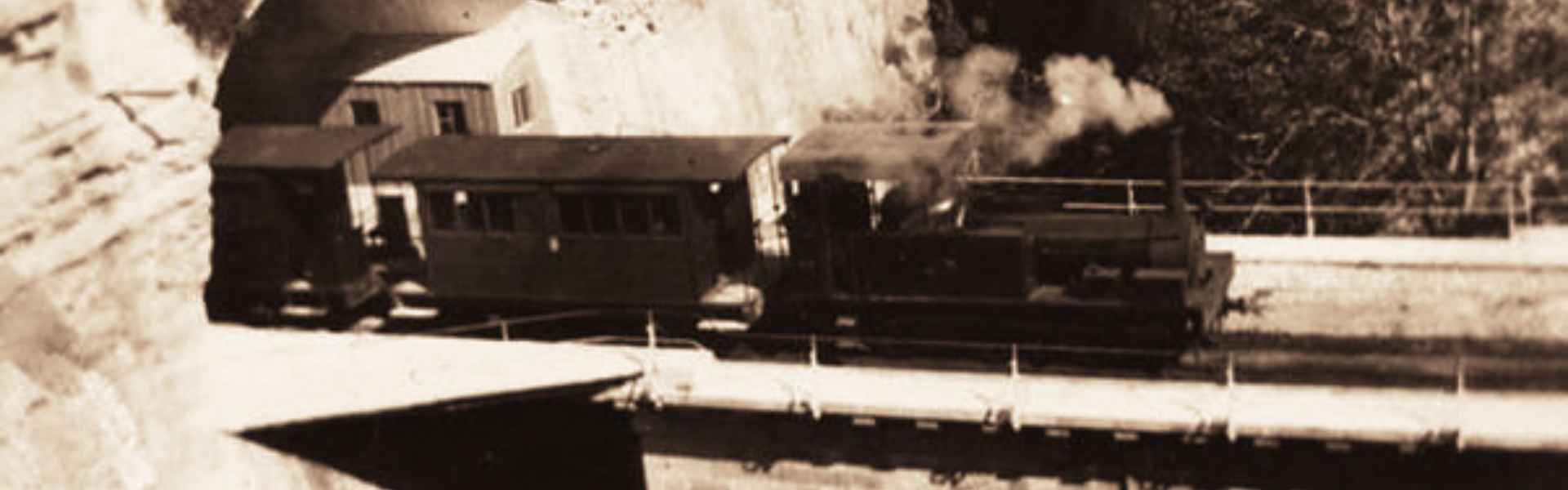
Caption: The first train left Valletta at 3pm on the 28th of February 1883 and reached Mdina in about 25 minutes, a journey that had previously taken some three hours by road. The line was single-track and metre-gauge, worked by British-built steam locomotives.
The Malta Railway finally opened on the 28th of February 1883, at 3pm, when the first train left Valletta and arrived at Mdina about 25 minutes later. A journey of three hours had become a journey of less than half an hour. For the Malta of 1883, it was a genuine technological marvel.
The line was a single-track, metre-gauge railway (the track 1,000 mm wide, narrower than the British standard gauge), running roughly 11 kilometres, just under seven miles, from Valletta to Mdina. It was not a flat run: the line climbed about 150 metres (500 feet) from the harbour up to the central ridge, at a maximum gradient of 25 per mille (a 2.5% slope, steep for a railway). It crossed roads at 18 level crossings, fourteen of them staffed, and when a train approached, the roads were physically chained off to let it pass, one of the details that lodged the railway so firmly in the memory of those who lived alongside it.
The stations ran the length of the central corridor of Malta. The first two, Valletta and Floriana, were underground, reached through a tunnel beneath the fortifications. From there the line ran out through Ħamrun, Msida, Santa Venera, Birkirkara, Balzan and Attard, before climbing to the terminus below Mdina. In all there were eleven stations, each with its own character, from the grand Valletta terminus to the smallest rural halt.
There was a remarkable piece of engineering hidden underground at the Valletta end. The route of the tunnel beneath the city's fortifications had to satisfy both military and civil authorities, which took considerable arguing to settle. Then, after the entrances had been fixed, the builders discovered that the agreed alignment would run straight into an ancient subterranean reservoir whose existence had not previously been known. Rather than move the tunnel mouths, the engineers deviated the tunnel around the reservoir in a double S-curve in the middle, and still brought the two ends together with an alignment error of just one inch.
The trains themselves were worked by British steam locomotives. The first three were 0-6-0 tank engines built by Manning Wardle of Leeds in 1882–83, and over the line's whole life it owned just ten locomotives, supplied also by Black, Hawthorn & Company of Gateshead and Beyer, Peacock & Company of Manchester. They were painted in an olive-green livery, and, a charming detail, the original engines had a system for recycling their exhaust steam back into the water tanks while in the tunnels, to keep the air breathable for passengers. The carriages, built by the Railway Carriage Company of Oldbury, were wooden bodies on iron frames, with first and third class, lit at first by candles and from 1900 by battery-powered electricity. The engine and carriage sheds were at Ħamrun.
Bankruptcy, Rescue, and the Climb to Mtarfa

For all the marvel of it, the Malta Railway was almost never financially healthy. As one history bluntly puts it, the finances of the railway always proved critical.
The original private operator, the Malta Railway Company Ltd., struggled from the start with financial, legal and technical problems, including unreliable locomotives that at times reduced the service to a single train. The company went bankrupt, and the railway stopped running, on the 1st of April 1890, barely seven years after it had opened.
Rather than let the line be broken up and sold off, the colonial government stepped in, took the railway over, invested in its neglected infrastructure, relaying the track with heavier rails so that more powerful locomotives could run, and reopened it on 25th of January 1892. Under government ownership the railway's fortunes improved: passengers returned, new locomotives and rolling stock were bought, and the line entered what was probably its healthiest period.
It was during this revival that the line was extended. From 1895, work began on a short extension beyond Mdina to the military barracks at Mtarfa, and this extension opened for traffic in 1900. The terminus station near Mdina became widely known as the 'Museum' station, after the nearby Roman antiquities museum. At its busiest, the railway ran an intensive timetable: more than a dozen return trips along the whole line each day, with extra short-distance services between Valletta and the closer towns. The uphill journey inland took about 35 minutes; the downhill run back to Valletta, about 30.
The Rival that Killed It: The Motor Bus

The Malta Railway was eventually killed not by any disaster, but by something far more ordinary: the arrival of better, cheaper, more flexible competition on the roads it ran beside.
Two rivals appeared in quick succession in the early twentieth century. In 1903 a company was formed to run electric tramways in and around Valletta, which began operating in 1905 partly parallel to the railway line, and immediately began eating into its traffic. In the very same year, 1905, the first motor buses appeared on Malta.
It was the bus, in the end, that proved decisive. Buses were cheaper to run than a railway, and, crucially, far more flexible: they could go where the rails did not, stop where passengers actually wanted to stop, and be re-routed at will. Through the 1910s and especially the 1920s, the Maltese bus became the islanders' preferred way to travel, and both the railway and the tram went into decline.
The tram company gave up first, closing in 1929. The railway hung on a little longer, but the writing was on the wall. The last train ran on the 31st of March 1931, after 48 years of service. The line that had once been a marvel was now an expensive relic, outcompeted by a technology that suited Malta's short distances and dense towns far better than a fixed steam railway ever could.
There is one final, almost comic footnote to the railway's story. During the Second World War, in 1940, the Italian dictator Benito Mussolini proclaimed that an Italian air raid had destroyed the Maltese railway system, a triumphant piece of wartime propaganda somewhat undermined by the fact that the railway had already been closed for nine years. There was nothing left to bomb. (The railway's tunnel under Valletta did serve one last purpose in the war, though: it was used as an air-raid shelter during the siege of Malta.)
What Remains: Hunting for the Land ship Today

For a railway that has been closed for over ninety years, a surprising amount of the Malta Railway survives, if you know what you are looking at. Over the decades, long stretches of the old track-bed were simply surfaced over and turned into roads, but the buildings and structures left behind tell the story to those who notice them.
Birkirkara station is the jewel. The old station building survives within Ġnien l-Istazzjon (Station Garden), a public park created on the railway land. It was officially inaugurated as a railway museum, the Malta Railway Foundation and Tram Museum, on the 19th of November 2023. Beside it stands the single most precious relic of the whole line: the only surviving original carriage, a wooden third-class coach on an iron frame, since restored. When the railway closed, 34 carriages were in use; this is the one that lived.
The Museum Station near Mdina, the old terminus, has had a colourful afterlife. In 1986 it was converted into a restaurant, and after a period of closure it reopened in 2016 as L-Istazzjon ('The Station'), so you can now eat a meal in the building where the land ship once came to rest below the walls of Mdina.
The Valletta station did not survive. Damaged during the Second World War, it was demolished in the 1960s to make way for Freedom Square, and its site is now occupied by Malta's Parliament House (the Renzo Piano building at the entrance to the city). The railway tunnel beside it spent decades as a public garage before being cleared as part of the City Gate redevelopment around 2011.
Other fragments are scattered across the island. The ticket office at Floriana still stands. The Ħamrun station is now the headquarters of the 1st Hamrun Scout Group. A railway tunnel under St Philip's Gardens in Floriana was reopened in 2011, and inside it were found two original luggage trolleys, in a sorry, dilapidated state. Bridges survive, some overgrown. And the railway lives on in Maltese street names: Railway Road in Santa Venera, Railway Street in Mtarfa, and the various Ġnien l-Istazzjon ('Station Garden') names that mark where the stops once stood.
There is also, in Attard, a small private Malta Railway Museum, opened in 1998, which displays photographs, documents and memorabilia, and which contains beautifully detailed scale models of eight segments of the line, reconstructed at 1:148 scale by Nicholas Azzopardi between 1981 and 1985, the work of a true enthusiast keeping the memory of the land ship alive.
The Railway that Might Never Come Back
Whether Malta will ever again have trains running across it remains to be seen. But there is a certain irony in it: the island abandoned its railway in 1931 because the flexible, modern motor bus had made the fixed steam line obsolete, and now, nearly a century later, the sheer number of those flexible, modern road vehicles has Malta wondering whether it should build the rails all over again.
For now, though, the Malta Railway remains a lost thing, a 48-year experiment in steam-age modernity, remembered in a handful of surviving buildings, a single restored carriage, a scattering of street names, and the wonderful Maltese phrase that captured it best. For half a century, on a small island in the middle of the Mediterranean, you really could catch il-vapur tal-art, the land ship, from the harbour city up to the silent walls of the old capital, in just twenty-five minutes.

About Matthew Gollcher
Hi, I'm Matthew, an SEO Specialist and Content Writer at Yellow Pages Malta. I'm passionate about creating meaningful content and exploring AI's creative possibilities. When I'm not working, I enjoy the gym, time with friends, watching series and reading, and playing guitar. I'm always eager to learn and grow both personally and professionally.