Napoleon Came to Malta and Stayed Six Days: What He Did, What He Took, and Why the Maltese Rose Against Him


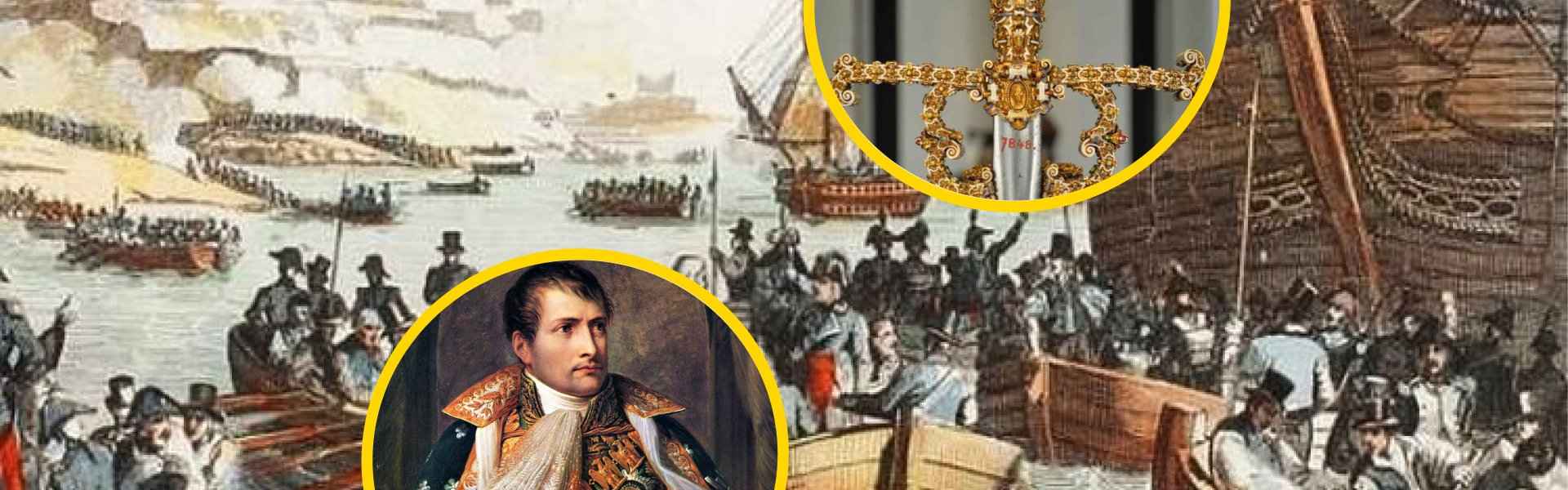
At 5:30 in the morning on the 9th of June 1798, lookouts on the walls of Valletta saw the horizon disappear. The French invasion fleet,472 ships, carrying an army of over 30,000 men on its way to Egypt — had arrived off Malta. A French knight on the island who witnessed the sight wrote that the Maltese, watching from their vantage points, saw 'the forest of masts which covered a vast expanse of sea'. He added: 'the sight petrified us.'
Three days later, the Order of St John, which had held Malta for 268 years, which had withstood 40,000 Ottoman troops at the Great Siege of 1565, which had built the most formidable fortifications in the Mediterranean, signed over the island to Napoleon Bonaparte. Without a real fight.
Napoleon arrived in Valletta on the 13th of June 1798 and stayed for six days. In those six days he issued ten orders comprising 98 articles. He abolished slavery and the feudal system. He closed the Court of the Inquisition. He freed political prisoners who had languished in the Knights' jails for decades. He set up schools, drafted a civil code, granted Jews the right to build a synagogue, and ordered the tricolour cockade to be worn by all citizens. He also stripped the island's churches and monasteries of their gold and silver, melted the altarpieces into military ingots, and took the ceremonial sword and dagger of Grand Master de Valette, the sword of the man who had saved Malta in 1565, for himself.
Then he sailed for Egypt.
Within three months, the Maltese had risen against the French. The uprising began during an auction of church property. A French officer was thrown from a balcony in Rabat and killed. The French were driven behind the walls of Valletta, where 4,000 troops held out for two years before surrendering to the British.
This is the story of the six strangest days in Maltese history, and what came after.
Why Napoleon Wanted Malta

Napoleon had been thinking about Malta for years. On the 26th of May 1797, he formally proposed its conquest to the French Directory: Malta was a 'pawing in the projected Mediterranean strategy,' whose fortifications were among the most powerful in Europe and whose position in the centre of the sea made it the key to controlling the route between France and Egypt.
His strategic logic was clear. The French Revolutionary Wars had driven the British Royal Navy out of the Mediterranean, by early 1798, the nearest British fleet was based at the mouth of the Tagus river in Portugal, thousands of miles away. The Mediterranean had effectively become a French lake. Napoleon's next target was Egypt: he intended to drive the Ottomans out, use Egypt as a base, and threaten British India from the east. To reach Egypt from France, he needed to cross a sea controlled by the Royal Navy. He needed a mid-point stronghold. He needed Malta.
He also needed to solve a second problem: money. The Egyptian expedition was expensive. The Order of St John had spent 268 years accumulating one of the greatest concentrations of gold, silver, jewellery and sacred objects in the Mediterranean. Their island was, as one historian has put it, a treasure chest with fortifications.
By the time Napoleon's fleet was ready to sail, the Order of St John was in no position to resist either ambition. Their French revenues had been confiscated in 1792. Their membership was largely elderly and demoralised. Their finances were effectively bankrupt. Their new Grand Master, Ferdinand von Hompesch zu Bolheim, elected only in 1797, had no military experience. A third of the Order's knights were French,and some of them were republican sympathisers. The treasure chest was real. The fortifications, without the will to defend them, were just stone.
9th to the 12th of June: The Conquest that took Three Days

The pretext for invasion was manufactured with minimal subtlety. On the morning of the 9th of June, Napoleon sent his aide-de-camp Jean-André Caruson to request permission for the entire French fleet to enter Maltese harbours to take on water. Grand Master von Hompesch convened his council and returned the reply: the Treaty of Utrecht of 1713 forbade more than four belligerent ships from entering Maltese ports during wartime. He would permit four ships at a time. It was a legally correct position. Napoleon declared it an insult, accused the Knights of showing favour to the British, and ordered the invasion to begin.
On the morning of the 10th of June 1798, the French landed simultaneously at four locations: St Paul's Bay in the north, St Julian's, Marsaxlokk in the south, and Ramla Bay on Gozo. Future marshals Marmont and Lannes commanded brigades under General Charles Henri Vaubois landing near Valletta. General Louis Charles Desaix landed in the south. General Jean-Louis Reynier took Gozo.
Most French knights commanding strategic positions deserted the Order without a fight. But Maltese resistance was fiercer than the surrender mythology suggests. At Fort San Lucian at Marsaxlokk, a garrison of 165 Maltese men held out for 36 hours, giving up only when they ran out of water and ammunition. At Fort Tigné, the Maltese Cacciatori regiment repelled three French assaults. These were not the actions of a population indifferent to the invasion.
Inside Valletta, the situation collapsed. Chaos spread through the streets. Several knights were killed by mobs after rumours spread that surrender was already agreed. The Grand Master remained in his palace, indecisive. Maltese representatives petitioned him to negotiate. Pro-French faction members within the Order pressured him to capitulate. One senior knight, Jean de Bosredon de Ransijat, Secretary of the Treasury, was imprisoned in Fort St Angelo for writing to Hompesch that he would not fight the French and asking to remain neutral.
By the evening of the 10th of June, Mdina had fallen to Vaubois. The next day the Order's council agreed terms. On June 12th 1798, Napoleon and representatives of the Order and the Maltese signed a convention aboard L'Orient: the Order surrendered sovereignty, all fortifications, all military supplies, all naval vessels. In exchange, Napoleon promised estates and pensions for the Grand Master and the knights, and a guarantee to respect the religion and private property of the Maltese. The 268-year rule of the Knights of St John ended on the deck of a French flagship.
13th to the 19th June: Six Days that Changed Malta Forever
Napoleon arrived in Valletta on the 13th of June, spending his first night at the Banca Giuratale and then moving to Palazzo Parisio, now the Ministry for Foreign Affairs. He spent six days transforming, on paper, a feudal island that had been governed by a religious order for two and a half centuries into a French republic.
The reforms he issued in those six days, ten orders, 98 articles, were remarkable in their scope and in the speed with which they were drafted. Some were genuinely revolutionary. Some were cynical. Almost none were fully implemented before he left.
On the genuinely revolutionary side: slavery was abolished and all enslaved men were freed, ending an institution that had operated continuously on the island since the arrival of the Knights in 1530. The feudal system was abolished. The Maltese nobility was dissolved. The Court of the Inquisition was closed. All inhabitants were declared French citizens with equality before the law. Political prisoners were freed, including the linguist and Maltese language advocate Mikiel Anton Vassalli, who had been imprisoned by the Knights for years, and those who had participated in the Rising of the Priests of 1775. The Jewish population was granted permission to build a synagogue, the first such right they had been given on the island. Marriage became a civil affair, removing it from Church control. The civil code introduced principles of secular law that were half a century ahead of most of southern Europe.
Napoleon also planned the complete overhaul of Maltese education: 15 primary schools for the island, free and open to all, replacing the system the Knights had provided. The University was dissolved and replaced with an École centrale with eight chairs of an aggressively scientific character: arithmetic and stereometry, algebra and stereotomy, geometry and astronomy, mechanics and physics, navigation, and chemistry. Furthermore, sixty children aged 9 to 14 from Malta's wealthiest families were to be sent to Paris to be educated in French colleges. It was a plan for cultural assimilation dressed as educational reform.
A National Guard of 900 men was formed. Malta was divided into twelve cantons and municipalities, each run by a president, secretary and four members. A Commission of Government was established, composed of five Maltese, to govern the islands. French replaced Italian as the official language. The tricolour cockade of the French Republic was mandated for all citizens. The government published a newspaper, the Journal de Malte, freedom of the press having been declared, with the single qualification that the only newspaper was the one the government controlled.
What He Took: The Looting of a Treasure Island

Napoleon's promises to respect the property of the Maltese lasted approximately as long as his signature on the capitulation document was wet.
On the 14th of June, the day after his arrival, he ordered all gold seized from churches, monasteries and the Order's treasury to be melted into ingots and deposited in the army's military chest. Silver objects valued between 250,000 and 300,000 francs were sold in Malta; the rest were minted into coins to pay the garrison he was leaving behind. The total value of confiscated treasures across Malta and Gozo came to 489,659 scudi, approximately €41 million in today's money.
The silver altar rails of St John's Co-Cathedral, the most extravagant church interior in the Mediterranean, were spared by a ruse: someone, unknown, had them painted black before the French inspectors arrived. They were assumed to be iron and left alone. This has been called one of the most effective acts of cultural resistance in Maltese history.
The ceremonial sword and dagger of Grand Master Jean Parisot de Valette were taken. These were the most precious objects in the Order's treasury: given to de Valette by King Philip II of Spain in recognition of his victory at the Great Siege of 1565, paraded annually in Malta for over two centuries. Both are now in the Louvre in Paris. Napoleon apparently kept the dagger as a personal talisman and carried it throughout his campaigns. It passed to his son on Napoleon's death in 1821, and was presented to the Louvre in 1840. In 2018, during Valletta's year as European Capital of Culture, the Louvre loaned the dagger to Malta for public display, the first time it had been seen on the island in 220 years. The sword was declared too fragile to transport. Neither has been returned.
In total, Napoleon's forces looted what one historian estimated as seven million francs in treasures from the island's churches, monasteries and residences. The Order's financial institutions were stripped: the Monte di Pietà, a lending fund established in 1598, lost assets valued at 443,484 scudi. The Massa Frumentaria, the grain fund that had kept Malta fed through shortages for centuries, was emptied to finance the Egyptian campaign. In a single week, Napoleon extracted from Malta a fortune that had been accumulated over 268 years.
Most of it was loaded aboard the French fleet and sailed east with Napoleon. On the 1st of August 1798, Admiral Nelson destroyed the French fleet at the Battle of the Nile at Aboukir Bay in Egypt. The flagship L'Orient, Napoleon's own ship, the same vessel aboard which the capitulation of Malta had been signed, caught fire and exploded. The silver of Malta's churches, the gold of its altarpieces, the accumulated loot of the Mediterranean's greatest treasure island, most of it is still in Aboukir Bay, two and a half centuries later. The silver altar rails of St John's, painted black by an unknown hand, are still in Valletta.
19th June: Napoleon Sails. The Maltese are Left with the French Garrison and the Promises.
On the 19th of June 1798, Napoleon Bonaparte sailed from Malta for Alexandria, leaving behind approximately 4,000 soldiers under General Charles Henri Vaubois to hold the island. The reforms he had proclaimed were real, on paper. The schools were not built. The 60 children sent to Paris for education represented a plan, not a reality. The Commission of Government of five Maltese existed; the decisions were made by Vaubois.
Grand Master von Hompesch left Malta the same day for Trieste, with a pension guaranteed at 300,000 francs per year, the sword of Grand Master de Valette, and the three sacred relics the French had permitted the Order to keep: the Fragment of the True Cross, the Icon of Our Lady of Philermos, and the Right Hand of St John the Baptist. He abdicated the Grand Mastership in 1799, retired to Montpellier, and died in poverty in 1805. The promised pension apparently proved as solid as Napoleon's other promises.
The Order's era in Malta had ended not with the heroism of 1565 but with a signature. It left, as one historian of the Order put it simply, a dishonorable end.
2nd of September 1798: the Day the Maltese Threw a French Officer from a Window

What followed Napoleon's departure was not the grateful implementation of his reforms. It was the systematic reneging on every promise his forces had made.
Pensions and salaries owed to Maltese sailors, soldiers and civil servants ceased to be paid. Religious institutions were suppressed one by one. The food funds that had fed the poor were confiscated. The gold and silver of the churches that had not already been looted continued to be removed. The Journal de Malte published French propaganda in a language most Maltese could not read. The 15 free schools existed as a decree. The French were not popular in the way that Napoleon's Enlightenment agenda might have expected them to be.
The moment of rupture came on Sunday, the 2nd of September 1798, three months after Napoleon had sailed. French officials ordered the possessions of the Carmelite Convent in Mdina to be auctioned. Villagers from Żebbuġ and Siggiewi had gathered in Rabat. An angry crowd blocked the sale. The situation might have been contained.
It was not. Captain Lazare Masson, the French commander of the Mdina garrison, became involved in a confrontation with the crowd in Rabat. He was thrown from a balcony to his death. His wife was reportedly spared only because she was visibly pregnant. Some of his men were killed alongside him. French reinforcements sent to retake Rabat, 250 soldiers, were routed.
By the following morning, Mdina was in Maltese hands. By September 4th, French forces across the island had withdrawn behind the walls of Valletta, the Three Cities and the harbour fortifications. The countryside was entirely in the hands of the Maltese rebels.
The Maltese sent appeals to Ferdinand, King of the Two Sicilies, and to Admiral Nelson. Nelson sent a Portuguese squadron of four ships of the line and two frigates under the Marquis Nizza Reale. The blockade began. In October 1798, Nizza Reale was replaced by Captain Alexander Ball, who would maintain the blockade for two years. The Maltese cut the Wignacourt Aqueduct that brought fresh water to Valletta, forcing the French to rely on cisterns. Approximately 10,000 Maltese irregulars, led by Emmanuele Vitale and Canon Francesco Saverio Caruana, surrounded the city, armed with 23 cannon and a squadron of coastal gunboats. Vincenzo Borg, later known as il-Brared, the Patriot, commanded forces in the area of the Three Cities. Mdina's armoury and the gunpowder magazine at Cottonera had been seized.
Inside Valletta, General Vaubois held out with a combination of tenacity and brutality. He expelled Maltese civilians from the city to reduce the mouths he was feeding. He extracted forced loans from wealthy Maltese who remained. He rationed ammunition. He maintained a garrison of approximately 5,000 soldiers and sailors, the crews of French ships that had escaped Nelson at the Battle of the Nile and taken refuge in the Grand Harbour.
On the 28th of October 1798, the 217 French soldiers on Gozo surrendered without a fight. On the 4th of September 1800, after two years, Vaubois finally surrendered Valletta to the British. The French were the last garrison from Napoleon's Egyptian expedition still in the field. They were taken to Toulon aboard British ships. Malta became a British protectorate.
What Napoleon's Six Days Actually Changed
The French occupation of Malta lasted just over two years. But the six days of Napoleon himself on the island left marks that outlasted the occupation.
The abolition of slavery was permanent. No administration that followed, British or Maltese, restored it. The principle of equality before the law, even if not immediately implemented, had been stated formally for the first time. The Inquisition was never restored. The idea of secular civil marriage, introduced by Napoleon, would eventually return, though not until 1975, nearly two centuries later. The principle of free public education that Napoleon proclaimed was eventually implemented by the British.
What was not permanent: the 2.2 million scudi looted from the Maltese financial system. The Monte di Pietà, the Massa Frumentaria and the other financial institutions that had fed and supported the Maltese poor for centuries were stripped and never restored. The British governors who followed made promises to compensate for the losses. The promises were not kept.
The sword of de Valette is in the Louvre. The dagger is in the Louvre. The Treaty of Vienna of 1815 required the French to return objects looted during the Napoleonic Wars. In the chaos following the Order's dispersal, no formal claim was ever made. By 2018, when Valletta was European Capital of Culture, the dagger was loaned to Malta for the first time in 220 years. The sword was too fragile to travel.
Most of the gold and silver sits in the silt of Aboukir Bay, along with the remains of L'Orient, the flagship on which the capitulation was signed.
How to Understand Napoleon's Six Days
The Maltese remember the French occupation with a complex feeling that resists simple categorisation. Napoleon is simultaneously the man who freed the slaves, closed the Inquisition and freed Mikiel Anton Vassalli from prison, and the man who stripped the churches, took the treasure and left a garrison to enforce his reforms with bayonets.
The contradiction is not resolvable because it is not a contradiction. Napoleon did both things. His reforms were real; his looting was real. His Enlightenment principles were genuine; his willingness to impose them on people who had not asked for them, while simultaneously extracting their wealth to fund a campaign in Egypt, was equally genuine. He was, in Malta as everywhere else, both the liberator of the revolutionary catechism and the most efficient extraction machine in the history of European conquest.
The Maltese uprising of the 2nd of September 1798 is one of the least-known but most significant acts of collective resistance in 18th-century European history. A population of around 100,000 people, without a standing army, without naval support and with almost no external assistance, drove 4,000 professional French soldiers inside the strongest fortifications in the Mediterranean and kept them there for two years. The numbers of Maltese who died in the insurrection, estimates range from 17,000 to 20,000, were greater than those killed in the Great Siege of 1565.
They did not receive independence. The British, who had helped them blockade the French, took the island instead. It would be 1964 before Malta governed itself.
But the insurrection is the moment when Malta said, for the first time in modern history, that it would not be ruled without consent. The principle Napoleon had proclaimed, that all people were equal before the law, the Maltese turned back against the French who had proclaimed it. Napoleon came to Malta and stayed six days. The Maltese response took the next 166 years to reach its conclusion.

About Matthew Gollcher
Hi, I'm Matthew, an SEO Specialist and Content Writer at Yellow Pages Malta. I'm passionate about creating meaningful content and exploring AI's creative possibilities. When I'm not working, I enjoy the gym, time with friends, watching series and reading, and playing guitar. I'm always eager to learn and grow both personally and professionally.