How Malta Became Independent: The Long Road to the 21st of September 1964


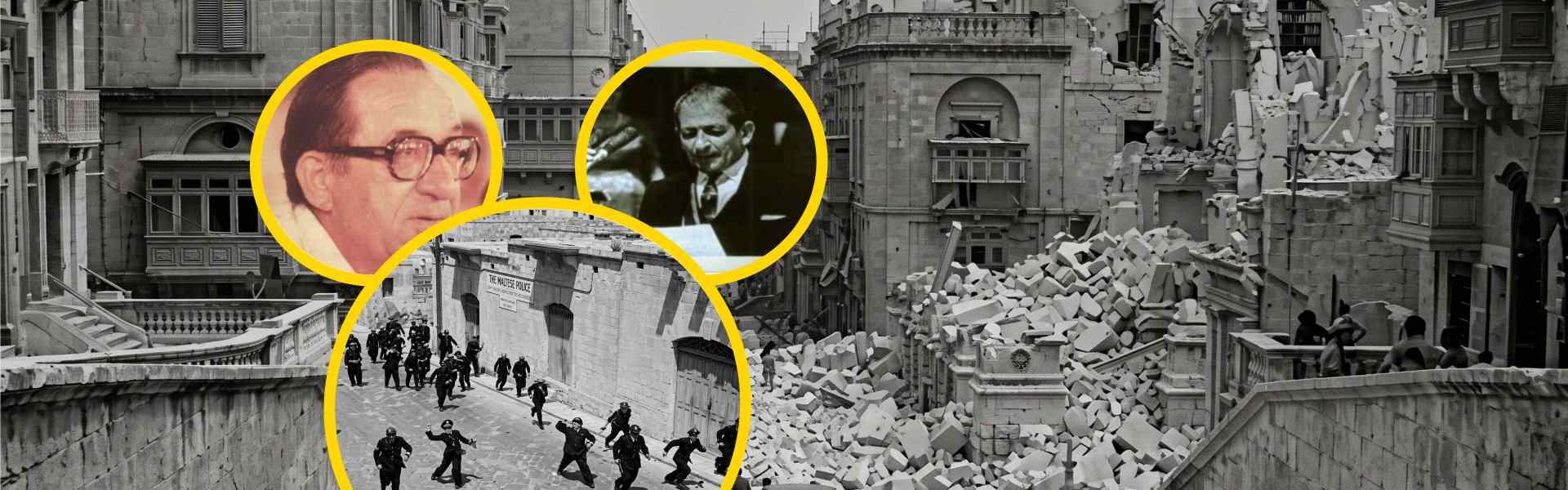
Just before midnight on the 21st of September 1964, the Union Jack was lowered over Malta for the last time. It had been flying for 164 years, raised when the British helped expel Napoleon's forces in 1800 and secured by the Treaty of Paris in 1814. In its place went the flag of the new State of Malta: red and white, with the George Cross in the corner.
George Borg Olivier, the Maltese Prime Minister who had spent a decade negotiating for this moment, was there to receive the constitutional instruments from Prince Philip, representing Queen Elizabeth II. The crowds that had filled St George's Square in Valletta all day, parades of floats, waterskiers in the harbour, the streets full of people who had lived their whole lives as British subjects, witnessed it.
But Dom Mintoff, the man whose career had done more than any other to make independence inevitable, was not celebrating. The Labour Party boycotted the independence ceremonies entirely. They had wanted something different, negotiated something different, and been refused. The independent Malta that came into existence that night was, in their view, not independent enough.
The road to that midnight moment was longer, stranger and more bitterly contested than the official celebrations suggested. It involved a serious proposal to make Malta part of the United Kingdom, a referendum that produced the wrong result, riots that brought the British back to direct colonial rule, and two men who agreed on almost nothing except that the status quo could not last.
This is the full story.
The Starting Point: 1947 and a Divided Island

Malta emerged from the Second World War as the most bombed place on earth, its Three Cities in ruins, its dockyard the economic lifeline of the island, its people carrying a George Cross awarded by King George VI in April 1942 for collective bravery. Britain had made vague promises of greater autonomy. What that would look like remained entirely unresolved.
In September 1947, Malta received a new constitution that restored self-government and granted universal suffrage for the first time. That year, Agatha Barbara became the first woman elected to the Maltese parliament. The restored political life almost immediately divided along the fault line that would define the next seventeen years: what kind of relationship should Malta have with Britain?
Two competing visions emerged. Dom Mintoff, born in Cospicua on the 6th of August 1916, architect by training, Labour leader from 1949, and widely known as il-Perit, believed Malta's poverty was colonial in origin and could only be solved by securing the same living standards, wages and social services as British workers enjoyed. He wanted either genuine integration with the UK or full independence. He was not much interested in half-measures.
Across the chamber sat George Borg Olivier, born in Valletta on the 5th of July 1911, a lawyer, leader of the Nationalist Party from 1950. Borg Olivier wanted dominion status, the arrangement that Canada, Australia and New Zealand enjoyed: full self-government with the Queen as head of state, responsibility for defence and foreign affairs shared with Britain through the Commonwealth. He had no interest in integration.
For most Maltese people in the late 1940s and early 1950s, neither position was primarily about flags and constitutions. It was about the dockyard. The British naval base was the engine of the Maltese economy. Tens of thousands of families depended directly or indirectly on the work it provided. The question of Malta's constitutional future was inseparable from the question of what would happen when the Navy started cutting back, and everyone knew the Navy would eventually start cutting back.
Dom Mintoff and the Integration Proposal

The February 1955 elections gave Mintoff's Labour Party 23 seats to the Nationalists' 17. He became Prime Minister and immediately began pushing his most ambitious idea: not independence, but integration with the United Kingdom.
The proposal was concrete and detailed. Malta would send three Members of Parliament to Westminster. The Home Office would take over from the Colonial Office as the responsible ministry for Maltese affairs. The Maltese Parliament would retain control of education, public life and the position of the Catholic Church. Britain would guarantee Maltese workers the same wages and standard of living as workers in Birmingham or Manchester. Malta's strategic position in the Mediterranean would be locked in; British spending on the dockyard would be secured.
To Mintoff this was justice, not charity. Malta had been bombed to rubble defending Britain's interests. The island had earned the right to share in British prosperity. Integration was the price of what Malta had already paid.
In December 1955, the British government convened the Malta Round Table Conference in London, chaired by the Lord Chancellor, attended by Mintoff, Borg Olivier, other Maltese politicians, and Colonial Secretary Alan Lennox-Boyd. The Conference's report endorsed the principle of three Maltese MPs at Westminster. The proposal went to a referendum.
Borg Olivier's Nationalists boycotted it. The proposal, they argued, threatened Malta's distinct identity, culture and Catholic character. They wanted dominion status, not absorption. The Catholic Church, under Archbishop Mikiel Gonzi, sided with the Nationalists: integration might elevate the Anglican Church above the Catholic in Malta's constitutional arrangements, and that was unacceptable.
On the 11th and 12th of February 1956, Maltese voters went to the polls. Of those who voted, 77% said yes to integration. But the turnout was only 59.1% because the Nationalist Party and the Church had urged a boycott. London looked at the figures and decided the result was not the 'clear and unmistakable verdict' it needed before committing to such a dramatic constitutional change. Mintoff stood outside 10 Downing Street and declared that the Maltese people had spoken. London was not so sure.
The Collapse: Why Integration Failed
For two years, negotiations continued. By November 1957, agreement on integration was almost within reach. Then the Admiralty announced it would reduce the volume of naval ship-repair work available to the Malta dockyard after 1960. The economic foundation of the whole arrangement began to crack.
The crisis escalated rapidly. Mintoff demanded guarantees of economic equivalence with Britain within a fixed timescale. London refused, this would, as one British minister put it, be 'equivalent to signing a blank cheque on the British Exchequer.' The Admiralty announced plans to dismiss 40 dockyard workers. Mintoff declared in Parliament that Malta was no longer bound by its agreements and obligations toward the British government. The Colonial Secretary warned him he had recklessly jeopardised the entire integration plan.
On the 21st of April 1958, Dom Mintoff and his MLP ministers met Governor Sir Robert Edward Laycock and handed in their resignations from the Legislative Assembly. Borg Olivier was offered the chance to form an alternative government. He refused. The Governor declared a state of emergency and suspended the constitution. Malta was placed under direct colonial administration from London for the third time in its history.
28th April 1958: The Day Malta Took to the Streets

One week after the resignation, on the 28th of April 1958, the General Workers' Union called a general strike. Tens of thousands of Maltese responded. The strike was about more than the constitutional crisis. It was the eruption of years of accumulated frustration; poor wages, uncertain employment, the deliberate closure of the Malta Drydocks by British authorities that had threatened the livelihoods of more than 13,000 families. Demonstrators took to the streets in Valletta, Sliema, Paola and Vittoriosa. Police were pelted with stones. An army jeep and a naval tug were set on fire. A state of emergency was declared. Soldiers were placed on standby to support the police.
Governor Laycock banned all public demonstrations and meetings for three months and ruled under emergency powers until the end of his term in 1959. British Prime Minister Harold Macmillan suspended the Maltese constitution. The integration project was dead. And the bitterness of 1958 would reshape everything that came after.
In 1959 an Interim Constitution provided for an Executive Council under British rule. In 1961, the Blood Commission produced a new constitution; named after its chairman Sir Hilary Blood, which restored self-government and formally recognised Malta as the 'State of Malta.' Elections were held in 1962. Borg Olivier's Nationalists won. He became Prime Minister for the second time. The island was now pointed unambiguously toward independence.
Borg Olivier and The Negotiation of Independence

On the 13th of July 1963, Borg Olivier led the Maltese delegation to the Malta Independence Conference in London. At its conclusion, Britain announced that Malta would become an independent nation. The outline was agreed. What remained was the constitution.
This proved harder than expected. Mintoff's Labour Party put forward six conditions for the independence constitution, one of which included the potential justification of political violence. The Labour Party was also unenthusiastic about Malta remaining in the Commonwealth and opposed retaining the George Cross in the national colours. These positions were rejected by Borg Olivier's Nationalist government. The two parties could not agree.
The British Colonial Secretary, in a Hansard exchange of July 1964, described the impasse directly: months of consultations between Maltese parties had produced no agreement. Invited to London in December 1963, still no agreement. Borg Olivier eventually proposed that the British government should simply settle the constitutional question on its own authority. London was reluctant — some of the contested clauses concerned the constitutional position of the Catholic Church, and no British government wanted to be seen deciding that. Borg Olivier therefore put the draft constitution to a popular referendum.
Voting took place over the 2nd, 3rd and 4th of May 1964. Of 156,886 eligible voters, 129,649 cast ballots, a turnout of 83.4%. The result: 65,714 votes for Yes, 54,919 votes for No, and 9,016 invalid. The constitution was approved by 54.5% of valid votes. The Nationalist government had secured its mandate. Labour had told its supporters to vote No.
21st September 1964: The Night the Flag Changed

Prince Philip arrived in Malta by RAF Shackleton as the personal representative of Queen Elizabeth II. The crowds that gathered at St George's Square in Valletta were vast, parades of floats, including one representing the George Cross, people lining the streets as the Duke rode through in an open-top car. There were also demonstrations. Independence was not a moment of complete national unity. It never is.
The ceremony was held that afternoon. Prince Philip conveyed a message from the Queen and handed the constitutional instruments to Prime Minister Borg Olivier. At midnight, the Union Jack that had first been raised over Malta in 1800, when the British helped expel Napoleon's occupying forces, was lowered. The flag of independent Malta was raised in its place.
The State of Malta came into existence at midnight on the 21st of September 1964. Malta remained a constitutional monarchy, with Queen Elizabeth II as Queen of Malta and Sir Maurice Dorman as Governor-General, representing the Crown. On the 1st of December 1964, Malta was admitted to the United Nations. In 1965, Malta joined the Council of Europe. In 1967, Prime Minister Aldo Moro of Italy visited the island, and Malta signed four cooperation agreements with Italy. Independence had arrived; the work of building a nation around it had barely begun.
What Independence Actually Meant for Ordinary Maltese People

For most Maltese people in September 1964, independence was a matter of flags, anthems and passports. The practical realities of daily life changed very little, at least immediately.
The British military bases remained. British military spending was still the dominant driver of the Maltese economy. The dockyard continued operating under British management. Sir Edward Wakefield, Britain's departing High Commissioner, produced a candid assessment in early 1965 that captured the situation precisely. He wrote that 'before independence their economy was sustained by British Services' expenditure in the island, coupled with British financial aid. It is still being sustained by the same means. The only apparent differences are that Malta's status at international assemblies is higher than it was, that Malta has become a member of the United Nations and its Specialised Agencies, that the Maltese flag flies in Malta in place of the Union Jack, and that the Hymn of Malta has taken the place of God Save The Queen.'
This was not cynicism but accuracy. Genuine economic independence was still fifteen years away. Mintoff, when he won the 1971 election, immediately set about renegotiating the defence agreements with Britain, driving a hard bargain that eventually led to the departure of the last British forces on the 31st of March 1979, the date now marked as Freedom Day. That, in Mintoff's view, was the moment Malta was truly free: not 1964, when the Union Jack came down, but 1979, when the last British soldier left.
Meanwhile, the emigration that had been draining the island throughout the 1950s continued. The dockyard's contraction was already well underway. Malta's economy needed to diversify urgently into tourism and manufacturing, a process that would define the post-independence decades. The safe harbour was gone. The hard work of building something new in its place had to start.
The Fractured Aftermath: One Independence, Two Memories
The division over independence did not end with independence. When Mintoff's Labour Party won the 1971 elections, one of its early decisions was to eliminate Independence Day as a public holiday. For Labour, the 21st of September 1964 was not a celebration but a compromise, a half-independence won by a party that had been in power because of Church interdictions that banned Catholics from voting Labour, on terms that left British forces on Maltese soil.
The Church's role in the independence story is worth pausing on. In the early 1960s, Archbishop Gonzi issued an interdict against the Labour Party, declaring it a sin for Catholics to vote for or support Labour. In a deeply Catholic country, this was an enormous political weapon. It cost Labour the 1962 and 1966 elections. Mintoff's absence from the independence negotiations was partly the result of a Church directive, not just political disagreement.
Borg Olivier, by contrast, regarded the 21st of September 1964 as the fulfilment of what the Nationalist Party had sought since the days of Fortunato Mizzi: self-government within the British Commonwealth, with Malta's identity, its Catholic character and its links with Europe preserved intact. A monument to Borg Olivier was erected in Castille Square, Valletta in 1989, as part of the 25th anniversary of independence celebrations. He had died in 1980.
Malta became a republic on the 13th of December 1974, with Sir Anthony Mamo replacing the Queen as Head of State, the final step in the constitutional journey that had begun in 1947. The republic was achieved by agreement between Borg Olivier's Nationalists and Mintoff's Labour, a rare moment of cross-party constitutional accord.
What the Long Road Left Behind
The independence story is often told as the story of George Borg Olivier's patience and persistence against Britain's reluctance. That is accurate but incomplete. The other essential part of the story is Dom Mintoff's integration proposal, which had it succeeded, would have made independence permanently unnecessary. The failure of integration, and the bitterness it left behind in 1958, is what made the eventual independence of 1964 not just possible but politically inevitable.
Had Mintoff's integration succeeded, Malta might today resemble Réunion or Martinique: a Mediterranean island economically integrated into a larger European nation, with higher living standards but permanently dependent on external subsidy. Had Borg Olivier lost the 1962 election, it is hard to know how much longer independence might have been delayed. The timing was driven not only by Maltese political will but by Britain's accelerating retreat from empire throughout the early 1960s, and by the Cold War calculus that made a strategically placed Mediterranean island's goodwill worth preserving through generous constitutional arrangements.
What ordinary Maltese people got in 1964 was a beginning. A flag of their own. A seat at the United Nations. The legal right to determine their own laws, their own foreign policy, their own future. The economic reality of that freedom took years to build and decades to consolidate. Malta joined the European Union in 2004, forty years after independence, and adopted the euro in 2008.
At midnight on the 21st of September 1964, a 23-year-old Maltese person watching the Union Jack come down in Valletta was seeing the end of something that had existed for their entire life and their parents' and grandparents' lives before them. And the beginning of something nobody had seen before: a Maltese nation, standing alone, responsible for itself.
Every year on the 21st of September, the Granaries in Floriana fill again. The flag goes up. The anthem plays. And Malta remembers the night the flag changed.

About Matthew Gollcher
Hi, I'm Matthew, an SEO Specialist and Content Writer at Yellow Pages Malta. I'm passionate about creating meaningful content and exploring AI's creative possibilities. When I'm not working, I enjoy the gym, time with friends, watching series and reading, and playing guitar. I'm always eager to learn and grow both personally and professionally.