The Maltese Who Refused to Speak Italian: The Language War That Shaped Modern Malta


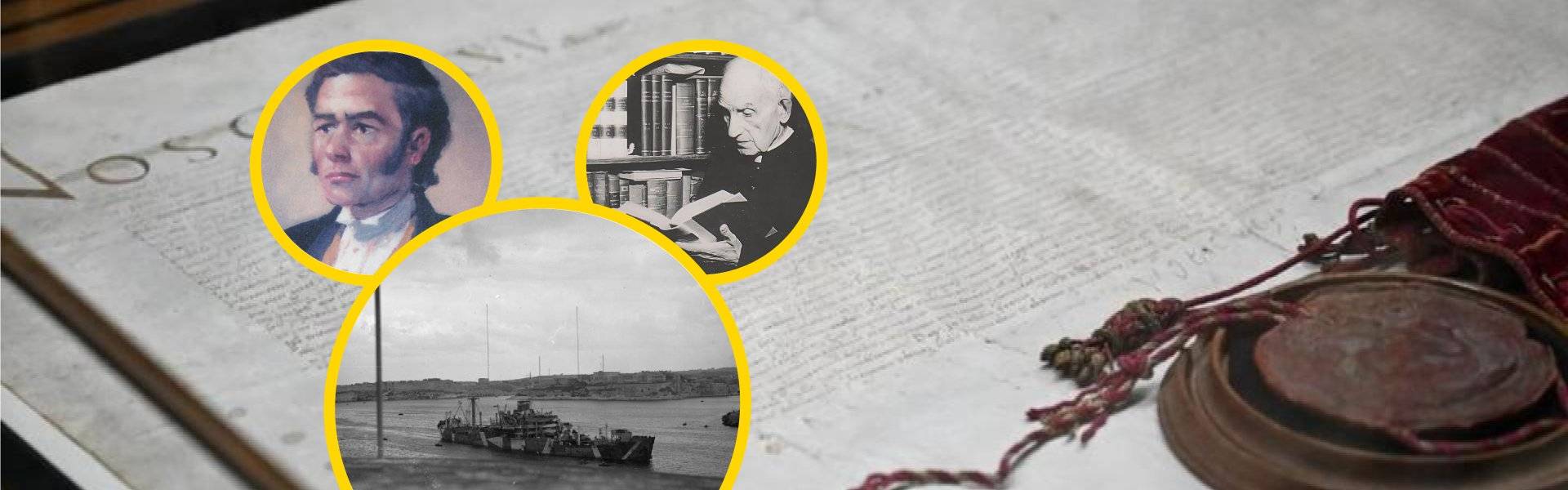
Here is something that should surprise you. When Italian was an official language of Malta in the 1930s, roughly one in eight Maltese people could actually speak it. When it was stripped of that status in 1934, that figure would eventually rise, slowly, through decades of Italian television beamed from Sicily, to nearly two in three. Today, with Italian carrying no official role whatsoever, more Maltese understand it than at any point in history.
That is the strangest fact in the strange story of the Maltese Language Question. But it is not the most important one. The most important one is this: the eighty-year battle over Italian and Maltese was never really about Italian. It was about what kind of nation Malta intended to become.
It was a civil war fought in classrooms, courtrooms and pulpits. The people who fought for the Maltese language were jailed, exiled, excommunicated and, at the height of the Second World War, loaded onto a warship and interned in Uganda without charge. The people who fought for Italian genuinely believed they were defending Maltese culture from colonial erasure. Both sides thought they were patriots.
This is the story of how Maltese went from being called 'the language of the kitchen' by the educated class, to becoming the national language, an EU official language, and the only language that rules in every court and every law of the Republic.
Why Italian was the Language of Educated Malta

When the Knights of St John arrived in Malta in 1530, they adopted Tuscan Italian as the Order's administrative language alongside Latin. It was the language of Dante, Petrarch and Boccaccio, recently codified by Bembo's grammar of 1525, and it carried unrivalled literary prestige across Europe. The Knights' choice was practical and neutral among French, Spanish and Italian knights. For Malta, it was decisive.
For the next two and a half centuries, Italian seeped into every formal institution of the island. It was the language of the law courts, the University, the avvocati and notari, the Catholic seminary in Mdina where almost all Maltese clergy trained, often completing studies in Rome, and the pastoral letters of the bishops. When the British took the island in 1800, they inherited a colony whose entire educated public sphere ran in a language no English officer spoke.
The spoken language of everyone else was Maltese. But Maltese had no formal standing. To the educated class it was a parlata, a kitchen vernacular, dismissed as a corrupted lingua saracena. The 1842 census, the first under British rule, found roughly 11% literate in Italian and just 4.5% literate in English. Almost every Maltese person spoke Maltese as their mother tongue, but nobody in power wanted to put it on paper.
The British tried early and failed. Lord Bathurst instructed Governor Maitland in 1813 that Italian should be replaced by English. It changed nothing. An Order in Council of 1833 under King William IV actually reconfirmed Italian as the official language of legal documents. The Royal Commission of 1838 recorded that Italian was 'far more useful to a Maltese than any other language, excepting his native tongue.' That native tongue had a long way to go before anyone would treat it as sufficient.
The Man who gave Maltese a Written Language (and Was Punished for It)

The man who first proved Maltese could be a written literary language did not live to see it recognised as one. Mikiel Anton Vassalli was born on the 5th of March 1764 in Ħaż-Żebbuġ to peasant parents, studied Arabic at the Propaganda Fide school in Valletta, and won a prize for Oriental languages at La Sapienza in Rome. In 1791 he published the first Maltese grammar, and in 1796 the first comprehensive Maltese-Latin-Italian dictionary, prefaced by a manifesto addressed Alla Nazione Maltese that demanded Maltese be taught in thirty free national schools and used as the language of the Church, the law and popular education.
Every regime punished him for it. The Knights jailed him for life in Fort Ricasoli in 1797 for plotting a Jacobin coup. Napoleon released him in 1798. The British, who took him for a French collaborator, imprisoned him in Mdina in 1799 and exiled him via Tunis in 1801. He spent two decades in France in poverty.
He returned to Malta in 1820 and worked as a Maltese translator for the Protestant Church Missionary Society. Through the personal patronage of Sir John Hookham Frere, Vassalli was appointed the first Professor of Maltese at the University of Malta in February 1825. He died on 12th of January 1829, was refused Catholic burial because of his Protestant Bible Society work, and was interred at the Msida Bastion cemetery in Floriana. His grave still stands.
For a generation after his death, nothing changed. Maltese remained what the lawyer class called it: the language of the kitchen.
1880: The Year the Language Question became Political War

The Language Question became formal political war in 1880, when the Rowsell-Julyan-Keenan Royal Commission published its reports on Maltese education. Patrick Keenan, Ireland's Commissioner of National Education, recommended using Maltese in early elementary years and targeting English as the academic goal, with Italian reduced to an optional subject. Sir Penrose Julyan went further, explicitly linking Italian-speaking Maltese with sedition.
The reports broke Maltese politics in two. Sigismondo Savona led the anglophile Reform Party. Fortunato Mizzi (1844–1905), a Gozitan-born advocate, founded the Anti-Reform Party in 1880, renamed the Nationalist Party by 1884, and launched the newspaper Malta, which would be the organ of Maltese nationalism for fifty years. Mizzi's argument was not that Maltese should be suppressed. It was that Italian must remain because it embodied Malta's italianità-latinità — its Catholic, Mediterranean, European cultural matrix, and that to remove it was to dissolve the people into a Protestant, English colonial fog. He died in May 1905, mourned as Pater Patriae.
The compromise of those decades was what Savona called the pari passu system: Italian and English taught simultaneously in primary schools, step by step. It satisfied nobody. In 1887, Malta got its first elected parliamentary majority. In 1899, London announced English would replace Italian in the courts within fifteen years. In 1903, after the elected members refused to vote the education estimates in protest, the constitution was suspended and direct Crown Colony government returned.
Outside this elite dispute stood a third and lonelier position. Manwel Dimech (1860–1921), born in Valletta, imprisoned at thirteen for theft, self-educated in prison in Maltese, English, Italian and French, published the weekly Il-Bandiera tal-Maltin from 1898 and founded his workers' movement Ix-Xirka tal-Imdawlin in 1911, agitating for Maltese as the sole national language. Bishop Pietro Pace excommunicated him in 1911. A mob stoned him in Qormi in 1912. The British arrested him as an alleged German spy in 1914, deported him to Egypt, and kept him interned in Alexandria and Cairo until his death on the 17th of April 1921, never charged, never tried, denied repatriation even after the war ended. The man who wanted Maltese and only Maltese could expect no quarter from anybody.
Strickland versus Mizzi: The War of the 1920s

The 1921 Amery-Milner Constitution granted self-government and declared Italian and English co-official, giving Maltese the modest dignity of 'the language of popular intercourse.' The clause looked balanced. It guaranteed civil war.
The war's two generals were already in place. Sir Gerald Strickland had been born in Valletta on 24 May 1861 to a British naval officer and a Maltese noblewoman, educated at Cambridge, and had governed British colonies across three continents before returning to Malta. His Constitutional Party was determined to promote Maltese and English together — and to displace Italian from public life. Across the chamber sat Enrico Mizzi (1885–1950), son of Fortunato, educated at the Universities of Rome and Urbino, who had been court-martialled for sedition in 1917 for wartime writings sympathetic to Italy and sentenced to a year's hard labour, commuted by the Governor to a censure.
When Strickland became Prime Minister after the August 1927 elections, he moved fast. Maltese was promoted as the medium of lower-primary instruction. Bilingual notices were replaced by English-only ones. From 1929, Maltese was permitted orally in court for the first time. Strickland founded the Maltese-language daily Il-Berqa and pushed for an English-medium college.
The Catholic Church saw an existential threat. On 1 May 1930, Archbishop Mauro Caruana and Bishop Mikiel Gonzi issued a pastoral letter declaring it a mortal sin to vote for the Constitutional Party or its Labour allies, or to read Strickland's newspapers. Strickland narrowly escaped assassination that same month. The 1930 elections were postponed. The constitution was suspended. When elections were finally held in June 1932, the Nationalists swept both houses. The new Prime Minister, Sir Ugo Mifsud, put roughly £5,000 for Italian teaching in elementary schools into the 1933–34 budget. London read it as deliberate provocation.
In November 1933, the constitution was suspended for the second time, and Mifsud's ministry dismissed.
16th of August 1934: Four Centuries of Italian End with a Signature
With the Maltese legislature suspended, and Mussolini's regime broadcasting Malta nostra over Radio Bari, the British Crown acted without a Maltese parliament to consult. Letters Patent dated 16 August 1934 restructured the language regime with surgical effect. English, Maltese and Italian were nominally all declared official, but English became the language of administration, Maltese became the language of the courts, and Italian was stripped of every substantive function.
The standardised Maltese orthography — thirty letters, including ċ, ġ, ħ, ż and the digraphs għ and ie, that the Ghħaqda tal-Kittieba tal-Malti had drawn up in 1924, received official recognition the same year. In 1935, Maltese became compulsory for entry into the civil service and the University. In 1936, a further Letters Patent, passed by the Westminster Parliament as the Malta (Letters Patent) Act 1936, removed Italian from official status altogether.
The numbers show how decisive the decree was. Lord Stanhope reported in the House of Lords in May 1936 that civil cases pending in the Maltese courts had fallen from 1,043 in October 1934 to 434 by July 1935, the entire stock of Italian-language litigation dissolved. The political logic was inseparable from international events. The Abyssinian crisis of 1935–36, the Rome–Berlin Axis of 1936, Italian government subsidies reaching Enrico Mizzi's political activities, and Mussolini's personal reception of Mizzi in Rome on the 30th of November 1936 all hardened the British line beyond any possibility of compromise. What had begun in 1880 as a quarrel about classrooms had become, by 1934, a question of imperial defence.
The Price: Deportation to Uganda, a Chief Justice's Exile, A Man was Hung

The decree did not end the conflict. It set the stage for its most brutal chapter.
On 30th of May 1940, eleven days before Italy entered the war, Governor Sir William Dobbie ordered the arrest of forty-eight Maltese citizens accused of Italian sympathies. Among them: Enrico Mizzi, Chief Justice Sir Arturo Mercieca, and the lawyer-editor Herbert Ganado of Lehħen is-Sewwa, whose later four-volume memoir Rajt Malta Tinbidel, I Saw Malta Change, would become the most widely read Maltese prose account of the era. They were held first at Fort San Salvatore in Cottonera, alongside a fuel depot, leading some to suspect they were being used as human shields, then at Corradino prison.
On the 7th of February 1942, the First Hall of the Civil Court ruled the Defence Regulations did not authorise deportation. The Council of Government was hurriedly summoned to pass enabling legislation. On 9 February 1942, Sir Ugo Mifsud rose to oppose the bill as a violation of the fundamental rights of the individual. He collapsed mid-speech with a heart attack on the chamber floor. He died two days later, on the 11th of February 1942, aged 52. The bill passed. George Borg Olivier, later Malta's Prime Minister at independence, was the only member to vote against it.
On 13th of February 1942, HMS Breconshire sailed from Malta with 41 Maltese internees bound for internment camps at Bombo, Soroti and Entebbe in Uganda. Lady Josephine Mercieca and her daughter Lillian voluntarily accompanied the Chief Justice into exile, raising the number to 43. The Court of Appeal, under Chief Justice Sir George Borg, ruled the deportation illegal on the 4th of May 1942, but the deportees were already in Africa. They were released in stages; Mizzi himself returned only on the 8th of March 1945. None was ever charged with any offence. A marble plaque commemorating the deportees and the Court's vindicating judgment was unveiled at the Maltese law courts only in 1994.
The single Maltese tried and executed for actual collaboration was a separate, tragic case. Carmelo Borg Pisani, born in Senglea in 1915 and trained in Italy, landed clandestinely below the Dingli Cliffs on the 18th of May 1942 as an Axis agent, was identified by a former schoolmate at Mtarfa hospital, and was hanged at Corradino on 28th of November 1942. He remains the only Maltese executed for wartime collaboration.
The People Who Built the Language while the Politicians Fought 
While politicians and prelates fought, a quieter revolution was building the language Malta would actually live in.
On 14th November 1920, the Ghħaqda tal-Kittieba tal-Malti, the Society of Maltese Writers held its first meeting at 266 Strada San Paolo, Valletta. The founding members included schoolteachers, clerks and one priest-poet: Carmelo Psaila, known to every Maltese as Dun Karm. The Society proposed its alphabet on the 18th of December 1921. In 1924 it published the standardised Maltese orthography, thirty letters, including the ħ, ġ and għ that have defined written Maltese ever since.
Dun Karm, born in Ħaż-Żebbuġ on the 18th of October 1871, had been a published Italian-language poet for over a decade when, in 1912, the newspaper Il-Ħabib invited him to contribute Maltese verse. He never returned to Italian. In 1922 he wrote the lyrics of L-Innu Malti, set to Robert Samut's melody, first sung publicly at the Manoel Theatre on 27th of December 1922 and adopted as Malta's official national anthem on the 22nd of February 1941. The University of Malta awarded him its first ever honorary doctorate in 1945. He died on 13 October 1961. He remains the most genuinely loved figure in Maltese letters.
The institutional consolidation followed. Joseph Aquilina was appointed the first modern Professor of Maltese at the University in 1937. The Compulsory Education Ordinance of 1946 made schooling compulsory between ages 6 and 14, with Maltese a core subject. On 21 September 1964, Article 5 of the Independence Constitution declared Maltese the national language of Malta for the first time in history, with both Maltese and English as official languages, and stipulated that in any conflict between texts, the Maltese version of the laws prevails. The 1974 Republic Constitution preserved the formula word for word.
On 1 May 2004, Malta joined the European Union and Maltese became one of the EU's official languages, the only Semitic language written in the Latin alphabet, and the only Semitic language with EU official status. The Maltese Language Act of 2005 established the Kunsill Nazzjonali tal-Ilsien Malti, finally giving the language the institutional protection Vassalli had sketched in his manifesto of 1796.
The Strangest Ending: Why More Maltese Speak Italian Now Than Ever Did When It was Official
Here is where history becomes ironic. In 1931, when Italian was still an official language of Malta, roughly 14% of Maltese could speak it. By the 2012 Eurobarometer, with Italian formally absent from Maltese public life for nearly eighty years, 66% of Maltese reported they could speak it — almost entirely thanks to decades of Italian television beamed from Sicily, 93 kilometres across the sea. The 2022 NSO Skills Survey found 96% understanding English, 90% Maltese, and 62% Italian. More Maltese understand Italian today than at any point in history. Italian was not killed in 1934. It was demoted — and then survived as the language of culture, leisure and television, the niche it had always occupied before the Knights arrived.
The Language Question's deepest lesson is that a nation can rescue a language even after its own elite spent four centuries belittling it. Vassalli died penniless in 1829, refused Catholic burial, and Malta made him Missier l-Ilsien. Dimech died forgotten in an Egyptian camp in 1921, and Malta still teaches his Maltese-language manifesto. Mifsud collapsed defending the rights of pro-Italian Maltese not to be deported without charge, and Malta buried him as a national hero. The fight was settled not by the British Crown but by a small society of writers who met in Valletta in November 1920 and decided that a Semitic kitchen language was worth a literature.
What was lost is real. A Maltese lawyer in 1900 could read Dante, plead in Italian, and argue Roman law in its original idiom. That connection to the wider Romance Mediterranean, through the law schools, the seminary and the press, is genuinely gone. But what was gained is the only national language any Maltese person has ever spoken at home: a Semitic tongue, written in Latin script, protected by EU treaty, taught in every school, ruling in every court, and printed in every law of the Republic.
That is the unlikeliest outcome anyone in 1880 could have predicted.
It is the one Malta cannot now imagine living without.

About Matthew Gollcher
Hi, I'm Matthew, an SEO Specialist and Content Writer at Yellow Pages Malta. I'm passionate about creating meaningful content and exploring AI's creative possibilities. When I'm not working, I enjoy the gym, time with friends, watching series and reading, and playing guitar. I'm always eager to learn and grow both personally and professionally.