Even More Maltese Surnames and the Stories Behind Them


This is the third article in our series on Maltese surnames. In the first, we looked at the ten most common, Borg, Camilleri, Vella, Farrugia, Zammit, Galea, Micallef, Grech, Attard and Spiteri. In the second, the next ten, Azzopardi, Cassar, Mifsud, Caruana, Muscat, Agius, Schembri, Abela, Fenech and Pace. Between them, those 20 surnames are shared by almost 40% of the entire Maltese population.
Now we come to the next ten, ranks 21 to 30 in Mario Cassar's analysis of the 2005 census: Sammut, Gatt, Gauci, Debono, Bugeja, Vassallo, Bonnici, Aquilina, Portelli and Calleja. As always, the sources we rely on are the foundational works of Maltese onomastics: Mario Cassar's The Surnames of the Maltese Islands (2003) and his academic papers; Godfrey Wettinger's studies of the medieval Militia List of 1419/20; and the etymological work of Professor Joseph Aquilina, the author of the encyclopaedic Maltese–English Dictionary and Malta's foremost authority on the Maltese language. Where folk etymology and academic scholarship disagree, we go with the academics and say so.
This batch contains one of the genuine treasures of Maltese onomastics: a surname documented in Malta in 1271, more than two and a half centuries before the Knights of St John arrived in 1530, and one of the oldest Maltese family names on record. But we'll come to that. Let's start at number 21.
21. Sammut: 'The Silent One'

Sammut is a Semitic surname, one of the roughly fifty surnames of Arabic origin that, despite being a minority of Maltese surnames, are each borne by very large numbers of families. According to Mario Cassar's academic paper 'Vestiges of Arabic Nomenclature in Maltese Surnames', Sammut derives from the Arabic personal name Samīt, meaning 'tacit', from samt, 'silence'. The Dictionary of American Family Names (DAFN2, Oxford University Press, 2022) gives the same root: 'from a personal name or nickname based on Arabic ṣamūt "silent, taciturn"'. In origin it was a nickname for a quiet, reserved, or taciturn person.
There is a striking footnote to the etymology. Cassar notes that among certain Shi'ite groups, al-samīt was the designation of 'a messenger of God who does not reveal a new law' — the silent prophet, as opposed to al-natik, the speaking prophet. There is no suggestion that the Maltese Sammuts descend from such a figure; but it is a reminder of how deep the Arabic linguistic stratum in Maltese surnames really runs.
Beware the folk etymologies here. One popular genealogy site claims Sammut comes from an Arabic word for 'protector or guard' and that the Sammuts were 'well-respected knights and warriors that defended Malta'. There is no academic support for this; it is the kind of flattering invention that attaches itself to common surnames. The scholarship is clear and consistent: Sammut means, simply, 'the silent one'.
22. Gatt: 'The Cat'

Gatt is classified by Cassar as a non-Semitic surname, in his words, 'Gatt (for Gatto/i)', that is, from the Italian and Sicilian gatto, 'cat'. As a surname it would have begun as a nickname, perhaps for someone agile, independent, or in some way cat-like, a very common type of medieval surname formation across Italy and Sicily. An alternative derivation links it to the female personal name Agata (Agatha), of which 'Gatt' could be a clipped form.
There is an interesting scholarly wrinkle. Some have proposed an Arabic origin, from Maghrebine Arabic qattūs, 'cat' (which gave the Sicilian surname Gattuso). But the academic literature on late-medieval Maltese surnames notes that, for phonetic reasons, this Arabic derivation is 'implausible' for the modern Maltese surname Gatt, although it may be correct for some of the very earliest recorded forms. The mainstream view places Gatt with the Italian gatto.
As a Maltese surname Gatt should not be confused with the unrelated Scottish and German surname Gatt (which has entirely separate origins in Middle High German and Middle English).
23. Gauci: 'The Gozitan'

Gauci is one of the most satisfying surnames to explain, because its most authoritative etymology is also its simplest. According to Professor Joseph Aquilina, Malta's foremost specialist in Maltese etymology, Gauci is a Maltese original formation, originating in the medieval notarial transcription of the Maltese word Għawdxi, meaning 'Gozitan', 'a person from Gozo'. The surname began as a nickname given to Gozitans living or working on the main island of Malta. (The Maltese name for Gozo is Għawdex, and Għawdxi is the adjective.)
On this reading, which is the standard Maltese scholarly position, any Italian holders of the surname would be descendants of Maltese emigrants, rather than the other way around. The Dictionary of American Family Names takes a slightly different view, suggesting the surname originated in Italy, flourished in Malta, and spread from Malta to the UK, US, Canada and Australia with the Maltese diaspora. Mario Cassar classifies Gauci among the Semitic-origin surnames, consistent with the Għawdxi derivation.
Gauci is an old surname, recorded in the Militia Roster of around 1417–1419. The bearers of the name have historically included one of the noble families of Malta, holders of the title Marquis of Għajn Qajjied. The surname is widespread across both Malta and Gozo today.
24. Debono: 'The Good Man'

Debono is classified by Cassar as a surname of European (Italian) extraction. It derives transparently from the Italian (de) buono, '(of the) good', from Latin bonus, 'good'. As a surname it began as a nickname or a patronymic: 'the good one', 'son of the good man', or a descendant of someone whose personal name or by-name was Bono / Bonus. The construction is identical to a whole family of Italian surnames built on bono / buono, Bono, Boni, Bonello, Bonelli, Bonaccio and many others.
The 'de' prefix is the Italian and Latin preposition 'of', indicating descent or belonging — a standard medieval surname-forming element. Debono is therefore best understood as '(son/descendant) of the good man'. It is one of a substantial group of 'De-' surnames in Malta (Debono, Debrincat, Degabriele, Degiorgio, Demanuele, Demicoli and others) that reflect the Italian and Sicilian patronymic tradition.
25. Bugeja: 'The North African Port' or 'The Herdsman'

Bugeja is, according to Mario Cassar, a Semitic surname, and one of the oldest, first recorded in Malta in 1417, when a 'Pinu Bugeja' appears in the Militia List. Old spellings include Bugeia, Bugia, Bugeya, Bugeija and Bogeia.
There are two main academic theories of its origin. The first, recorded by Cassar in his etymological dictionary, links the surname to the name of the North African seaport historically known in European languages as Bougie, today Béjaïa, in the Kabylie region of Algeria, in the historic department of Constantine. (This is the same port that gave its name, via the wax candles traded through it, to the French and English word 'bougie'.) On this reading, Bugeja was originally a name for someone connected to that port, a merchant, a sailor, or a migrant from that part of the Maghreb.
The second theory, proposed by Joseph Aquilina, derives the surname from the Sicilian Bug(g)ea, itself from the Greek Boukaios, 'cowherd' or 'herdsman', or from Buggia in the Salentine and Sicilian dialects. Both theories place the surname firmly in the medieval Mediterranean world of trade and migration between Malta, Sicily and North Africa. The surname also appears in Greece, in variants such as Boutzegia(s), through later migration. In Malta, Bugeja is particularly concentrated in Marsaxlokk.
26. Vassallo: 'The Vassal'

Vassallo is a surname of Italian and Spanish origin, common across the western Mediterranean and especially common in Malta. It derives from the medieval Latin vassallus, 'vassal', a person who held land or owed service and allegiance to a feudal lord. As a surname it would have denoted someone who held this feudal status, or who served in a particular lord's household. The same root gives the Italian Vassalli, the Spanish Vasallo, and the English word 'vassal' itself.
In Malta the surname has a distinguished literary history. Ġan Anton Vassallo (1817–1868) was a Maltese poet, novelist and professor at the University of Malta, best remembered for his patriotic poem Tifħira lil Malta ('In Praise of Malta'). He should not be confused with the closely-related but distinct surname Vassalli, borne by Mikiel Anton Vassalli (1764–1829), the writer and lexicographer often called 'the father of the Maltese language' for his pioneering work on Maltese orthography and grammar, Vassallo and Vassalli are separate surnames, though they share the same feudal root.
27. Bonnici: 'The Good Little One'

Bonnici is classified by Cassar as a surname of European (Italian) extraction, and, like Debono, it belongs to the great Mediterranean family of surnames built on the Latin bonus, 'good'. The form appears to be a diminutive: 'the good little one', or 'little Bono', from an Italian or Sicilian original such as Bonicio / Boniccio. The closely related Maltese surname Bonici (with a single 'n') shares the same origin.
Bonnici was already well established in Malta by the late Middle Ages, appearing in the early surname records. It is frequently found in the double-barrelled form Mifsud Bonnici, which has produced several prominent figures in modern Maltese public life from related branches of the family.
28. Aquilina: 'The Little Eagle'

Aquilina is classified by Cassar as a surname of European (Latin / Italian) extraction. It derives from the Latin aquila, 'eagle', via the diminutive or derived form aquilina, 'little eagle' or 'eagle-like', and is connected to the late-Latin and Italian personal name Aquilino / Aquilina, itself borne by early Christian saints. As a surname it could have begun as a personal name handed down, or as a nickname for someone thought to have an eagle-like quality (keen sight, a prominent nose, or a proud bearing).
There is a lovely circular irony in the surname's most distinguished bearer: Professor Joseph Aquilina (1911–1997), the first Professor of Maltese and Oriental Languages at the University of Malta, author of the monumental Maltese–English Dictionary, and the single most important scholar of Maltese etymology, the very discipline that explains his own surname. Much of what we can reliably say about the origins of Maltese surnames, including several in this very article, rests on Aquilina's foundational work.
The surname has a notable geographic concentration in the village of Għargħur, in the north of Malta, where Aquilina families have historically been especially numerous.
29. Portelli: 'The Little Door' or 'The Little Harbour'

Portelli is an Italian and Maltese surname, classified by Cassar among the European-origin names, and well established in Malta since the late Middle Ages. It derives from the Italian portello, a diminutive meaning 'little door', 'little gate', or 'wicket', itself from Latin porta, 'door, gate'. (The same Latin root also gives porto, 'harbour', so a secondary sense of 'little harbour' or 'small port' is also possible.)
As a surname, Portelli could have originated as a topographic name, for someone who lived by a small gate in a town wall, or by a postern (a secondary, smaller entrance to a fortified place), or as an occupational name for a gatekeeper. Given Malta's long history of fortified cities with named gates, the topographic sense is particularly fitting. The surname is common across Malta and Gozo and among the Maltese diaspora.
30. Calleja: 'One of the Oldest Maltese Surnames of All'

We have saved the most remarkable for last. Calleja is one of the very oldest documented surnames in Malta, and its history overturns one of the most widespread folk beliefs about it.
The common assumption is that Calleja is Spanish: there is indeed a Castilian surname Calleja, from the Spanish calleja, 'alley' or 'narrow street', originating around Ampuero in Cantabria. But the historical evidence indicates that the Maltese Calleja is almost certainly not related to the Spanish one. The Maltese surname is simply too old.
The first written appearance of the Calleja surname in Malta is in a document dated 22 May 1271, in the spellings Calleya and Caleya. On that day, Bertrand de Real, the magister (master) of Malta, was instructed to record the names of those who transported falcons to the royal court from Malta. A Martinus Calleya appears as a witness, and a Leo Caleya is among those listed. This is more than two and a half centuries before the Knights of St John arrived in 1530, and it predates both Aragonese rule (1283–1412) and the later Aragonese-Castilian period, which is precisely why the Spanish derivation does not fit. The Maltese Calleja was already here before the Spanish connection could have brought it.
So where does it come from? The leading theory, endorsed by none other than Gian Frangisk Abela (1582–1655), the Vice-Chancellor of the Order of St John and 'the father of Maltese history', is that the Maltese Calleja is of late Greek or Byzantine formation. This would place it alongside Grech as one of the surnames marking Malta's Greek-Byzantine cultural layer. There is a further intriguing possibility: in the fifteenth century there was a village in Malta called Calleja, situated near Mosta, which seems linguistically and geographically connected with the place known as il-Qlejgħa in the same area, raising the possibility of a topographic origin on Maltese soil itself.
Calleja is, with Grech, Falzon, Attard and Lentini, among the oldest documented surnames in Malta, several of them traceable to the thirteenth-century Angevin period. Its most internationally famous modern bearer is the renowned operatic tenor Joseph Calleja (born 1978), whose surname, contrary to what many assume, most likely reaches back not to Spain but to Malta's Greek and medieval past.
What This Third Group Tells Us
If the first two articles established that Maltese surnames are an archive of Mediterranean movement, this third group deepens the same lesson and adds a crucial dimension: time.
The Semitic stratum is here again, Sammut ('the silent one'), Bugeja, and (on Cassar's classification) Gauci all reach back to the Arabic and Siculo-Arabic world. The Italian and Latin stratum is well represented, Gatt ('cat'), Debono and Bonnici (both from bonus, 'good'), Vassallo ('vassal'), Aquilina ('little eagle'), and Portelli ('little gate'). The Maltese language itself generated Gauci, from Għawdxi, 'the Gozitan'. And the Greek-Byzantine layer surfaces in Calleja.
But the dimension this group adds most powerfully is the sheer antiquity of the Maltese surname pool. Calleja documented in 1271; Gauci and Bugeja in the Militia Roster of around 1417; Sammut, Vassallo and the rest well established by the late Middle Ages. These are not recent names. They were already being written down by notaries and tax-collectors and militia-clerks centuries before most of the great events of Maltese history, the Great Siege, the building of Valletta, the plague of 1813, the British period, had even happened. When a modern Maltese person signs their surname, they are, very often, using a word that was first written down on the island seven or eight hundred years ago.
That is the real story behind the Maltese surnames. They are not labels of recent fashion. They are among the oldest continuously-used words in the country, fossils of Arabic, Sicilian, Italian, Greek, Spanish and native Maltese, carried down through thirty generations of islanders, and still, today, spoken aloud every time someone answers to their name.
Got a surname you'd like us to research in a future article? Let us know.
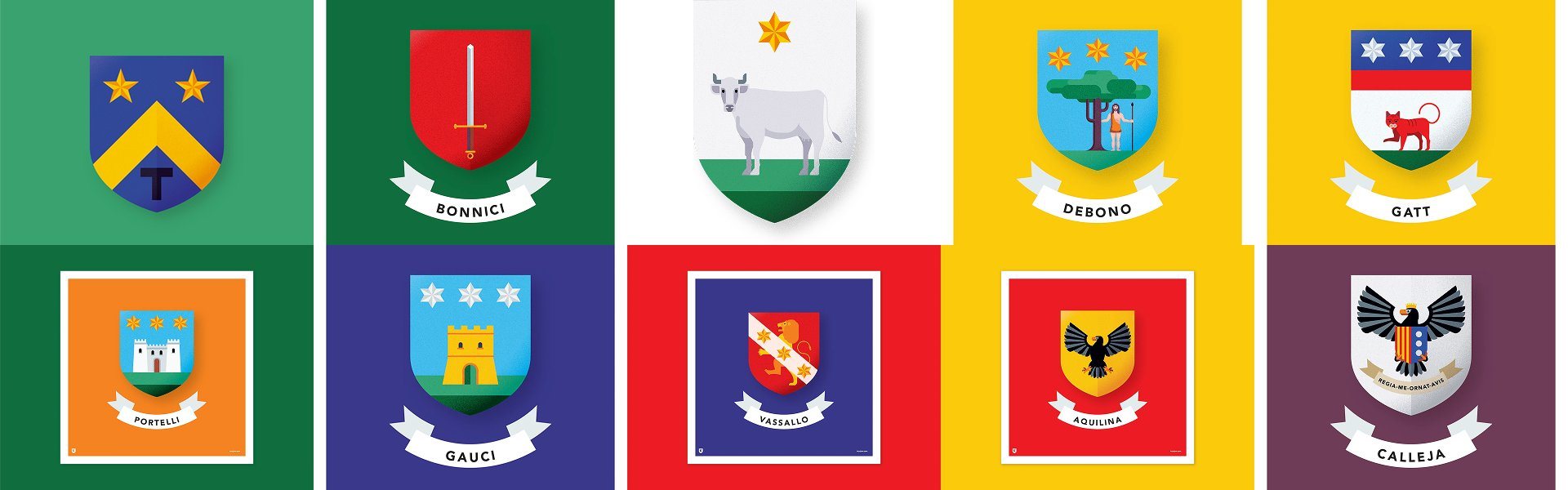
All coat of arms for this article have been taken from Kunjom. For more information visit their website.

About Matthew Gollcher
Hi, I'm Matthew, an SEO Specialist and Content Writer at Yellow Pages Malta. I'm passionate about creating meaningful content and exploring AI's creative possibilities. When I'm not working, I enjoy the gym, time with friends, watching series and reading, and playing guitar. I'm always eager to learn and grow both personally and professionally.