How the Maltese Language Survived 7,000 Years of Invasion


If you want to understand what makes Malta remarkable, do not start with the architecture or the history or even the food. Start with the language.
Maltese, Malti, is unlike anything else spoken in Europe. Its grammar is Semitic, built on the same ancient foundations as Arabic and Hebrew. Its everyday vocabulary blends Arabic roots with Italian and Sicilian words. Its most recent additions come from English. And it is written uniquely among all Semitic languages in the world, not in Arabic script but in the Latin alphabet.
Since Malta joined the European Union in 2004, Maltese has been one of the EU's official languages. It is the only language of Arabic origin to hold that distinction. Every piece of EU legislation is translated into it. A language once dismissed by colonial administrators as a corrupted dialect of Arabic, spoken only by the uneducated poor, is now read in the chambers of the European Parliament.
That journey from an oral vernacular with no alphabet, no grammar books, and no official status to a recognised national and European language, is one of the most improbable stories in European cultural history. And it begins, as almost everything in Malta does, with people arriving from the sea.
A Language Born from Conquest

The islands of Malta have been inhabited for around 7,000 years. In that time, they have been settled by Sicilians, colonised by Phoenicians, absorbed into the Carthaginian world, conquered by Rome, occupied by the Byzantines, seized by the Arabs, taken by the Normans, passed through a succession of European dynasties, granted to the Knights of St John, captured by Napoleon, and governed by the British for a century and a half.
Every one of those powers brought a language with it. Most of those languages are gone from Malta today, leaving at most a handful of place names or family surnames as archaeological evidence of their presence. The Phoenicians left place names. The Romans left Latin loanwords. The Byzantines left almost nothing. The Knights left their baroque architecture and Italian administrative vocabulary. The British left English.
But the language that shaped the deepest foundations of Maltese, the language that gave it its structure, its grammar, and the core of its most basic everyday vocabulary came from North Africa. It arrived not with a royal fleet but with ordinary settlers speaking a form of Arabic, and it arrived in 870 AD, when the Aghlabid dynasty from what is now Tunisia conquered the Maltese islands from the Byzantines.
For the next two centuries, Malta was an Arab island. The population spoke a dialect of Maghrebi Arabic, closely related to the forms of Arabic still spoken today in Tunisia and Libya. The language spread into the place names of every village and valley on the island: Ħamrun, Qormi, Birżebbuġa, Marsamxett. These are Arabic names. So is Għawdex, the Maltese name for Gozo. So is the word Malti itself, derived from the Arabic word for the island.
The Moment that Made Maltese Possible

In 1091, Count Roger I of Sicily conquered Malta and ended two centuries of Arab rule. What happened next is the linguistic miracle at the heart of the Maltese language's existence.
In Sicily, the Arabic dialect that had developed under Arab rule did not survive the Norman conquest. It was gradually replaced by Sicilian, and by around 1300 it had died out entirely. In Malta, the opposite happened. The Arab population remained on the islands, was converted to Christianity over the following century and a half, a process that was substantially complete by around 1249, when the Holy Roman Emperor Frederick II expelled the last Muslim communities, but kept speaking its language. The Norman, Swabian, Aragonese and Castilian rulers who controlled Malta over the following centuries brought their own languages for administration and law, but they never systematically interfered with what the people spoke at home.
This neglect was, paradoxically, what saved Maltese. Isolated from the Arabic-speaking world by Frederick II's expulsions, the language could no longer be refreshed or influenced by Classical Arabic or the spoken dialects of North Africa and the Middle East. Cut off from its source, it began to evolve entirely on its own terms, absorbing words and influence from the succession of European rulers who governed the islands, without ever losing its Arabic grammatical skeleton. The result, over several centuries, was something entirely new: a language that was neither Arabic nor Italian nor Sicilian, but a blend of all three that belonged only to Malta.
Professor Joseph M. Brincat, one of the University of Malta's foremost authorities on the origins of Maltese, has noted that the succession of rulers who governed Malta after the Normans, the Swabians, the Angevins, the Aragonese, the Castilians, "never bothered to interfere with the way the people spoke." What began as neglect became, over centuries, the foundation of a distinct national identity.
What Maltese Actually Is: The Language of Two Worlds
To understand what Maltese actually is, it helps to think of it in layers.
The deepest layer, the grammar, the verb system, and the core vocabulary of everyday life, is Semitic. The days of the week in Maltese are counted in the Arabic manner. The word for 'heart' is qalb. The word for 'night' is lejl. The word for 'water' is ilma. A speaker of Arabic encountering Maltese for the first time can understand a significant proportion of ordinary speech, though the full language is far harder to follow. According to an analysis of the 41,000 words in Aquilina's Maltese-English Dictionary, Arabic-origin words make up around a third of the total vocabulary. But because those words include the most frequently used terms, function words, basic nouns, everyday verbs, they account for a substantially larger share of ordinary conversation.
The second layer is Italian and Sicilian, which together make up roughly half of the total vocabulary. These are the words that entered the language during the centuries of Christian rule: the vocabulary of religion, administration, law, trade, and culture. The same concept can often be expressed in two ways in Maltese, once with an Arabic root and once with an Italian one. The word for 'answer' can be either tweġiba (Arabic origin) or risposta (Italian), rather like the difference between 'answer' and 'response' in English. Both words are used; both are Maltese.
The outermost layer is English, which has added a growing share of everyday vocabulary since the British colonial period began in 1800. Words like 'fridge,' 'TV,' and 'weekend' have passed into Maltese largely unchanged. More formal English loanwords are often Italianised as they enter the language. Estimates of the English component range from around six to twenty percent, depending on what counts as official vocabulary versus everyday use.
What makes the combination extraordinary is the script. Every Semitic language in the world, Arabic, Hebrew, Aramaic, is written in its own distinct alphabet. Maltese alone among Semitic languages is written in the Latin alphabet, with six additional characters added to represent sounds specific to the language: ċ, ġ, ħ, ż, and the uniquely Maltese ġħ. It is the product of a language with Arabic bones that grew up in a Catholic island, surrounded by European powers, and eventually adopted the script of its conquerors as its own.
Il-Kantilena: A Poem in a Notarial Archive

For most of the first four centuries of its existence, Maltese had no written form. It was spoken at home, in the fields, in the markets, and in the churches after the Normans converted the population to Catholicism. But official life, the courts, the contracts, the administration, was conducted in Latin, then in Italian. The language of the Maltese people was treated as a vernacular, a dialect, something spoken rather than written, heard in the streets but not seen on the page.
The oldest known written reference to Maltese as a distinct language appears in a document from 1436, which refers to it as lingua maltensi. But the oldest surviving text written in Maltese is older still: a poem, probably composed in the 1470s, that lay in a notarial register at the Valletta archives for approximately five centuries before anyone recognised what it was.
Il-Kantilena, The Old Song, is attributed to Pietru Caxaro, a 15th-century Maltese philosopher, notary, judge, and civic official from Mdina who died in 1485. The poem was not written down by Caxaro himself but copied into a notarial register by his nephew Brandano, decades after his death. When historians Godfrey Wettinger and Mikiel Fsadni found it in the Notarial Archives in Valletta in 1966, it astonished the scholarly world. Until then, the oldest known Maltese poem was thought to date from the 17th century. This discovery pushed the record back by two hundred years.
The language of Il-Kantilena is strikingly different from modern Maltese. Almost every word is of Arabic origin. In the entire poem, there are only two Romance words: vintura, meaning luck or fate, and the conjunction et. In 1966, reading it was like reading a window into the Maltese of five centuries earlier, before Italian had penetrated deeply into everyday speech, before the Knights had made Italian the language of culture and administration, before English had arrived at all. It is a poem almost entirely in the language the Aghlabids left behind.
In April 2025, UNESCO added Il-Kantilena to its Memory of the World Register, only the second Maltese document ever to receive that recognition. Malta's National Heritage Minister Owen Bonnici described it as "not only an honour for the document itself but for the Maltese language and the literary and cultural heritage of our country."
The Language the Upper Classes Refused to Speak
When the Knights of St John arrived in 1530, they brought with them a European culture in which Italian was the prestige language of the Mediterranean. The Order conducted its official business in Italian. The Catholic Church operated in Italian. The law courts were in Italian. The arts and literature that the Knights patronised and produced were in Italian. Maltese was the language of the labouring population, useful for giving orders to servants and tradespeople, but not a language anyone with social ambition would commit to paper.
This division persisted through the entire 268 years of the Order's rule, through the brief French occupation that followed, and into the British colonial period that began in 1800. The educated Maltese elite spoke Italian. The Church conducted ceremonies in Italian and Latin. Even as late as 1934, only around fifteen percent of the Maltese population could speak Italian fluently, meaning that the language of the courts and the administration was understood by a small minority, yet it remained the official tongue. Out of approximately 58,000 men of jury-qualifying age, only 767 could meet the language requirements for jury service, because Italian alone had been used in the courts.
Throughout this period, Maltese survived because the ordinary people kept speaking it. It was the language of the home, the market, the village festa, the fishing boat. It absorbed words constantly, Italian terms for new concepts, French words from the Knights' own usage, Latin terms from the Church, but its Semitic backbone held. Every ruler imposed a different language on public life. None of them managed to change what the Maltese spoke to each other.
The Man Who Gave it a Grammar: Mikiel Anton Vassalli

The man who changed everything about how Maltese was regarded was born in Ħaż-Żebuġ in 1764, the son of a peasant family, and his name was Mikiel Anton Vassalli.
Vassalli went to Rome in 1785 to study oriental languages. He returned convinced that Maltese, the language spoken by the vast majority of his people, the language with no official status, no dictionary, and no grammar, was not a corrupted dialect but a legitimate tongue with its own Semitic structure, its own literary potential, and its own claim to be the national language of Malta. In a world where Italian-speaking aristocrats and Church officials regarded Maltese as the speech of the uneducated, this was a radical idea.
He published a Maltese grammar in 1791 and a dictionary, the Lexicon, in 1796. He proposed Maltese as a language of education, arguing that a people could not truly call themselves a nation if their own tongue was excluded from their schools and courts. His political views, shaped by the Enlightenment and by sympathy with the French revolutionary ideals then sweeping Europe, brought him into repeated conflict with authority. He was imprisoned under the Knights, suspected of conspiracy. He was arrested and exiled under the British. He spent approximately twenty years outside Malta, in France and Spain, before being allowed to return in 1820, aged fifty-six, in poor health and with the best years of his life behind him.
He died in 1829 and was refused burial by the Catholic Church because of his Protestant connections. He was buried in the Msida Bastions Garden of Rest, in a Protestant cemetery primarily used by the British. The man who had dedicated his life to asserting the dignity of the Maltese language was buried, in death, outside the Catholic community that spoke it.
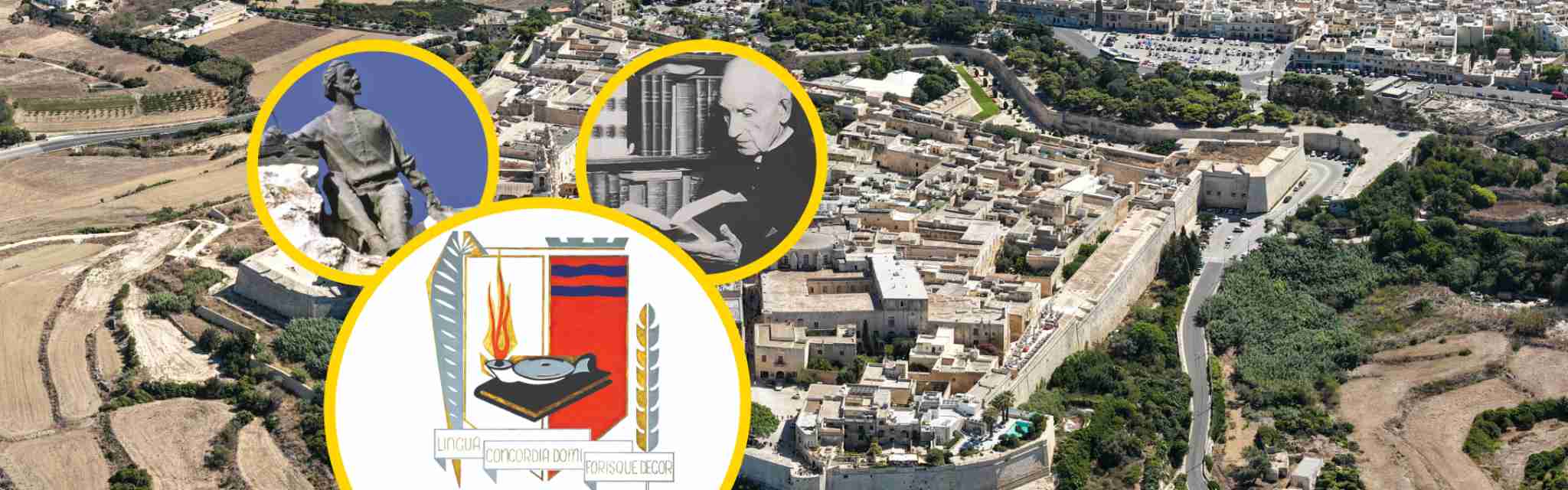
History has been more generous. Vassalli is now remembered as Missier il-Malti, the Father of the Maltese Language, and his portrait appears on the Maltese two-euro coin.
The Language War: Italian, English, and the Battle for Malta's Tongue

In the early 20th century, Malta was caught in an argument about its own identity. On one side stood those who argued that Malta's cultural allegiance belonged to Italy, its closest neighbour, the source of its artistic heritage, the language of its Church and its educated elite. On the other side stood those who argued that the future lay with English, the language of the Empire, of trade, of education, and of opportunity. The debate became known as the Language Question, and it dominated Maltese politics for decades.
Maltese was largely absent from both sides of the argument. The language the people actually spoke was not, in the view of most public figures of the time, a serious contender for official status. That began to change in 1920, when a group of writers, among them a priest named Dun Karm Psaila, founded what would become the Akkademja tal-Malti, dedicated to promoting and standardising the Maltese language. In 1924, the Akkademja published the first standardised Maltese alphabet: 30 letters, based on the Latin alphabet but with six additional characters to represent sounds specific to the language.
The Language Question was settled not by consensus but by politics. As Mussolini's Italy became an increasingly threatening presence in the Mediterranean in the 1930s, the British colonial administration decided that Italian influence in Malta was incompatible with the island's security. In 1933, the constitution was suspended partly over a dispute about the teaching of Italian in elementary schools. In 1934, Maltese was declared an official language alongside English; Italian was stripped of its official status. In 1936, a new constitution confirmed that Maltese and English were the island's only official languages. The Italian language, which had been official in Malta for centuries, was gone from public life within a few years. And as Italy began bombing Malta from the air in 1940, whatever sympathy had remained for Italian cultural affiliation disappeared.
Dun Karm and the Poem That Became an Anthem

Among the founders of the Akkademja tal-Malti was a priest from Ħaż-Żebuġ named Carmelo Psaila, who wrote under the name Dun Karm. Born in 1871, he had initially written in Italian, as educated Maltese of his generation typically did. In 1912, he began writing in Maltese instead, a deliberate choice that marked him out in a society where Italian remained the language of cultural prestige.
In 1922, Dun Karm was commissioned to write the words for a school hymn, to fit a melody already composed by the musician Robert Samut. The result was L-Innu Malti, The Maltese Hymn, a prayer for divine protection of the island, written entirely in Maltese. It was first publicly performed at the Manoel Theatre on the 3rd of February 1923. The Maltese government officially declared it the national anthem on the 22nd of February 1941, at the height of the wartime bombardment. Malta's independence in 1964 confirmed it as the National Anthem in the new constitution.
The anthem had already earned its defining moment, three years before independence, in March 1945. A football match was held at the Gżira Stadium between Malta XI and Yugoslavia's Hajduk Split. The band played the Yugoslav anthem and then 'God Save the King,' as was customary under British rule. The British Governor took his seat. And then, uninvited and unplanned, the crowd in the stadium rose and sang L-Innu Malti. The Governor had no choice but to stand. It was the first time the Maltese people had claimed their anthem in public, in front of a colonial official who had no framework for what to do about it.
Dun Karm died in 1961, three years before independence and before the anthem he had written became official. In 1956, he had been appointed Malta's first National Poet. His poems are still studied in every Maltese school.
The Language Today: an EU Tongue, a National Treasure, and a Daily Question
On the 1st of May 2004, Malta joined the European Union. Maltese became one of the EU's official languages the same day, the only language of Arabic or Semitic origin on that list. Every piece of European legislation is now translated into a language whose grammar was shaped by North African Arabs in the ninth century, whose vocabulary was expanded by Italian and Sicilian under Catholic rule, and whose alphabet was standardised by a literary society in 1924. It is, by any measure, one of the more extraordinary arcs in European linguistic history.
Today, Maltese is spoken by approximately 420,000 people in Malta and Gozo, with additional communities abroad, particularly in Australia, the United Kingdom, Canada, and the United States. It is used in Parliament, in the courts, in the media, and at home. Most Maltese people switch easily between Maltese and English within the same conversation, a phenomenon sometimes called Maltenglish, and many also understand and speak Italian, which remains widely understood through decades of Italian television reaching the island from nearby Sicily.
There are concerns. With more than a quarter of Malta's current population now made up of foreign nationals, and with English increasingly dominant in professional and social life, questions are being asked about the health of the language over the next generation. The Akkademja tal-Malti continues its work. Maltese remains compulsory in schools. The conversation about the language's future is, in a sense, the same conversation the island has been having since Vassalli first argued, in 1791, that a people without a language of their own has something missing at its core.
A Language as Unlikely as the Island that Speaks It
What is Maltese? It is, at root, a form of Arabic that was cut off from its source a thousand years ago and left to grow on its own, shaped by every ruler who passed through, absorbing their words without losing its own structure, written by a people who were Catholic in faith but Semitic in linguistic heritage, eventually given an alphabet, a grammar, a dictionary, a national anthem, and a seat at the European table.
It is the language of a 15th-century poem that sat in a notarial archive for five centuries before anyone knew what it was. It is the language of a priest-poet who wrote a school hymn that became a national anthem. It is the language of a philosopher who was refused burial by his own Church. It is the language that the farmers and fishermen and tradespeople of Malta spoke at home through every occupation, every conquest, and every change of flag, and kept speaking, because nobody ever quite got around to stopping them.

About Matthew Gollcher
Hi, I'm Matthew, an SEO Specialist and Content Writer at Yellow Pages Malta. I'm passionate about creating meaningful content and exploring AI's creative possibilities. When I'm not working, I enjoy the gym, time with friends, watching series and reading, and playing guitar. I'm always eager to learn and grow both personally and professionally.