Caravaggio in Malta: How a Fugitive Painter Left Two Masterpieces and Fled in the Night


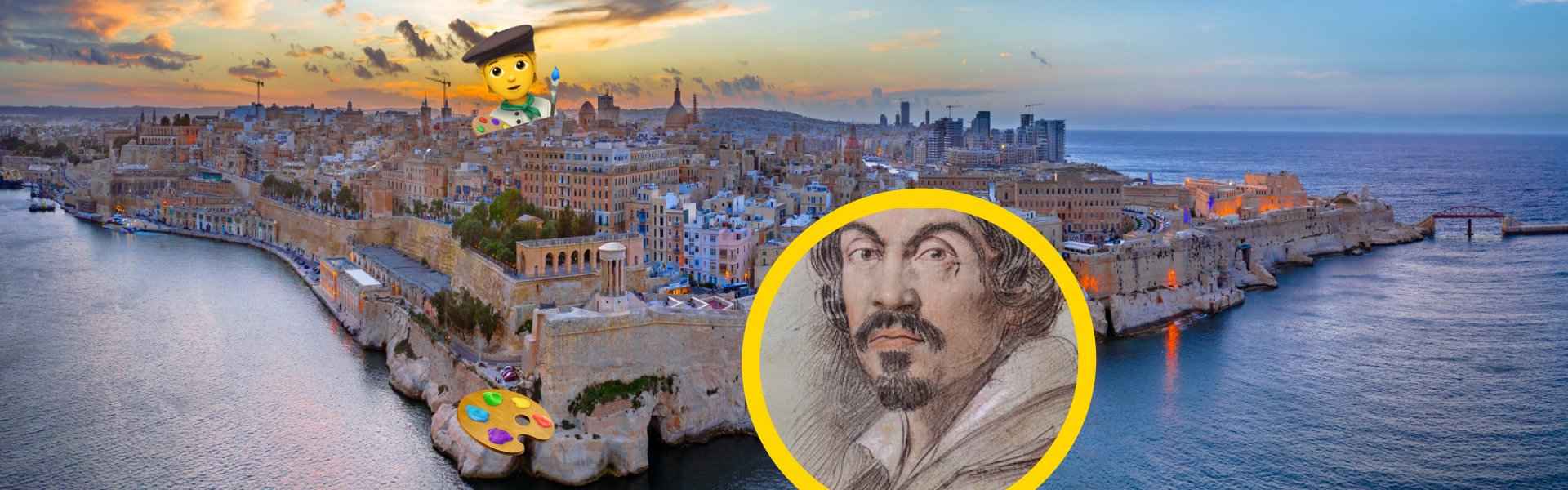
In the Oratory of St John's Co-Cathedral in Valletta, there is a painting that measures nearly four metres tall and more than five metres wide. It is the largest canvas Caravaggio ever painted. It is also the only painting he ever signed, and he hid his name not in a corner but in a pool of blood flowing from the neck of a decapitated saint.
The story of how that painting came to be in Malta, and the story of why its painter was not there to see it celebrated, is one of the most extraordinary episodes in the history of Western art. It involves murder, exile, a military order of knights, a papal dispensation, a violent brawl, a prison break from a medieval fort, and one of the most ignominious expulsions in the annals of chivalry. And it lasted, from beginning to end, just fifteen months.
Who was Caravaggio, and why was he running?

By the time Michelangelo was in his thirties, he was the most celebrated painter in Rome, arguably the most celebrated in Europe. His technique was like nothing that had come before: real figures, real faces, real dirt under real fingernails, illuminated by dramatic shafts of light cutting through dense darkness. He painted saints who looked like labourers, Madonnas who looked like women from the street, and biblical scenes of unbearable physical immediacy. The Cardinal patrons of Rome competed for his work. He was, in the language of his time, untouchable.
He was also, by almost every account, dangerous. Caravaggio's Rome police record runs to at least eleven incidents: assaults, illegal sword-carrying, stone-throwing, libel. He was described by a contemporary, in 1604, as "ever ready to engage in a fight or an argument, with his sword at his side." His patrons repeatedly shielded him from serious consequences. Until they couldn't.
In late May 1606, on what may have been a tennis court in Rome, Caravaggio fought with a young man named Ranuccio Tomassoni. The exact cause of the quarrel is disputed, a gambling debt over the game, according to early accounts; jealousy over a woman, according to a 2002 investigation that uncovered a surgeon's report suggesting the nature of the wound. Whatever the cause, Caravaggio's sword opened Tomassoni's femoral artery, and Tomassoni bled to death. Caravaggio was himself wounded in the fight.
The Roman authorities issued a bando capitale, a sentence of death in absentia, and declared an open bounty: anyone in the Papal States was legally entitled to collect a reward for delivering Caravaggio's severed head. He fled south that same night, taking refuge first on the estates of the Colonna family and then in Naples, outside the Pope's jurisdiction. In Naples he was an immediate success, winning major commissions within weeks. But Naples was uncomfortably close to Rome, and Tomassoni's family had powerful connections. Caravaggio needed somewhere safer, and preferably somewhere with enough influence to secure a papal pardon.
He chose Malta.
Arrival in Valletta: A Fugitive at the Court of the Knights

Caravaggio arrived in Valletta in July 1607, most likely aboard a vessel of the Order of St John. The city was still barely forty years old, built on the Sciberras Peninsula in the years after the Great Siege of 1565, and it was already one of the most formidable, fortified capitals in the Mediterranean. Its inhabitants were warrior-monks, the Knights Hospitaller, and their world, martial, Catholic, hierarchical, obsessed with lineage and honour, was about as far from Caravaggio's Rome as it was possible to get.
He came with a plan.
The Knights of Malta had a power that almost no other institution in Europe possessed: the ability to obtain dispensations from the Pope. The Grand Master of the Order, Alof de Wignacourt, was a cultured man who wanted to embellish his capital and elevate the prestige of his Order through the arts. For Wignacourt, having the most famous living painter as the Order's court artist was enormously attractive. For Caravaggio, becoming a knight, even a knight of the second class, would confer the social status and protection that might, eventually, persuade the Pope to grant a pardon for the Rome killing. Each man had something the other wanted.
The arrangement required papal permission. Caravaggio's background, the criminal record, the murder charge, the death sentence, should have made him ineligible for the Order. Wignacourt used his considerable influence with Rome to obtain a special dispensation. The St John's Co-Cathedral's own account of the period notes that the Grand Master "had managed to obtain papal permission to accept the artist within the Order."
In the meantime, Caravaggio painted. According to the early biographer Giovanni Pietro Bellori, his first commission was a portrait of the Grand Master himself: Wignacourt in armour, standing with his page. The portrait was taken from Malta by Napoleon in 1798 and is now in the Louvre. It gave Wignacourt such satisfaction, Bellori records, that the Grand Master resolved to make Caravaggio a knight.
The Beheading: The Only Painting Caravaggio Ever Signed

The commission for the Oratory of the Conventual Church of St John, now St John's Co-Cathedral, was the centrepiece of Caravaggio's Maltese period. The painting, depicting the execution of John the Baptist, measures 3.7 metres tall by 5.2 metres wide. It was the largest canvas Caravaggio had ever attempted, a scale more suited to a fresco than an easel painting, and it was painted in situ for the very room in which it still hangs.
The scene is brutal in its specificity. John the Baptist lies on the prison floor, his head not yet fully severed. The executioner, his sword discarded, reaches for a knife to complete the act, gripping the Baptist's hair with his other hand. A servant girl holds a platter to receive the head. An older woman covers her ears rather than her eyes, suggesting the sounds are worse than the sight. Two prisoners watch from a barred window at the back. The jailer points, directing the operation with the business-like authority of a man overseeing an administrative procedure.
For a man who was himself under sentence of beheading, the subject was not an abstract one.
The signature is in the blood. Caravaggio wrote 'f. Michelang.o' in the pool of red flowing across the stone floor from the Baptist's neck. The 'f' has been interpreted in two ways; as 'fra' (brother or friar), indicating his status as a Knight, which would date the completion of the painting after his investiture on 14 July 1608; or as the conventional Latin abbreviation 'fecit' (made or did), meaning simply that he made this painting. Wikipedia's entry on the work notes that the word may have been used "with deliberate ambiguity." Either way, the signature is unique in his entire known body of work. No other surviving painting by Caravaggio bears his name.
The painting was widely considered the masterpiece of his career even in his own lifetime. Andrea Pomella's 2005 monograph describes it as "one of the most important works in Western painting." The art critic Jonathan Jones has called it one of the ten greatest works of art ever made. Grand Master Wignacourt, according to Bellori, rewarded Caravaggio with gifts including a gold chain on its completion.
St Jerome Writing: The Quieter Masterpiece

Hanging directly opposite the Beheading in the Oratory of St John's Co-Cathedral is the second of Caravaggio's two surviving Malta paintings: St Jerome Writing. It is a very different work, small (117 by 157 centimetres), quiet, contemplative, and the contrast with the scale and violence of the Beheading is striking.
St Jerome is shown as a gaunt, aged man in a crimson robe, seated at a simple table in a darkened room, his quill moving across the page. A skull rests on the table beside him, a symbol of mortality. The light falls on his bent head and skeletal hands with the focused intensity that was Caravaggio's signature.
The painting was not commissioned by the Grand Master but by a senior Knight named Ippolito Malaspina, Prior of the Order in Naples, whose coat of arms appears in the lower right corner. Malaspina had almost certainly been one of the key figures in arranging Caravaggio's passage to Malta in the first place, he was connected by marriage and friendship to several of Caravaggio's existing Roman patrons and had served in Malta since the Great Siege of 1565. The painting was probably intended for Malaspina's private residence in Valletta.
In December 1984, the painting was stolen from the Co-Cathedral. The canvas was cut from its frame. Two years later, following extensive negotiations between the thieves and the then Director of Museums in Malta, Fr Marius J. Zerafa, it was recovered. It had been damaged and required restoration before returning to display. The theft and recovery were subsequently the subject of a 2021 episode of the PBS documentary series Secrets of the Dead.
A Knight for Six Weeks: Investiture and Catastrophe

On the 14th of July 1608, in the Conventual Church of St John in Valletta, Michelangelo Merisi da Caravaggio was formally invested as a Knight of Obedience of the Order of St John of Jerusalem, Rhodes, and Malta. The investiture document, quoted by later scholars, expressed the Order's satisfaction in terms that leave no doubt about what his presence meant to them: "We wish to gratify the desire of this excellent painter, so that our Island Malta, and our Order may at last glory in this adopted disciple and citizen."
He was the most famous artist in the world and, for a brief moment, a Knight of one of the oldest and most prestigious orders in Christendom. It was, by any measure, an extraordinary achievement for a man who had arrived fourteen months earlier as a fugitive under sentence of death.
It lasted approximately five weeks.
On the night of the 18th of August 1608, a brawl broke out at the home of an organist attached to the Conventual Church of St John. The precise cause and circumstances are not fully documented in the records. What is clear from contemporary archival research, cited by the University of Malta's Caravaggio scholars Keith Sciberras and David Stone, is that the fight involved several Italian knights, that an illegal pistol was fired, and that a senior knight named Giovanni Rodomonte Roero, Count of Asti, was seriously wounded. Caravaggio was identified as one of those responsible.
He was arrested and imprisoned in Fort St Angelo, the same fort in Birgu that had anchored the defence of Malta during the Great Siege of 1565, now serving as the state prison of the Hospitaller Order. He was held in its dungeon.
On the 6th of October 1608, he escaped. Nobody knows quite how. The fort was one of the most secure structures in the Mediterranean, guarded by the most experienced military order in Europe. Contemporary accounts record that he climbed the ramparts and scaled the exterior wall, probably with a rope and almost certainly with help from allies within the Order. Within days he had crossed the sea to Sicily. He never returned to Malta.
Expelled Before his Masterpiece: The Ceremony of Degradation
The Order was thorough in its response. An investigation was opened. A declaration of escape was issued. On the 1st of December 1608, the General Assembly of the Order, all its Bailiffs, Priors, Commanders, and Brothers assembled in the Convent at Malta, convened in the Oratory of St John's Church to pass judgement.
They met directly in front of the Beheading of St John the Baptist.
The Assembly unanimously decreed that Michelangelo Merisi da Caravaggio be stripped of his knighthood and expelled from the Order, declared, in the formal Latin phrase used for all such expulsions, 'tanquam membrum putridum et foetidum': as a putrid and fetid member. His name was struck from the Order's rolls. He was expelled from the brotherhood in front of the largest and finest painting he had ever made, in the room where he had been invested as a Knight less than five months earlier.
Caravaggio was in Sicily by then, already moving between Syracuse, Messina, and Palermo, painting ferociously, The Burial of Saint Lucy in Syracuse, The Raising of Lazarus in Messina, and apparently still hoping for a path back to Rome.
What Happened Next: The Last Years of a Fugitive Painter
The years after Malta were among the most productive and also the darkest of Caravaggio's career. He returned to Naples in 1609, where he was attacked in a knife assault so severe that rumours of his death circulated across Italy. His face was disfigured. He continued to paint, and continued to obsessively depict severed heads, many of them his own self-portrait, in works that art historians have long read as expressions of guilt, penance, or psychological torment.
By 1610, a papal pardon seemed finally to be within reach, secured through the intercession of Cardinal Scipione Borghese. In June or July of that year, Caravaggio boarded a boat heading north from Naples towards Rome, carrying with him three paintings as gifts for the Cardinal. He never arrived. He died on the 18th of July 1610 at Porto Ercole, a small coastal town in Tuscany, aged 38. He had a fever at the time of his death. A 2018 paper published in the medical journal The Lancet, following forensic analysis of remains now believed with reasonable confidence to be his, concluded that the likely cause of death was sepsis caused by Staphylococcus aureus, possibly from an untreated wound sustained during the Naples attack.
He had been a fugitive for four years and two months. He had spent fifteen of those months in Malta.
Where To See the Paintings Today

Both paintings remain in the Oratory of St John's Co-Cathedral in Valletta, exactly where Caravaggio made them. The Beheading hangs above the altar for which it was commissioned. St Jerome Writing faces it from the opposite wall. They have been in this room, more or less continuously, for over four centuries.
A dedicated Caravaggio Wing opened at the Co-Cathedral in April 2024, offering interactive exhibits and a short documentary on the artist's Maltese period for visitors who want context before entering the Oratory. Caravaggio's other known Malta works are dispersed: the Portrait of Alof de Wignacourt is in the Louvre in Paris (taken by Napoleon in 1798), and both the Sleeping Cupid and the Portrait of Fra Antonio Martelli are in the Palazzo Pitti in Florence.
Standing in the Oratory of St John's Co-Cathedral, looking up at the Beheading, it is worth considering the specificity of what you are seeing. This is not a painting that was later moved to Malta for safekeeping or posterity. It was painted here, for this room, above this altar, by a man who was simultaneously at the height of his powers and at the lowest point of his life. He painted the Baptist's execution while himself under sentence of execution. He signed it in blood. He was expelled from the Order that had commissioned it in front of the painting itself, less than five months after it was finished.
The painting has been in this room ever since. Caravaggio never came back.

About Matthew Gollcher
Hi, I'm Matthew, an SEO Specialist and Content Writer at Yellow Pages Malta. I'm passionate about creating meaningful content and exploring AI's creative possibilities. When I'm not working, I enjoy the gym, time with friends, watching series and reading, and playing guitar. I'm always eager to learn and grow both personally and professionally.