The Catacombs of Rabat: What Lies Beneath Malta's Oldest City


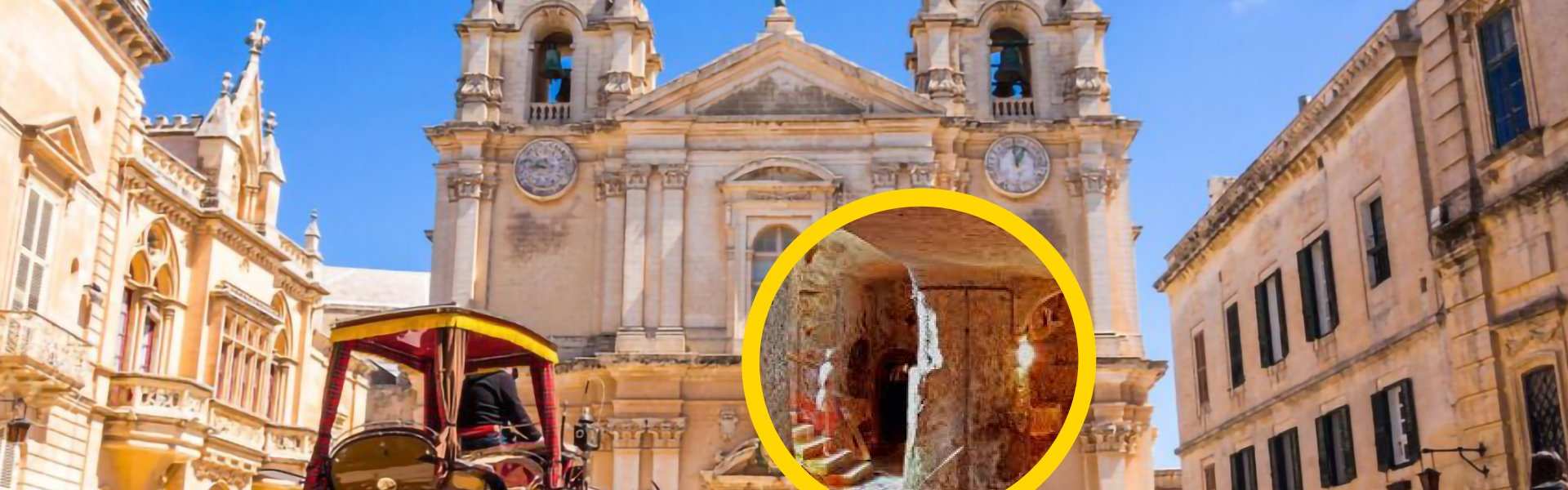
Most people who visit Rabat are really there for Mdina. They walk through the town, pass the church, maybe stop for a pastizz, and head through the old city gate into the silent streets of the walled city. It is entirely understandable. Mdina is extraordinary.
But beneath Rabat itself , beneath its streets, its gardens, its private homes, lies something that has no parallel anywhere else on the island, and arguably few equals anywhere in the Mediterranean. A network of ancient burial chambers, carved out of limestone by hand over many centuries, that together form one of the most significant early Christian archaeological sites in the world.
This is what they are, what is inside them, and why they matter.
Why Is Rabat So Old, and Why Are The Catacombs There?

Rabat and Mdina were not always two places. During the Roman period, the entire area formed a single, considerably larger city called Melite, Malta's administrative capital and the most important settlement on the island. The Roman city was roughly three times the size of the walled Mdina that survives today, extending deep into what is now the town of Rabat.
At some point during the Byzantine period or the Arab occupation, historians debate the exact timing — the city was reduced to a smaller, more defensible core, which became the fortified Mdina. The area that lay outside its walls became known as Rabat, from the Arabic word meaning "suburb" or "fortified town." Arabs ruled Malta from 870 to 1091.
The reason the catacombs are here follows directly from Roman law and Roman geography. Roman practice required that burials take place outside city walls. The dead could not be buried within the city of the living. So when Melite's population needed to bury their dead, they dug outside the city limits, in the area that is now Rabat. Over several centuries, from at least the third or fourth century BC through to the seventh or possibly eighth century AD, this zone outside the walls became an enormous, layered underground burial ground. What remains of it today is one of the most remarkable archaeological sites in the Mediterranean.
St Paul's Catacombs: The Largest Underground Cemetery in Malta

The main complex of St Paul's Catacombs covers more than 2,000 square metres of interconnected underground passages and burial chambers. It is the largest catacomb complex yet discovered on the island. The wider site, including the neighbouring St Agatha's cluster, contains over 30 hypogea, or individual burial chambers, more than 20 of which are currently open to the public.
Heritage Malta, which manages the site, describes it as the earliest and largest archaeological evidence of Christianity in Malta. The cemetery began in the Phoenician-Punic period, but the catacombs as they exist today largely date from the third to the eighth centuries AD, growing and evolving as successive generations carved new chambers, joined adjacent tombs, and expanded outwards through the limestone.
The name "St Paul's" comes from a long-standing belief that the catacombs were once connected underground to St Paul's Grotto, the cave nearby where the apostle is said to have stayed during his three months on Malta in around 60 AD. Heritage Malta is clear on this point: the connection is a myth. Recent research shows the catacombs and the grotto were originally part of the same large cemetery outside Melite's walls, but there is no underground tunnel linking them. The association with Paul is a matter of tradition and proximity, not archaeology.
What is Inside: The Baldacchino Tombs and the Agape Tables

Descending into St Paul's Catacombs is a genuinely disorienting experience. The corridors are cut from limestone, low-ceilinged and narrow in places, spreading outward in what appears to be a haphazard network, but which reflects, on closer examination, a series of deliberate architectural choices made across many generations.
The two large entrance halls contain the site's most striking features. The first are the agape tables: large circular stone tables carved from a single block of living rock, surrounded by a sloping bench in the shape of a reclining couch. They were almost certainly used for commemorative meals in honour of the dead, a practice rooted in pagan Roman tradition that early Christians adopted and transformed into what they called the agape, or "love feast." What makes these tables remarkable is that this form, circular tables hewn out of the living rock in dedicated underground chambers, is a feature of the Maltese catacombs that has not been found in this form anywhere else in the Mediterranean. Heritage Malta is explicit on this point.
The main corridors are dominated by the baldacchino tombs: free-standing, canopied burial structures with four arches and supporting pillars, resembling miniature stone canopies over the graves beneath. They are among the most elegant architectural features of the site, and the most numerous burial types in the complex. Simpler tombs, rectangular slots cut into the floor or walls, are also found throughout.
One smaller catacomb in the complex contains something particularly unexpected: relief carvings of surgical tools on its blocking stones. The identity of those buried here is unknown, but the carving strongly suggests they were members of a family or professional group connected to medicine, perhaps surgeons, or their guild.
Christians, Jews and Pagans, Buried Side by Side
One of the most historically significant features of the Rabat catacombs is something that is easy to miss: the people buried here did not all share the same religion, and they were not segregated.
Evidence from at least 24 of the catacombs shows Christian and Jewish burials side by side, with no visible divisions between them. Symbols from both traditions appear on the walls, crosses and Christian inscriptions alongside carvings of the menorah. Pagan burials are also present. According to UNESCO, which has included the Maltese catacomb complexes on its tentative World Heritage list, this co-mingling of religious traditions is "rarely equalled anywhere else in the Mediterranean," and reflects the genuine cultural and religious diversity of the population of late Roman Melite.
It is a reminder that the early history of religion in Malta was not one of rigid separation, but of communities living and dying alongside one another in the same limestone rock.
What Happened to the Catacombs Over the Centuries?
The catacombs were in use as burial grounds until roughly the seventh or eighth century AD. When the Arab rulers arrived in 870, burial customs changed, and the underground cemetery was largely abandoned. The main entrance was eventually blocked off. The site was covered with soil and cultivated as agricultural land. For several centuries, much of what lay beneath Rabat was simply forgotten, or at best known only through access points in private land.
During the re-Christianisation of Malta in the thirteenth century, after the Norman conquest that ended Arab rule in 1091, parts of the catacombs were reused. An open space within the complex was recut and decorated with murals to serve as a Christian shrine. But the wider complex remained largely out of use and gradually fell into disrepair.
The first proper scientific investigation of the site took place in 1894, when Dr Antonio Annetto Caruana cleared the passages of rubble and produced detailed plans of the complex. His work established the scale and importance of the site and led to the government's acquisition of the surrounding fields. For most of the twentieth century, no further conservation was undertaken.
From 2010 onwards, Heritage Malta undertook a major archaeological programme, including ground-penetrating radar scans and extensive excavation of previously inaccessible areas. In October of 2015, 20 of the 25 catacombs were formally opened to the public for the first time, with a new visitor centre providing context and interpretation.
St Agatha's Catacombs: The Legend and The Frescoes

Directly across the road from the St Paul's complex, and forming part of the same ancient burial ground, are St Agatha's Catacombs, a separate site managed by the Missionary Society of St Paul, with its own small museum and guided tours.
According to tradition, St Agatha, a young Sicilian Christian martyr who died during the Decian persecution of the mid-third century AD, fled to Malta to escape the unwanted attentions of a Roman prefect named Quintianus, and took shelter in the crypt that now bears her name. Whether Agatha was ever actually in Malta is unverifiable; the association is understood to be a legend rather than documented history. What is more likely, according to researchers, is that the crypt was founded by Christian immigrants from Catania, Agatha's home city in Sicily, who brought her cult with them.
What is not in doubt is the extraordinary quality of what lies inside. The crypt contains frescoes that include 13 depictions of St Agatha, some of the oldest and most significant religious paintings in Malta. They date from the medieval period, and their condition reflects a turbulent history: during the sixteenth century, corsairs are recorded as having deliberately slashed and scratched off the faces of the figures in the paintings. The damage is still visible today, and in a strange way makes the frescoes more affecting, not less.
The catacombs themselves contain over 500 tombs of various types, with Latin and Greek inscriptions, wall paintings, and evidence of both pagan and Christian burial practices. The guided tour, which runs regularly, is one of the most informative ways to understand the site.
St Paul's Grotto and the Wider Rabat Underground

A short walk from the catacombs brings you to the Wignacourt Museum, which provides access to St Paul's Grotto, an entirely separate underground site from the catacombs, despite the similar name. The grotto is a small cave beneath the Collegiate Church of St Paul, traditionally identified as the place where the apostle Paul lived and preached during the three months, he spent on Malta after his shipwreck in around 60 AD.
The grotto has been a pilgrimage site for centuries. It was visited by Pope John Paul II on two occasions, in 1990 and 2001, and subsequently by Pope Benedict XVI in 2010 and Pope Francis in 2022. A statue of Paul donated by Grand Master Pinto in 1748 stands inside the cave.
Beneath the grotto complex, tunnels dug during the Second World War served as air-raid shelters for local families, adding yet another layer of underground history to a site already saturated with it. The Wignacourt Museum ticket covers the grotto, the wartime tunnels, and some adjacent Roman-era catacombs, making it one of the most layered underground visits in Malta.
What Else is Worth Seeing in Rabat While You're There?
Rabat rewards those who slow down. Beyond the catacombs, the town has several attractions worth combining into a longer visit.
The Domus Romana, also known as the Roman Villa, is a short walk from the catacombs and offers a completely different perspective on the same Roman period. Discovered in 1881, it preserves fine mosaic floors from a wealthy Roman town house, and the associated museum displays everyday objects, pottery, glass, marble fragments, that give a vivid sense of life in ancient Melite.
The St Cataldus Catacombs, a smaller and less visited site nearby, also contain an agape table and offer a quieter, less crowded alternative for those who want more time to look.
And the town itself, its narrow streets, its parish church, its traditional balconies and small cafés, is worth exploring. Unlike Mdina, which functions largely as a heritage site, Rabat is still a working Maltese town where people live. That ordinariness is, in its own way, part of what makes it special. The extraordinary lies very close to the surface here. Sometimes, literally beneath your feet.
A City Built on Layers
What the catacombs of Rabat offer, above all, is depth, not just physical depth underground, but historical depth. Phoenician burial traditions, Roman law, early Christian practice, Jewish ritual, Arab conquest, Norman re-Christianisation, medieval pilgrimage, wartime shelter: all of it is present in the limestone beneath a quiet Maltese town.
They are not the most dramatic or visually spectacular attraction on the island. They are cramped, dark, and require some patience. But for those interested in understanding Malta, how it came to be what it is, what forces shaped it over two and a half millennia, the catacombs of Rabat are as close as you can get to the bedrock of that story.

About Matthew Gollcher
Hi, I'm Matthew, an SEO Specialist and Content Writer at Yellow Pages Malta. I'm passionate about creating meaningful content and exploring AI's creative possibilities. When I'm not working, I enjoy the gym, time with friends, watching series and reading, and playing guitar. I'm always eager to learn and grow both personally and professionally.