10 More Maltese Surnames and the Stories Behind Them


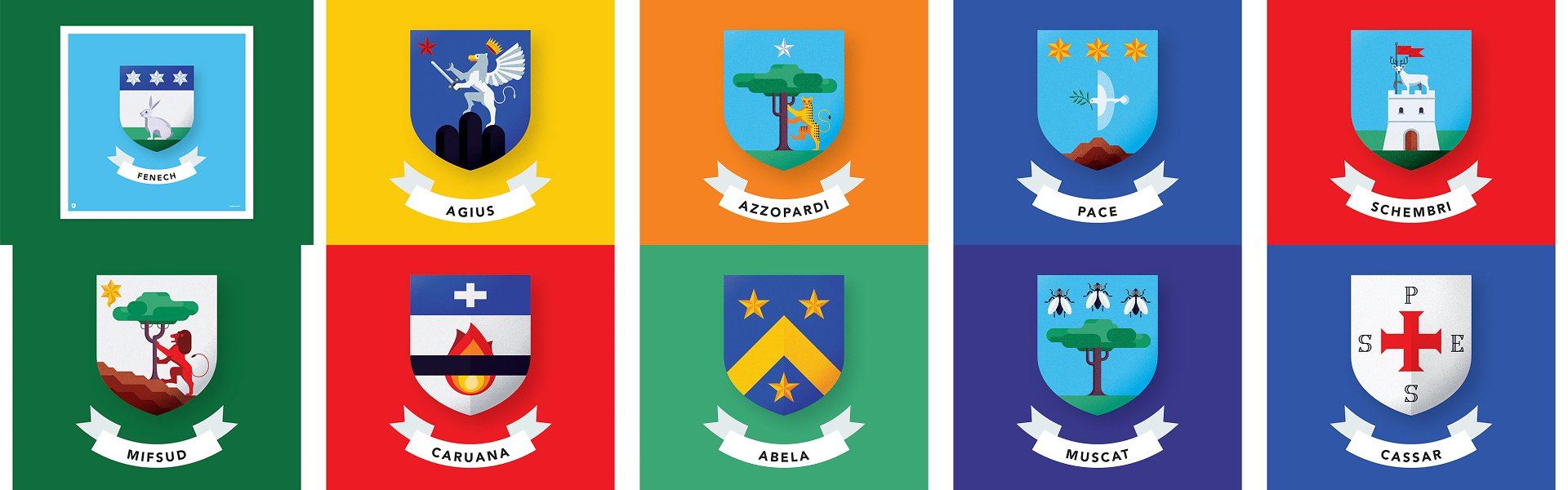
Last time we looked at Borg, Camilleri, Vella, Farrugia, Zammit, Galea, Micallef, Grech, Attard and Spiteri; the ten most common Maltese surnames, which together account for almost a quarter of the population. This time, the next ten: Azzopardi, Cassar, Mifsud, Caruana, Muscat, Agius, Schembri, Abela, Fenech, and Pace. Their combined count in the 2005 National Statistics Office census was approximately 58,590 people; about 14.5% of the Maltese population at the time. Add them to the top ten and we are at almost 160,000 people sharing just 20 surnames; nearly 40% of all Maltese.
As before, the sources we rely on are the two foundational works on Maltese onomastics: Godfrey Wettinger's analyses of the 1419/20 Militia List (the oldest comprehensive Maltese name list) and the 1480s register; and Mario Cassar's 2003 monograph The Surnames of the Maltese Islands plus his subsequent academic papers on Arabic, Sicilian and historical Maltese nomenclature. For each surname we have cross-checked against the Dictionary of American Family Names (DAFN2, Oxford University Press, 2022) and Stanley Fiorini's Sicilian Connexions of some Medieval Maltese Surnames. Where folk etymology and academic etymology disagree, we go with the academics and say so.
If you want to learn more about why so many Maltese people share the same 100 surnames, check out this article here. Let's begin.
11. Azzopardi: 'The Mercenary'
Folk tradition links Azzopardi to the Sephardic Jews, specifically to the Hebrew term s'faradi referring to Jews from the Iberian Peninsula expelled by Spain in 1492. The theory has been popular for centuries among Maltese genealogists. But Godfrey Wettinger has dismantled it.
Azzopardi appears as Azupardu in Malta's Militia List of 1419-1420, over seventy years before the Jewish expulsion from Spain (1492). It also appears in the form Oğerius Açopardus in a Genoese notarial deed dated 4 August 1201. As Wettinger writes in his Melita Historica article on Maltese surname origins: 'Some would regard Azzopardi as ethnic, associating it with the word Sephardic referring to an Oriental Jew, but the separate existence of Accio and Pardo as surnames in the twelfth century counsels caution in reaching premature conclusions.'
The current academic consensus, recorded in the Dictionary of American Family Names (DAFN2, 2022), is that Azzopardi is an ethnic name for a person of African descent, or occupational name for a mercenary soldier, derived from medieval Greek atsoupas (plural atsoupades). The term originally denoted a mercenary soldier; outside Greece it later acquired the secondary sense 'black person' or 'person from Mauritania'. The Germanic name element (h)ard (meaning 'hardy, brave, strong') appears to have influenced the spelling. As an Italian surname it is rare, originating from Sicily where it is found in the forms Azzupardi and Azzuppardi.
12. Cassar: 'The Mat-Maker' or 'The Man from the Castle'

Folk tradition derives Cassar from Latin Caesar, with the suggestion that the family is descended from Roman nobility or at least from a Romanised personal name Cesare. The Cassar coat of arms with the Latin motto Spes ('hope') was sometimes invoked to reinforce this. The folk etymology is now rejected by every serious academic source.
According to Mario Cassar's own scholarship, he is, after all, named for the surname himself, and writes from a position of unimpeachable familiarity; the surname is of Arabic origin, dating to the Muslim period of Malta (870–1091). There are two competing Arabic candidate roots:
First, ḥaṣṣār (حَصَّار) 'mat-maker', or in Sicilian 'fuller' (someone who scoured and thickened raw cloth by trampling it). This passed through spoken Sicilian Arabic into the Sicilian word càssaru and from there into the modern Maltese surname. The Arabic voiceless pharyngeal fricative ḥ evolved through rural Sicilian Arabic into a voiceless velar plosive [k], a phonetic shift that has produced many other Latinised Sicilian and Maltese surnames of Arabic origin.
Second, qaṣr (قَصْر) 'palace', 'castle', or 'fortress'. This passed through Sicilian Arabic into càssaru and again into the modern surname, in this case as a topographic name (denoting someone associated with a particular castle or fortress), rather than as an occupational one.
The Dictionary of American Family Names (DAFN2, 2022) accepts both candidates and is non-committal between them. Pierre Caracausi, in his standard Dizionario onomastico della Sicilia (1993), gives a separate derivation that has also been proposed: an apocopated form of the Sicilian surname Càssaro, which is itself from the same Arabic root.
The Latin/Caesar etymology has been rejected by current onomastic scholarship as folk reconstruction: Cassar is documented in medieval Maltese sources in forms ('de Cassar', 'Kassar') that are consistent with the Arabic derivation and not with the Latin one. As Cassar himself notes, even the modern Maltese surname Cassar, spelled as it is, would be more correctly written in Maltese orthography as Kaṣṣar, which preserves the Arabic phonology of the original.
The surname Cassar appears in 60 Italian communes, plus Cassaro (a related variant) in another 138 communes, mainly along the Agrigento–Caltanissetta–Licata axis in Sicily. The Sicilian distribution confirms the Sicilian-Arabic transmission route.
13. Mifsud - The Not-So-Flattering Nickname

Mifsud was the ninth-commonest surname in Malta in 1687 according to the Status Animarum. It is now the 13th. There is a sustained popular legend that the name comes from Old Norman miferes + sud, giving 'southern faithful'; a loyal soldier from the south. This is folk etymology with no academic support.
The academic consensus is firm: the surname derives from Arabic mafsūd (مفسود), the past participle of the verb fasada 'to spoil, to corrupt, to ruin'. As a personal name it carried the meaning 'spoilt', 'rotten', 'corrupted', used as a pejorative or descriptive nickname for a person considered defective in some way (whether physically, morally, or socially). Mario Cassar in his 2005 Pisa congress paper Vestiges of Arabic Nomenclature in Maltese Surnames places Mifsud explicitly in the category of 'nicknames … with pejorative connotations'.
An alternative derivation, also Arabic, has been proposed: mifṣad (مفصد), meaning 'a lancet' (the surgical blade for bloodletting), perhaps a personal name borne by a barber-surgeon or by someone known for having been bled by a lancet. The Dictionary of American Family Names accepts both Arabic roots and is non-committal between them.
Mifsud is mentioned in Wettinger's lists of surnames recorded in the 1419/20 Militia List, which means it predates the Knights' arrival in 1530. The pejorative origin is a recurring pattern in Maltese surnames: Mintuf ('plucked, dishevelled'), Mhanuq ('strangled'), and other unflattering nicknames have similarly survived as surnames. The Maltese, it seems, had a sense of humour about such things — or, more likely, were given names that someone else thought were funny and could do nothing about it.
14. Caruana: 'The Caravan-Driver'

If your surname is Caruana, you may have been told it comes from the Latin carus ('dear', 'beloved'), a sweet etymology that has spread widely on the internet. The academic answer is more interesting.
Godfrey Wettinger writes flatly in his Melita Historica study: 'Caruana from Karwan.' The Arabic word karwān / qayrawān means 'a caravan', the camel- or donkey-train of medieval Mediterranean trade. The surname originally denoted a caravan-driver or caravan-leader — one of the central professional roles of the trans-Saharan and Levantine trading economy that connected Sicily, North Africa and the eastern Mediterranean. Stanley Fiorini, in his 'Sicilian Connexions of some Medieval Maltese Surnames' published in the Journal of Maltese Studies, confirms the same derivation from the Arabic root, recorded in Sicilian-Arabic documents from 1145 onwards.
Wettinger explicitly classifies Caruana as one of the Maltese surnames that were originally Arabic but became Latinised, part of the wider trend in late medieval Sicily and Malta of disguising Arabic origins under Romance-looking spellings.
In the 1687 Status Animarum, 23.2% of all Caruanas in Malta were resident at Żejtun, a striking concentration. The surname is today the top-ranking family name in Senglea, and is second-ranking in Għaxaq and Marsaxlokk. These are all coastal or near-coastal southeastern locations, exactly where one would expect a trading-and-caravan name to have clustered.
15. Muscat: 'The Spice Merchant' or 'The Jew'

Muscat appears as a Maltese surname from at least 1372. The standard reference Dictionary of American Family Names (DAFN2, 2022) lists Maltese Muscat as a variant of the Italian surname Muscato (which appears in 43 Italian communes, especially in Sicily and Apulia). The cognate Italian form Moscato is much commoner and appears in 423 communes.
There are two principal etymological traditions for Muscat / Muscato / Moscato:
First, the spice trade: the German and Ashkenazic Jewish surname Muskat is a metonymic occupational name for a spice merchant, from Middle High German muscāt / modern German Muskat 'nutmeg, mace'. The Sicilian / Maltese Muscat is, on this reading, a parallel formation from the same root, a name for someone who traded in nutmeg, mace, or related spices. Muscat (the Omani city on the Indian Ocean spice route) is etymologically connected, though indirectly.
Second, Jewish origins. Godfrey Wettinger, in his Origin of the Maltese Surnames study, writes: 'It has also been suggested that Muscat could also be of Jewish origin.' This is offered as a hypothesis rather than a settled conclusion. The Jewish-origin theory rests on the wider phenomenon of Maltese Jewish families converting to Christianity in the 14th and 15th centuries, often taking surnames either similar to their original Hebrew names or translated into Romance forms.
Muscat placed 11th in the Status Animarum of 1687 and is now 15th. It is the top-ranking surname in Sannat, Gozo, and the second-ranking surname in Mġarr, Malta. There are several Maltese double-barrelled forms (Muscat Azzopardi, Muscat Drago, Muscat Fenech, Muscat Terribile and others), reflecting the historic Maltese practice of preserving maternal surnames through hyphenation.
16. Agius: The 'Old Man' or 'The Saint'

There are two academic candidates for Agius, and they are pulling in opposite directions:
First, the Greek hypothesis: Agius is a Latinisation of the Greek word hagios (ἅγιος) meaning 'holy', 'saintly', 'consecrated'. This is the etymology recorded in many older Maltese onomastic works and in Wikipedia. It links the surname to the wider Greek and Greek-influenced (Byzantine, Sicilian-Greek) cultural stratum that contributed several other Maltese surnames, most notably Grech (which is Greek).
Second, the Arabic hypothesis: the Dictionary of American Family Names (DAFN2, 2022) records Agius as 'a regional variant of Arabic ʿajūz', the noun meaning 'old woman', but also used (with the same word or with masculine ʿajūz) for 'old man'. As an Arabic nickname-surname, ʿajūz describes someone elderly, venerable, or simply remembered as having been old by the time the family naming convention crystallised. Mario Cassar, in his analyses of vestigial Arabic nomenclature in Maltese surnames, treats this as the more likely derivation.
It is possible that both etymologies are partially true: that some Agius families derive from a Greek-Christian ancestor named for sanctity, while others derive from an Arabic nickname for an old man, and that the two streams converged under the same modern spelling. The 1687 Status Animarum ranks Agius seventh; the 2005 census ranks it 16th.
17. Schembri: 'The Albanian Mercenary'

Of all the surnames in this list, Schembri has the most unexpected academic etymology. The folk traditions range from Maltese xemx ('sun') for a sun-tanned person, to Arabic shammar ('dark') for a dark-complexioned one, to Sicilian sciambru/schembru ('November') for someone born in that month. None of these is the academic consensus.
The DAFN2 records Schembri as 'Italian (Sicily) and Maltese: possibly of Albanian origin, a habitational name derived from the placename Shkëmber', a settlement in modern Albania. The Albanian word shkëmb means 'rock, cliff', and Shkëmber was the name of a locality near the Albanian coast. The surname was 'presumably brought to Sicily centuries ago with Albanian mercenaries and later spread to Malta (and apparently from there to the Greek island of Corfu, where it is spelled Skempris).'
Albanian mercenaries, the stradioti, were a major military presence in the late-medieval and Renaissance western Mediterranean. The Venetian and Spanish military service drew heavily on Albanian soldiers from the 14th to 16th centuries. Many of these soldiers settled in Sicily and southern Italy, and a smaller wave appears to have continued on to Malta. The arbëreshë communities of Sicily, with their Albanian-Greek liturgy and distinctive surnames, are the lasting trace of this migration.
Schembri was the fourth-commonest surname in Malta around 1419/20; a striking peak. By 1687 it had slipped to 15th, and it is now 17th. The remarkable medieval prominence supports the early-mercenary settlement hypothesis. Mario Cassar notes that the alternative spelling Schembi (without the second r) may be the older form, with the -r- being an epenthetic insertion, a phonological addition for ease of pronunciation, as in many other Sicilian-derived surnames.
18. Abela 'The Bee', 'The Biblical', or 'The Catalan'

Abela is conspicuously absent from the 1419/20 Militia List, the 1480s register, and Wettinger's broader medieval list. It first appears in Maltese records around 1390 (a single instance) and becomes common only during the Knights' period (post-1530). Mario Cassar classifies it as a surname 'imported at a later stage, probably during the period of the Knights'.
Three academic candidates have been proposed:
First, the Italian/Sicilian candidate: Abela is a variant of the southern Italian and Sicilian surname Abella (with the final -a feminine ending), itself from a personal name. The Dictionary of American Family Names (DAFN2, 2022) records this as the primary derivation. Abella is a common Sicilian surname and is found across southern Italy.
Second, the biblical candidate: Abela is a feminine form of the Italian male personal name Abele ('Abel', son of Adam in Genesis). This was a recognised personal name in medieval Sicily and southern Italy.
Third, the Catalan/Iberian candidate: Abela is from Catalan abella 'bee', either as an occupational nickname for a beekeeper, or as a metaphorical nickname for someone industrious. The first recorded Spanish instance of the surname is from Girona in 1675. This candidate would link the Maltese Abelas to the Aragonese and Catalan presence in late-medieval Malta.
The most famous historical Maltese Abela is Ġann Frangisk Abela (Giovanni Francesco Abela, 1582–1655), the Vice-Chancellor of the Order of St John and author of Della descrittione di Malta isola nel mare siciliano (1647), the first systematic description of Malta and the foundational text of Maltese historical scholarship. His coat of arms shows three gold spurs on a blue background, emblems of honour and readiness; the Sicilian Abela family in Syracuse used six-pointed stars instead.
19. Fenech: 'The Rabbit' (Sort Of)

This is the famous one. Fenech, the surname most Maltese will explain to you confidently as meaning 'rabbit', because fenek means 'rabbit' in modern Maltese.
They're half right.
The Maltese word fenek does mean 'rabbit'. But fenek is itself derived from Arabic fanak (فَنَك), which originally meant 'fennec fox', or more generally 'fox, marten, furry animal'. The fennec (Vulpes zerda) is the small, pale, big-eared desert fox of North Africa. In its travel from Arabic through Sicilian Arabic into Maltese, the word seems to have shifted from designating the fennec fox to designating the rabbit — the two animals share the visually striking feature of very large ears, and the substitution probably happened around the time that Malta's rabbit population became culturally and economically significant (medieval Malta had a thriving rabbit-hunting tradition).
So Fenech originally meant 'the fennec fox-man' (a nickname for someone with prominent ears, perhaps, or someone who hunted desert fauna, or simply someone whose family name had crystallised in the older Arabic sense). By the time the modern Maltese surname is being explained in cafes, it means 'rabbit'. Both are right in their own time-period.
Wettinger lists Fenech as one of the Maltese surnames originally derived from Arabic nicknames, surviving in Romance-looking form into the 1419 Militia List and beyond. The Dictionary of American Family Names records: 'Maltese: from Maltese Arabic fenek 'rabbit' (from Arabic fanak 'fox, marten, furry animal').'
An unrelated medieval Italian-language attempt to 'translate' Fenech into the Italian Coniglio ('rabbit') failed completely, the Arabic-derived surname survived under official Italian language pressure and is now one of the most distinctively Maltese names in the country. The same fate befell the parallel attempt to replace Psaila (from Arabic baṣal, 'onion') with the Italian Cipolla.
20. Pace: 'The Peaceful' or 'The Calque of Salam'

Pace closes the top twenty. It is first recorded in Malta in 1372, in the forms Pax and Pache. The Italian form has been continuously present in Malta ever since.
The standard etymology is the obvious one: Pace is from Italian pace / Latin pax, pacis, 'peace'. As a nickname or personal name it would have been bestowed on a mild-mannered or even-tempered person, a peacemaker, or a person known for arbitration. Variant Italian forms include Pacini, Pacione, Pacillo (all 'little Pace' or 'big Pace'). The first European references to the surname Pace occur in the 6th and 7th centuries in the forms Pace, Pacius, Pacinus, and Pax. In the Italian context Pace is concentrated in Pratola Peligna in L'Aquila, Abruzzo, where 'virtually everyone has a relative with the surname Pace and it can take up pages in the phonebook'.
But Godfrey Wettinger makes a more interesting observation. In his 'Origin of the Maltese Surnames', listing surnames that he believes were translated from Arabic into Romance forms during the late medieval Christianisation process, Wettinger writes: 'Other possibilities of such calques can be pointed out, such as that of Salam, Salāma, Selmun, Salma into Pace.'
In other words: some Maltese families bearing the surname Pace are likely descended from Arabic-speaking ancestors whose original surname was Salām (سَلَام) or one of its variants, the Arabic word for 'peace'. When these families converted to Christianity or were subject to surname-Latinisation, the Arabic Salām was translated (calqued) into its Italian semantic equivalent Pace. The placename Selmun in northern Malta near St Paul's Bay, and the Maltese personal name Salma, are both fossilised survivors of the same Arabic root.
This means the Maltese Pace surname has at least two parallel origins: some families are descended from Italian immigrants who arrived with a pre-existing Pace surname (well-established in medieval Italy), while other families are descended from Arabic-speaking Maltese whose surnames were translated into Italian forms during the late-medieval Christianisation. There is no way, from the surname alone, to tell which path any individual modern Pace family travelled.
What the Next Ten Surnames Tell Us
Taken together, these ten surnames, the 11th to 20th most common in Malta, confirm the same broad pattern that the top ten established. The Arabic substratum runs deep: Cassar, Mifsud, Caruana, Fenech, and (in part) Agius and Pace all derive ultimately from Arabic roots, even where the modern spelling has been Italianised. The Sicilian-mediated transmission is the principal carrier of this Arabic material: Maltese surnames were not created in isolation but moved with people through the trans-Sicilian and trans-Mediterranean networks that defined the western Mediterranean economy from the 11th to the 16th centuries.
The non-Arabic layer is similarly multi-stranded. Schembri carries an Albanian-mercenary trace; Pace is Latin/Italian; Abela is Sicilian-Italian (with possible Catalan and biblical strands); Muscat is the German-Sicilian spice-trade name (with a possible Jewish line). Even within this small sample of ten, every major migrational stream that crossed Malta in the late medieval and early modern periods has left a surname trace: Arab, Greek, Sicilian, Catalan, Albanian, Italian, German-Jewish.
What folk tradition gets wrong, in every single case, is to assume that the family stayed put, that the Maltese surnames of today reflect populations that have been there since the Phoenicians or since Roman times. The academic record is the opposite: Maltese surnames are an archive of movement, of conversion, of trade routes, of marriage between communities, of language change under the pressure of religious and colonial authority. They are, in a word, Mediterranean surnames; not because Malta is in the Mediterranean, but because they were formed by the centuries-long churn of a sea that connected three continents and traded goods, people, languages, and names between them.
If you have one of these surnames, the most likely truth about your family is not that you are descended from a single ancestor of a single origin. It is that you are descended from a network of ancestors who moved, married, converted, and renamed across Malta, Sicily, North Africa, the Iberian Peninsula and the Levant, and whose surnames were repeatedly translated, mistranslated and re-spelt along the way. Your Maltese surname is not a fixed origin: it is a record of the longest argument in the western Mediterranean about what people should be called.
Got a surname not on either list, ours or the previous one, that you'd like us to research? Let us know, and we may cover it in a future article.
For more on the history of the Maltese surnames, click on this link.
All coat of arms for this article have been taken from Kunjom. For more information visit their website.

About Matthew Gollcher
Hi, I'm Matthew, an SEO Specialist and Content Writer at Yellow Pages Malta. I'm passionate about creating meaningful content and exploring AI's creative possibilities. When I'm not working, I enjoy the gym, time with friends, watching series and reading, and playing guitar. I'm always eager to learn and grow both personally and professionally.