The Pakistanis Who Made Malta Home: A Community of Several Thousand and Growing


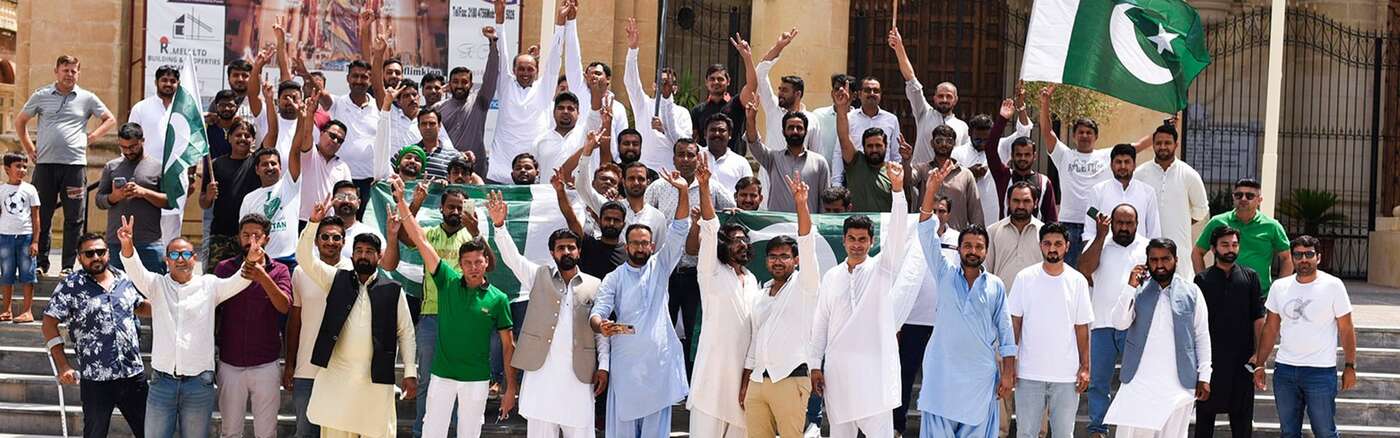
Among the many communities that have made modern Malta their home is a growing Pakistani community. Its members work across the Maltese economy, in hospitality, construction, delivery and courier services, retail, food, and a range of other sectors; and the community has, over the last decade, established the beginnings of its own institutional life in Malta: a consulate, community organisations, restaurants and food businesses, and the informal networks that every migrant community builds.
Before going further, a word about honesty. This article is harder to write than our pieces on the Indian or Filipino communities, for a simple reason: the Pakistani community in Malta is newer, smaller, and far less documented. There is no dedicated census breakdown for it in the way there is for some other groups, no body of academic research comparable to the scholarship on the Sindhi merchant families, and no single authoritative published history.
How Many? An Honest Look at the Numbers
Let's deal with the headline question first, because it is where most casual accounts go wrong.
The most reliable public data on foreign nationals working in Malta comes from figures tabled in the House of Representatives by the Finance Minister, drawn from Jobsplus. The data for July 2023, reported by MaltaToday and The Shift, ranked the largest third-country foreign-worker nationalities in Malta as follows: Indians, Filipinos, Nepalese, and Britons (around 5,100), followed by Serbians, Albanians, Colombians, Turks, Pakistanis, and Macedonians.
That ranking is the key to an honest estimate. Pakistanis appear below Colombians in the list, and the Colombian workforce in July 2023 was about 3,149. That places the registered Pakistani workforce in 2023 at somewhere in the region of two to three thousand people. The total community; including spouses, children, students, and Pakistanis who have since acquired Maltese or other citizenship, is somewhat larger than the workforce figure, but there is no published source that puts it anywhere near the 'tens of thousands' that sometimes circulate in casual conversation. For comparison, even the Serbian community in Malta, which ranks above Pakistanis in the workforce data, numbered only 5,935 in the 2021 census.
So the honest formulation is this: the Pakistani community in Malta numbers several thousand people, it is growing, and it sits in the middle tier of Malta's foreign-national communities, substantial and increasingly visible, but considerably smaller than the Indian, Filipino, Nepalese or British communities. Anyone who tells you a precise five-figure number for the Pakistani community in Malta is, at the time of writing, going beyond what the public data can support.
Part of a Much Bigger Story: Malta's Third-country Workforce
The Pakistani community's growth is one strand of one of the most significant transformations in modern Maltese society: the rapid arrival, since the mid-2010s, of a large third-country-national (TCN) workforce.
The scale of that transformation is striking. According to data analysed by The Shift from figures tabled by Finance Minister Clyde Caruana, the share of migrant workers in Malta's roughly 300,000-strong workforce rose from around 10% in 2013 to almost 33% by the end of 2022. By mid-2023, Malta employed more than 100,000 foreign workers; about 37,000 from the European Economic Area and more than 67,000 third-country nationals. Malta had gone, in barely a decade, from a largely homegrown workforce to one in which a third of all workers were foreign, one of the fastest such shifts anywhere in Europe.
Pakistanis arrived as part of this broader wave, predominantly as third-country nationals on work permits, processed through the Single Permit system that governs non-EU nationals' right to live and work in Malta. Like most TCN communities, the Pakistani presence is concentrated in the sectors where Malta's labour shortages have been most acute and where the work is often lower-paid: hospitality and catering, construction, delivery and courier services, cleaning and facilities, retail and wholesale, and food service. The Central Bank of Malta's research on the foreign workforce confirms that third-country nationals are spread across most sectors of the economy, with the strongest concentrations in lower-skilled and service-oriented roles, though TCNs are increasingly present in professional and administrative-support sectors too.
An Unexpected Historical Link: Sindh, Hyderabad, and the Old Merchant Families
There is a historical curiosity worth pausing on, because it connects Malta's newest South Asian arrivals to one of its oldest.
Malta's historic 'Indian' community, the small, deeply-rooted community of Hindu merchant families who have run shops in Valletta since 1887, traces its origins specifically to the bhaiband Hindu Sindhi community of Hyderabad, a city in the region of Sindh. At the time those families began migrating, in the late nineteenth century, Sindh was part of British India. Today, Sindh , and Hyderabad, are in Pakistan, which was created by the partition of British India in 1947.
So the geographic origin of Malta's oldest South Asian community lies within the borders of the country that Malta's newest South Asian arrivals come from. The historic Sindhi merchant families are Hindu and migrated under the British Empire; the modern Pakistani community is predominantly Muslim and has arrived as part of twenty-first-century labour migration into an EU member state. They are entirely distinct communities, separated by religion, by era, by circumstance, and by more than a century of history. But the thread of geography, Sindh, the lower Indus valley, runs through both. It is one of those quiet connections that Malta's long history as a Mediterranean crossroads throws up again and again.
Community Life: Consulate, Organisations, Food, and Faith

What can be reliably said about the institutional and cultural life the Pakistani community has built in Malta? Several things.
A consulate. Pakistan maintains a Consulate of Pakistan in Malta, headed by an Honorary Consul, which provides consular services to resident and non-resident Pakistanis, passport and documentation services, attestations, and assistance to Pakistani nationals. (Pakistan's full diplomatic representation to Malta is handled at ambassadorial level from outside the island, with the local consulate providing day-to-day services.) Reciprocally, Malta maintains an honorary consulate in Lahore, which assists with visa matters and consular support. The existence of a dedicated consular presence is itself a marker of a community substantial enough to need one.
Community Organisations
There are community networks that bring Pakistanis in Malta together, including the 'Pakistani Community in Malta' (PCIM), which operates as an online community group, and the informal networks of mosque attendance, regional and family ties, and workplace connections that characterise most migrant communities. As with many newer communities, much of this organisational life happens through social media and word of mouth rather than through formal, registered institutions with public histories.
Food
One of the most visible expressions of the community is culinary. Pakistani restaurants now operate in Malta, serving the cuisine of the Punjab and the wider subcontinent, part of a broader flourishing of South Asian food on the islands that has accompanied the growth of the Indian, Pakistani, Nepalese and Bangladeshi communities. Asian grocery shops stocking South Asian ingredients, spices and brands have become a familiar feature of districts such as Marsa, Ħamrun and Gżira.
Faith

The Pakistani community is predominantly Muslim, and its religious life is part of the wider Muslim community in Malta; which includes Maltese converts, Arab and North African residents, and Muslims from many countries. Malta has had an established modern Muslim presence for decades, centred on the Mariam Al-Batool Mosque in Paola, the only officially recognised, purpose-designed mosque on the island. Its foundation stone was laid in 1978, it opened to the public in 1982, and it was officially inaugurated in 1984; it was built with Libyan funding through the Islamic Call Society. Alongside it are a number of smaller prayer spaces around the island. Pakistani Muslims in Malta worship within this broader community rather than in specifically Pakistani religious institutions, as far as the public record shows.
What We Don't Know and Why that Matters
It is worth being candid about the limits of what can be said. For the Pakistani community in Malta, several things that one would want to know are simply not established in any reliable public source:
- Exactly when the community began to form. There is no documented 'first arrival' or founding moment of the kind that the Sindhi merchant community has in the Pohoomull Brothers' shop of 1887. The Pakistani presence appears to have grown gradually as part of the post-2010s labour-migration wave, but a precise starting point is not on the public record.
- A precise population figure. As discussed above, the workforce data places the community in the low thousands, but no census or statistical release isolates the total Pakistani population (workers plus dependents plus naturalised citizens) the way it does for some other groups.
- Detailed demographic and regional breakdowns. We do not have reliable public data on which regions of Pakistan the community predominantly comes from, its gender and age profile, or its precise sectoral distribution within Malta.
This matters for two reasons. First, it is a reminder that official statistics and academic attention tend to follow the largest and longest-established communities; newer and mid-sized communities like the Pakistani one can be under-documented even as they grow. Second, it is a caution against the confident-sounding but unsourced numbers and stories that circulate about migrant communities, in casual conversation, on social media, and sometimes in the press. The responsible thing, when the record is thin, is to say what is known, mark clearly what is not, and resist the temptation to fill the silence with invention.
The Bigger Picture: Malta's Changing Face

Whatever the precise numbers, the direction is not in doubt. The Pakistani community in Malta is growing, as part of the broader and historically unprecedented diversification of Maltese society over the past decade.
In 2013, foreign workers made up around a tenth of Malta's workforce. A decade later they made up a third. The islands that were, within living memory, a country of emigration, sending tens of thousands of Maltese to Australia, Canada, Britain and the United States in the mid-twentieth century. have become, in the twenty-first, a country of immigration, drawing workers from India, the Philippines, Nepal, Serbia, Albania, Colombia, Turkey, Pakistan, North Macedonia, and dozens of other countries. The Pakistani community is one thread in this much larger fabric. Where the community goes from here; how large it grows, how it settles, what institutions it builds, how it is received, is not yet written, and we will not pretend to predict it.

About Dr Hillary Hopkins
Dr Hopkins is a Maltese lawyer, with a love for Malta's historic stories, forgotten corners, and little cultural rabbit holes.