The Filipinos Who Form Part of Modern Malta: How Thousands Came to Live in Malta


Malta's Filipino community is now one of the country's largest foreign minorities. According to official figures released by the Maltese Finance Minister Clyde Caruana in answer to a parliamentary question from PN MP Graziella Galea, as of July 2023 there were 9,560 Filipino nationals registered as working in Malta, making the Philippines one of the largest foreign-worker communities in Malta; by July 2023, Filipinos were the second-largest third-country nationality registered for work, after India, and appear to have been the third-largest foreign-worker nationality overall when EU nationals are also counted. The actual community is larger still: that figure counts only registered workers, not spouses, dependents, or recently-naturalised Maltese citizens of Filipino origin.
This is a community that has built itself in Malta over the course of a single generation. It barely existed in any visible form before the 1990s. By the late 2010s it had become one of the institutions of Maltese health and care. By the mid-2020s it is part of the fabric of everyday Maltese life, working in the country's hospitals, raising children in Maltese schools, celebrating its own feasts in Maltese streets, and quietly reshaping what 'Maltese' means in the twenty-first century.
This is the story of how Malta's Filipinos came to call the island home.
To understand the Filipino community in Malta you have to start with a much bigger story: the global Philippine labour-export model that has shaped Philippine society since the 1970s.
Since the presidency of Ferdinand Marcos, successive Philippine governments have explicitly promoted the migration of skilled Filipino workers, especially nurses, care workers, seafarers, domestic helpers, teachers and engineers; to countries around the world. The Philippines maintains formal labour agreements with dozens of destination states. Remittances sent home by overseas Filipino workers (OFWs) have grown into one of the country's largest sources of foreign income. The result is a Filipino diaspora that today spans every continent: large communities in the United States, the United Arab Emirates, Saudi Arabia, Canada, the United Kingdom, Italy, Spain, Ireland, Australia, Hong Kong, Singapore and many other countries.
The healthcare component of this migration is particularly important. The Philippines is one of the world's major exporters of trained nurses. Its nursing schools have, for decades, prepared graduates for international careers, and an entire industry of recruitment agencies, language schools and credential-verification services has grown up around the process. By the 2000s, several European countries, including Ireland, the United Kingdom, and later Malta; had become significant destinations for Filipino nurses.
Malta entered this global story relatively late. Two factors made it eventually inevitable. The first was Malta's rapidly ageing population: the share of Maltese people aged 65 and over has grown sharply this century and is now around one in five. The second was Malta's explosive economic growth after EU accession in 2004, which created demand for labour across the whole economy, especially in healthcare, hospitality, and personal services, that the local workforce could not meet. The Philippines was an obvious match: skilled, English-speaking, predominantly Catholic, with a labour-export system already designed for the European market.
Two Republics, 50 Years of Formal Ties
The Republic of the Philippines and the Republic of Malta have had formal diplomatic relations since the 9th of June 1977, thirteen years after Maltese independence in 1964 and during the presidency of Ferdinand Marcos in the Philippines. The relationship has been a quiet, working one, focused on consular and migration matters rather than headline-making politics.
Malta does not host a full Philippine embassy. The Philippines is represented in Malta by the Embassy of the Philippines in Rome, which is concurrently accredited to Malta, supported by a Philippine consulate in Malta handling day-to-day consular needs of the community. Consular outreach missions, where embassy staff travel from Rome to Malta to process passports, OFW documentation and similar paperwork on the ground, are held periodically.
There is a separate and much older relationship worth flagging only to avoid confusion: the Sovereign Military Order of Malta, the modern descendant of the medieval Knights, now headquartered in Rome, established its own diplomatic relations with the Republic of the Philippines in 1965, twelve years before the Republic of Malta did. The Order of Malta is a non-territorial sovereign entity, distinct from the Republic of Malta, and its relations with the Philippines are part of its humanitarian and medical mission, not part of the migration story we are telling here.
The Arrival: Nurses, Carers, and the 1990s Wave

There is no single founding moment for the Filipino community in Malta in the way that, say, the Sindhi merchants from Hyderabad can be traced to the 1880s. The community grew gradually, through the late 1990s and the 2000s, as individual recruitment by Maltese hospitals and care providers turned into a sustained migration stream.
Academic studies of Filipino working conditions in Malta (most notably the research published by Manwel Debono, Anna Borg and Gabriella Vassallo at the University of Malta's Centre for Labour Studies) date the systematic recruitment of Filipino health workers in Malta to the late 2000s and early 2010s. The Malta Independent reported in 2011 that Malta was moving 'from a passive to a more active international recruitment of workers in the health sector'. From that point onward the numbers grew steadily.
The pattern was strongest in two specific sectors. The first was nursing, concentrated at Mater Dei Hospital and other public and private healthcare facilities, where the demand for trained, English-speaking, internationally-credentialed nurses ran ahead of what Maltese training could supply. The second was home-based and live-in care for elderly Maltese people, as families sought support for ageing parents in a country whose pension system and informal family structures were under pressure from demographic change.
The scale of the care-work component is striking. In September 2019, of 209 registered home-based care workers in Malta, 174 were Filipino, around 87% of the entire category, of whom 87% were women. In 2021, Filipinos were the largest foreign nationality among care workers, with 1,147 workers, ahead of Indians at 958, while Maltese and Gozitan care workers numbered 1,997. These were the figures that Finance and Employment Minister Clyde Caruana tabled in Parliament in response to a question from Labour MP Silvio Grixti. Filipinas had quietly become the largest single foreign group in one of the most intimate sectors of Maltese life: looking after the country's elderly in their own homes.
Working conditions in the live-in care sector have been a recurring subject of academic and policy concern. EU data published by Eurofound and based on Department of Industrial and Employment Relations figures showed Filipino domestic carers in Malta earning a gross salary of around €10,000 a year in 2020, with the regulated monthly rates set at €799.23 for workers sleeping at the employer's house more than 16 nights per month, and €782.94 for those sleeping there fewer than 16 nights. The 2018 art and research project Exiled Homes: Embroiderers of Actuality, led by artists Aglaia Haritz and Abdelaziz Zerrou with the anthropologist Gisella Orsini and shown at The Mill in Birkirkara, documented the experiences of six Filipina live-in carers; Ritzel, Nida, Jenifer, Criselda, Lorna and Jazmin, and ended with a video of fifteen Filipina women singing the Maltese national anthem in Tagalog.
Faith and Culture: Santo Niño, Simbang Gabi, Tagalog Mass

One of the points of unusually close fit between the Filipino and Maltese communities is religion. The Philippines is one of the only majority-Catholic country in Asia. Malta is one of the most Catholic countries in Europe. Filipino devotion to Santo Niño (the Child Jesus), to the Virgin Mary, to the rosary and the novena, slotted naturally into a Maltese religious culture that practises all of the same forms.
Three Filipino Catholic devotions in particular have become visible parts of the Maltese religious calendar:
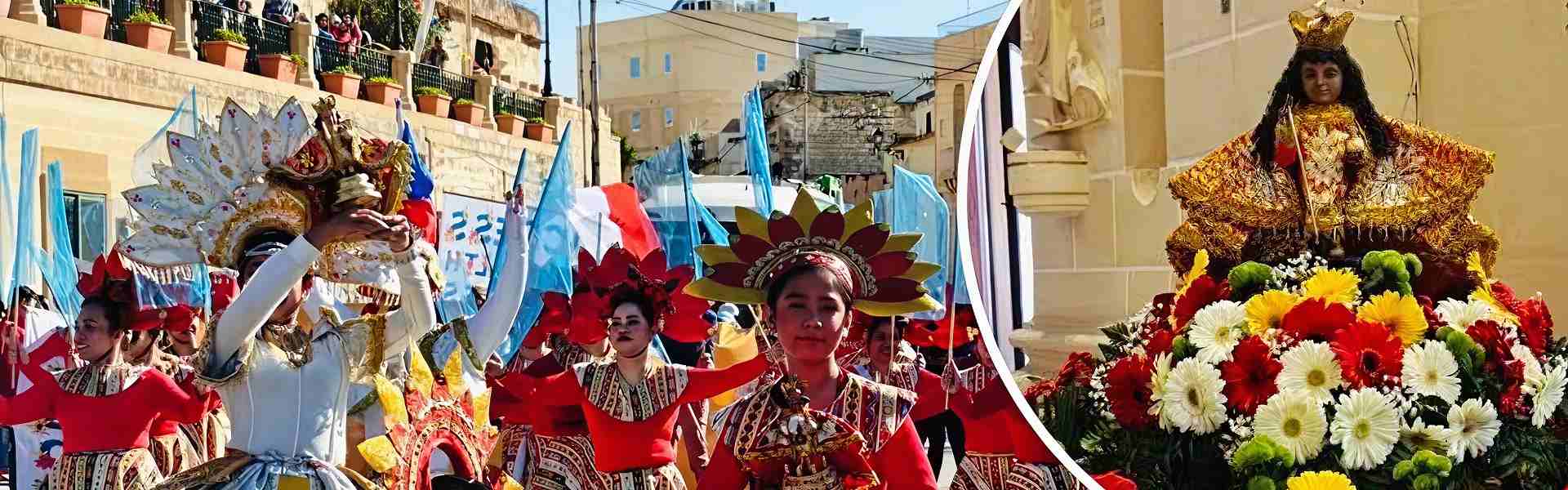
Santo Niño. The Feast of Santo Niño, the Child Jesus, is celebrated every year on the third Sunday of January, with its most prominent Maltese expression at the parish church of St Anne in Marsaskala. The day involves a procession with the statue of the Child Jesus through the streets of Marsaskala, Mass (typically in English), traditional Filipino dance and the distribution of Filipino food. In January 2024, when some social-media commentary on the celebration veered into xenophobia, Home Affairs Minister Byron Camilleri publicly defended the community's right to hold the feast: 'these comments are not worthy of the people who made them and do not represent the beliefs of the Maltese and Gozitans of good standing.' He compared the Filipino celebration to the way the Maltese diaspora in Canada and the United States celebrates its own traditions abroad.
Simbang Gabi. The traditional Filipino nine-day cycle of dawn or evening Masses leading up to Christmas, a devotion dating back to the Spanish colonial period in the Philippines, is observed by the Filipino community in Malta in the days before Christmas, typically with the support of parish priests who open their churches to the practice.
Tagalog Mass. Regular Mass in Tagalog is celebrated at in Valletta, the historic parish church dedicated to the Apostle whose shipwreck on Malta is recorded in the Acts of the Apostles. The choice of venue is itself meaningful: a Filipino community gathered in the parish of the saint who, on a Maltese tradition's reading, first brought the Christian faith to the island.
These three observances, Santo Niño, Simbang Gabi, the Tagalog Mass, anchor the public Catholic life of Malta's Filipino community. Around them have grown the usual ancillary institutions: parish-based Filipino social groups, online community networks (the 'Filipino Maltese Catholic Community' has a substantial Facebook membership), and family-based gatherings around birthdays, baptisms, anniversaries, and Filipino national days.
What It Means: A Community of One Generation
Compared with the historic Indian community in Malta, the Hindu Sindhis whose forty-five families trace their presence back to 1887, the Filipino community is very young. It is essentially the work of a single generation. Almost everyone in it arrived from the late 1990s onward; the great majority arrived after 2010. There is no late-Victorian shopfront on Republic Street to mark its arrival, no monument in a cemetery, no nineteenth-century newspaper trail.
What there is, instead, is the daily evidence of presence. A care worker quietly looking after an elderly Maltese person in Sliema. A nurse on shift at Mater Dei. A waiter in a St Julian's restaurant. A teacher's aide in a school in Birkirkara. The grandparents' voices in Tagalog on a video call from a flat in Hamrun. The smell of adobo cooking in a shared kitchen on a Friday evening. The procession through Marsaskala on a Sunday in January. The flag of the Philippines on a small altar in a corner of a Maltese living room, alongside an image of Our Lady of Mellieħa.
In time, perhaps in another generation, some of these families will move into the same long, slow trajectory the Sindhi community travelled before them: from work-permit holders to permanent residents, from permanent residents to Maltese citizens, from a community in Malta to a Maltese community. Maltese-born children of Filipino parents are already attending Maltese schools, speaking Maltese alongside English and Tagalog, and growing up with the same comfortable bilingualism that defines a Maltese childhood. The boundary between 'Filipino in Malta' and 'Maltese of Filipino heritage' will, for many of them, blur over the years.
That is, in the end, the lesson of Malta's long history with migrants. The Phoenicians came and stayed. The Romans came and stayed. The Arabs came and stayed. The Normans, the Aragonese, the Knights, the French, the British, the Sindhis, the Egyptian-Maltese, and now the Filipinos and the Indians, all came across the sea, and many of them stayed. Each new arrival changes what 'Maltese' means, and is in turn changed by it. The 9,560 Filipinos who were registered as working here in 2023, and the family members and the new arrivals and the citizens-in-waiting around them, are simply the latest chapter of a story that has been written, in successive languages, on these islands for three thousand years.

About Matthew Gollcher
Hi, I'm Matthew, an SEO Specialist and Content Writer at Yellow Pages Malta. I'm passionate about creating meaningful content and exploring AI's creative possibilities. When I'm not working, I enjoy the gym, time with friends, watching series and reading, and playing guitar. I'm always eager to learn and grow both personally and professionally.