The Indian Community in Malta: From Sindhi Merchants in the 1800s to the Thousands Who Call It Home Today


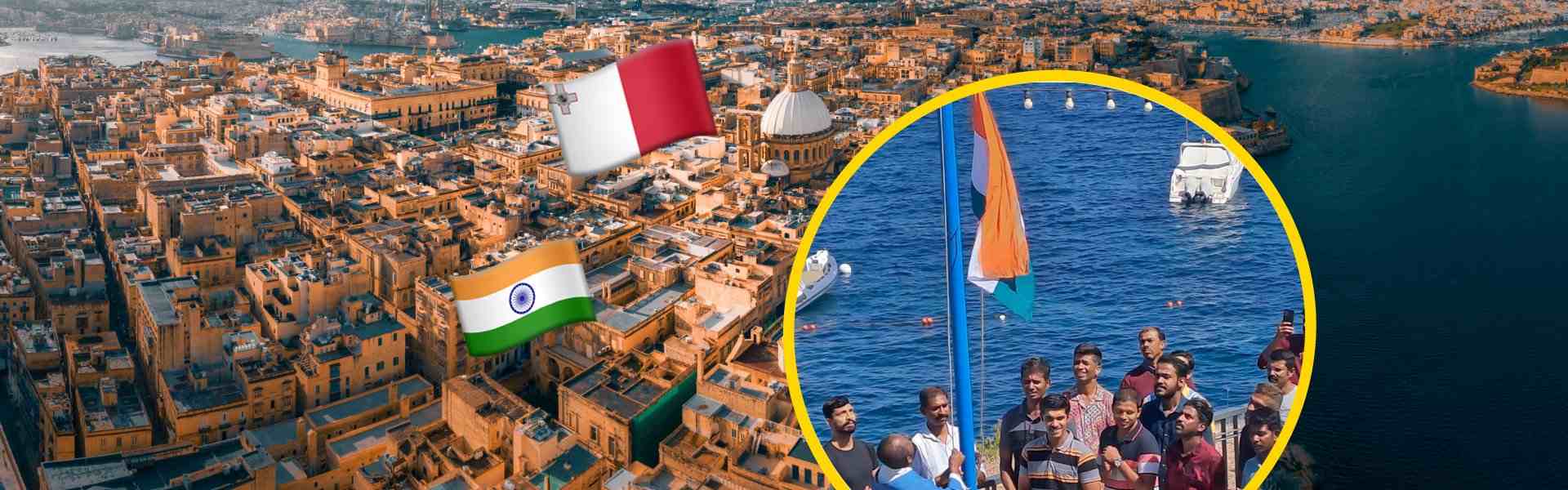
Malta's Indian community is really two stories, separated by a century and by almost everything else.
The first is the story of a small, remarkable, deeply-rooted community: the Hindu Sindhi merchants who began arriving from Hyderabad, then in British India, today in Pakistan, in the 1880s, and who built much of the textile and souvenir trade of Valletta's main shopping street. There are only around 45 of these families, but some have been in Malta for four or five generations. They are Maltese now, in culture as much as in passport.
The second is the story of a recent, much larger wave: the tens of thousands of Indian nationals, a large share of them from the southern state of Kerala, who since the 1990s, and especially in the last decade, have come to work in Malta's hospitals, hotels, restaurants, care homes, and many other sectors. By 2023, Indians had become the single largest foreign nationality in Malta's workforce.
This article tells both stories. For the history of the Sindhi community, it draws principally on the work of Professor Mark-Anthony Falzon of the University of Malta, a social anthropologist, life member of Clare Hall, Cambridge, and the author of Cosmopolitan Connections: The Sindhi Diaspora, 1860–2000 (2005) and The Sindhis (2022). His 2001 paper in the Bank of Valletta Review, 'Origins and establishment of the Indian business community in Malta', remains the foundational scholarly account, and almost everything reliable that has since been written about the Sindhis of Malta traces back to it.
Where They Came Grom: Sindh, Hyderabad, and the Sindwork trade
To understand how Hindu merchants from a city in present-day Pakistan ended up running the smartest shops in Valletta, you have to start with the British annexation of Sindh in 1843.
Sindh, the lower Indus valley, with Karachi as its great port, was annexed by the British East India Company under Sir Charles Napier in 1843. The historic Indian Maltese community derives specifically from the bhaiband jati (loosely, a sub-caste or 'type') of the Hindu Sindhi community of Hyderabad, a city in Sindh. After annexation, a group of Hyderabadi entrepreneurs began to seek opportunity across the wider British Empire.
Originally, they traded in the handicrafts of Sindh, embroidery, ornamental silks, lacquered and inlaid work, the distinctive products that came to be called 'Sind works'. Because of this, the merchants became known as 'Sindworkis', and the long-distance trade they practised as 'Sindwork'. This was, in the language of anthropology, a 'trade diaspora': a population movement centred entirely around commerce, in which young men were sent out from a home base to distant trading nodes and rotated back again, while the families and the capital remained anchored in Hyderabad.
Three pieces of nineteenth-century infrastructure made the Sindwork diaspora possible. The Suez Canal, opened in 1869, put the Mediterranean on the direct sea route between Britain and India. The telegraph allowed a firm in Hyderabad to coordinate shops thousands of miles apart. And the spread of railways moved goods and people across continents at unprecedented speed. By the 1860s, traders from Hyderabad had established businesses in places as far apart as Japan, Ceylon (Sri Lanka), the Gold Coast (Ghana), Gibraltar, and Hong Kong. Malta, a British naval fortress and a busy Mediterranean port of call, was a natural addition to the network.
Arrival in Malta: The Pohoomull Brothers and Strada Reale

The Sindhi trade diaspora reached Malta in the late nineteenth century, drawn by the growing flow of British and northern European tourists and servicemen through the Mediterranean, a profitable market for Sindhi handicrafts. In 1887, the firm Pohoomull Brothers applied to establish a shop in British-ruled Malta. This is the date from which the documented history of the Indian business community in Malta is conventionally counted.
The business grew quickly. By 1910, Malta had more than ten Sindhi firms. They concentrated on the high-end market along Valletta's central shopping thoroughfare, known successively as Strada Reale, then Kingsway, and today as Republic Street, supplemented by branch stores and by itinerant peddlers who carried goods directly to customers. As Falzon records the contemporary impression: from the moment a ship dropped anchor to the moment it left Malta, the visitor was constantly tempted by the Sindworkis' wares.
The product range was deliberately exotic and tuned to the tourist's eye. The firms traded silk and curiosities, and added imported goods from the Far East, Japanese ceramics, kimonos, and similar items. In a striking commercial twist, the Sindhi network also became a major channel for the export of Maltese lace: the Sindworkis sub-contracted and distributed Gozitan and Maltese hand-made lace through their global trade network, sending it as far afield as Java and South Africa. The Indian merchants, in other words, did not only sell Indian goods to Malta, they helped sell Maltese goods to the world.
The structure of these businesses was distinctive and demanding. The shops in Malta were local branches of a central firm in Hyderabad. Personnel, usually selected through ties of kinship, were sent out from Hyderabad to Malta for fixed periods of several years. Sindhi workies as young as 15 shared company-provided accommodation in Valletta or Floriana. Men could not bring their wives or other dependents. Working days could run up to 15 hours, with no weekends; employees were often treated as personal servants by the shop managers, and firms expected total loyalty. Socialisation outside the firm was discouraged. This was not, in its early decades, a settled immigrant community in the ordinary sense, it was a rotating commercial posting, far from home.
From Sojourners to Settlers: Depression, War, and Partition
Two things gradually turned this rotating trade posting into a permanent Maltese community: economic hardship, and the partition of India.
During the Great Depression of the 1930s, the Mediterranean tourist trade contracted, and many of the Sindhi parent-firms in Hyderabad reduced their investments in Malta. Rather than close the shops entirely, the firms often sold them to their own former employees, men already in Malta, willing to operate on smaller margins. In this way a number of the rotating branch-shops became permanently family-owned Maltese businesses, run by men who now had a personal stake in staying.
Indian soldiers also served in Malta under the British. The Ta' Braxia Cemetery in Pietà contains a memorial commemorating twenty-eight Indians who fought on behalf of the British in the First World War and died of injuries or disease in Malta. The bodies of thirteen British-Indian soldiers and seven men of the Labour Corps were cremated at the Lazzaretto on Manoel Island, a notable detail, given that cremation would not be legally available to Malta's Hindu community for another century.
The partition of India in 1947, which placed Hyderabad and Sindh inside the new state of Pakistan, and drove most Hindu Sindhis out of their homeland, might have been expected to send a wave of Sindhi refugees toward established diaspora nodes like Malta. It did not. Malta was considered too small to offer sufficient opportunity, and most displaced Sindhis went elsewhere. What partition did do was sever the Malta community's organisational link to Hyderabad. The shops could no longer be branches of a Hyderabad parent-firm, because the Hyderabad world the firms came from had effectively ceased to exist.
In response, the Sindhi traders of Malta formed the Indian Merchants' Association (Malta) in 1955, to provide the collective organisation that the link to Hyderabad had previously supplied. The association was, by Falzon's account, never very active, but its later history is revealing. In 1989 it was renamed the Maltese-Indian Community, a change of name that marked a profound shift: from a self-image as a community of Indian merchants temporarily resident in Malta, to a self-image as a permanent local ethnic-cultural group; Maltese people of Indian heritage.
The Closed Years: 1952 to 1985
One factor cemented the small, self-contained character of the historic Sindhi community: for more than three decades, Malta was effectively closed to new Indian immigration.
Between 1952 and 1985, strict Maltese immigration rules meant that, in practice, almost the only Indians who could move to Malta were men newly married to Maltese-Indian women, that is, men marrying into the existing community. There was no route for general Indian immigration. The effect was to freeze the historic community at a small size and to make it tightly inter-related: a few dozen families, intermarrying, running their shops, raising Maltese-born children, and slowly becoming as much a part of Valletta as the Maltese families around them.
Through the post-war decades, the Sindhi businesses adapted with notable commercial agility. After the Second World War, with Maltese society growing more affluent under continued British rule, the Sindhis came to dominate the textile trade. As the Maltese female workforce grew from the 1970s, the shops introduced ready-made clothing for the lower- and middle-price market, and used their trade networks to become wholesalers of cloth and textiles to Maltese retailers. The handful of firms still trading in curiosities moved, in the 1980s, into cheap electronics and into the souvenir trade serving the new mass tourism. By the end of the twentieth century, Sindhi businesses had diversified and integrated deeply into the Maltese economy. The Indian-owned textile shops that older Maltese readers will remember on Republic Street, names recalled with affection in the community's collective memory, were the visible face of this long commercial history.
The New Wave: Kerala, Healthcare, and the Largest Foreign Workforce nationality

From the 1990s onward, and with gathering speed in the 2010s and 2020s, a completely different Indian community took shape in Malta, one that has almost nothing to do with the historic Sindhi merchants except the country of origin.
This new wave is drawn substantially from Kerala, the southern Indian state with a long tradition of skilled emigration, and works principally in the health and hospitality sectors, although Indian nationals are now found across almost every part of the Maltese economy. Where the historic community was Hindu Sindhi from the northwest, this community is religiously and regionally diverse, with a large Malayali (Kerala) component that includes Christians, Hindus and Muslims. Since 2017, the Kerala community in Malta has celebrated the annual Onam harvest festival publicly and on a large scale.
The scale of this second wave dwarfs the historic community. Official figures released by the Finance Minister in answer to a parliamentary question showed that, as of July 2023, there were 13,158 Indian nationals registered as working in Malta, making India the single largest source country for foreign workers in Malta, ahead of Italy (11,566), the Philippines (9,560), Nepal (8,157) and the United Kingdom (5,144). At that time the Maltese economy employed almost 106,000 foreign workers in total, out of a population that has since passed 574,000.
These figures need careful reading, and we have been deliberately cautious with them. The 2021 Census recorded 6,972 people identifying as ethnically Indian, a different measure from the work-permit count, since it captures self-identified ethnicity (including Maltese-born people of Indian descent) rather than current foreign work registrations. The work-permit figure (13,158 in July 2023) and the census figure (6,972 in 2021) are measuring different things, and both are lower than some of the rounder numbers ('around 15,000', 'up to 30,000') that circulate in casual commentary and which we have not been able to source to any official release. What is beyond dispute is the direction: the Indian community in Malta has grown very rapidly, India is now the largest single foreign nationality in the workforce, and the total is several thousands once dependents and recently-naturalised citizens are included.
Faith, Festivals, and The Question of Recognition
Throughout both waves, the Indian community has maintained its religious and cultural traditions in Malta. The community organises celebrations of Diwali (the festival of lights), Holi (the spring festival of colour), Onam, and other Hindu festivals. For much of the historic community's life these were private, family-based celebrations; in recent decades, with the much larger new community, several have become large public events.
There is, however, a long-standing and genuine point of friction. Hinduism is not officially recognised as a religion in Malta. Malta has no Hindu temple. For most of the community's history, Malta also had no crematorium, which meant that deceased Hindus, Buddhists, Sikhs and Jains had to be buried under arrangements that did not accord with their religious practice, rather than cremated. In 2010, Maltese Hindus publicly sought intervention on the question of equal recognition for their religion. Cremation was finally legalised in Malta in 2019, however, cremation is still not being offered in Malta.
Two Communities, One Name

It is worth being clear, in closing, that 'the Indian community in Malta' is a single label covering two very different groups.
The first is the historic Sindhi community: Hindu merchants from Hyderabad, present in Malta since the 1880s, numbering only around 45 families today, deeply integrated, Maltese in culture and citizenship, and the authors of a commercial history that runs through the heart of Valletta's main street for well over a century. Many of these families are now in their fourth or fifth Maltese generation. They are, in every meaningful sense, Maltese.
The second is the recent, much larger and still-growing community of Indian nationals, substantially from Kerala, who have arrived since the 1990s to work across the Maltese economy, and who by 2023 had made India the largest single foreign nationality in the country's workforce. This community is at an earlier stage of the same journey the Sindhis travelled: from sojourners to settlers, from work-permit holders to, in time and for many of them, Maltese citizens raising Maltese-born children.
What links the two is a pattern as old as Malta itself. The islands have always been a meeting point, of Phoenician and Roman, Arab and Norman, Sicilian and Spanish, French and British. The Sindhi merchants who stepped off the ships in the 1880s, and the Keralan nurses who fly into Malta International Airport today, are part of the same long Maltese story: people who came across the sea to work, and stayed to belong.

About Dr Hillary Hopkins
Dr Hopkins is a Maltese lawyer, with a love for Malta's historic stories, forgotten corners, and little cultural rabbit holes.