The Maltese Who Came to Britain: Why Over 30,000 Maltese Settled in the UK After the War


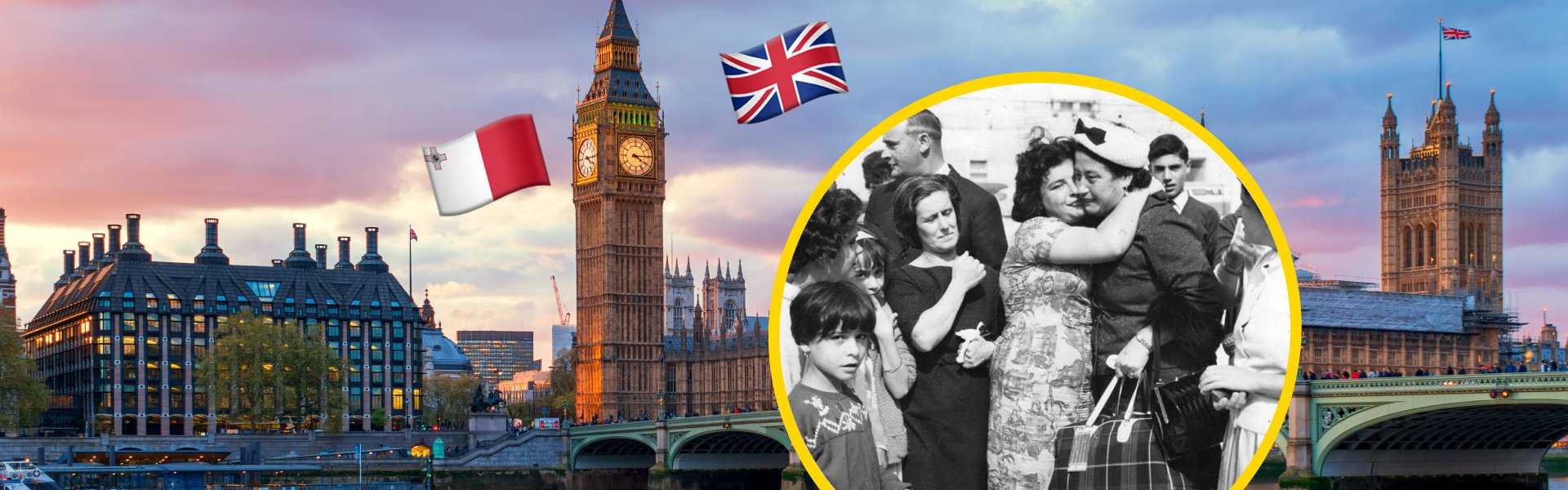
Between 1946 and 1996, 31,489 Maltese migrants left Malta for the United Kingdom. That figure, recorded by the Malta Emigration Museum from official Maltese government statistics, makes Britain the second-largest destination of the great post-war Maltese exodus, behind Australia and overall ahead of Canada and the United States.
Of those 31,489 Maltese who arrived in Britain, 12,659 eventually returned to Malta. Net migration to the UK across those fifty years was 18,830, a return rate of 40.2%, the highest of any major destination, almost twice the rate of return migration from Australia or Canada. By the 2001 UK Census, 30,178 people in the United Kingdom had been born in Malta. By the 2021 Census, the figure for England, Wales and Northern Ireland combined was 24,679, reflecting the natural decline of the original migrant generation.
These were not invented numbers. They are the official record of one of the most significant population movements in modern Maltese history. The people behind them, their reasons for leaving, the places they chose, the work they did, the institutions they built, the families they raised, are the second largest Maltese diaspora, the one that settled closer to home than the migrants who chose Australia and Canada, the one whose marks on British life are still visible today if you know where to look.
This is their story.
The Early Maltese in Britain: Cardiff, the Docks, and the Empire

Before the Second World War, there were very few Maltese in Britain. Drawing on Malta's Emigration Museum data, records that: 'prior to World War I, there were very few Maltese in the UK, except for a community in Cardiff.' The UK was seen by most Maltese as cold, distant and unappealing. Those who emigrated in the late nineteenth century and early twentieth century went overwhelmingly to North Africa, Algeria, Tunisia, and especially Egypt, where 20,000 Maltese were living by 1939, or to the United States, primarily the industrial cities of the Midwest.
The exception was the small community that established itself in the docks of Cardiff. By 1911, Cardiff's port was handling more coal than any other port in the world, and Butetown, also known by the local name Tiger Bay, had become one of Britain's earliest multi-ethnic communities, with people from over 50 different national backgrounds settled in its dock-adjacent streets. The Maltese were one of those communities. They were seamen, dock workers, kitchen porters, and the families they brought with them or formed there. Cardiff's status as the world's leading coal port made it natural for Maltese sailors working British merchant ships to come ashore there, and a small permanent community gradually formed.
Between 1919 and 1929, 3,354 Maltese sailed to the UK, with 1,445 of them subsequently returning. The remainder did not all stay in Britain; many were on their way to Australia and used Britain as a stopover. By 1932, 'a street adjoining Commercial Road in London was home to a Maltese community,' according to the Maltese-in-UK historical record. Most of these Maltese worked in London's docks. Similar smaller Maltese communities existed around the dockyards in Chatham and Portsmouth, the principal Royal Navy bases of southern England, where Maltese sailors discharged from British naval service or working in merchant shipping settled with their families.
In September 1944, while the war was still being fought, a hostel called the George Cross Club Hostel and Club for Maltese Seamen was built on a bomb site in Bute Street, Cardiff. The Imperial War Museums hold an official photograph of its opening, showing the British and Maltese flags side by side at the entrance, just two and a half years after the George Cross had been awarded to the people of Malta by King George VI in 1942. (The George Cross would appear on the Maltese national flag from December 1943 onwards, where it remains today.) The Cardiff hostel was for Maltese merchant seamen passing through the port; an institutional acknowledgement of how long the Maltese community had been part of Welsh dockland life.
Why They Came After the War: The Dockyard, the Population Pressure, and the Colonial Bond

The mass Maltese migration to Britain after 1945 had specific causes, and they were not romantic ones.
After the war, Malta was facing a demographic and economic emergency. The birth rate had increased significantly. The British dockyard at the Grand Harbour, the institution that had employed thousands of Maltese for more than a century, was facing major cutbacks. In March 1945, the Colonial Administration decreed that it would be illegal to offer even temporary jobs to those with other sources of income, because many young men were being released from the British Forces with no prospects for immediate employment. Between November 1947 and July 1948, 941 dockyard workers had been discharged or had left of their own accord. In August 1949 the Admiralty announced that 1,200 workers were to be dismissed. The British view in London was that Malta was a strategic base of the Empire with a population too heavy to support. Whitehall urged a solution to the double problem of over-population and unemployment.
The solution, as it had been after 1918, was mass-organised emigration. The Malta Emigration Department was established to organise the exodus. It assisted emigrants with the cost of their travel. It arranged for prospective migrants to be interviewed by British firms looking to fill labour shortages. It assisted with travel costs and organised passage. Between 1946 and the late 1970s, over 140,000 people left Malta through post-war organised or assisted emigration channels. 57.6% went to Australia. 22% went to the United Kingdom. 13% went to Canada. 7% went to the United States.
Why did one in five of those migrants choose Britain rather than Australia, where the assistance was more generous and the opportunities better-advertised? The answers were mostly practical:
First, proximity. The UK was three days by ship; Australia was six weeks. Maltese who left for Britain could realistically expect to return on holiday, to bring their families back occasionally, or to come home if things did not work out. The 40.2% return rate from Britain, nearly twice the return rate from Australia, reflects this practical reality. Britain was, for many Maltese, an emigration that did not entirely close the door home.
Second, the colonial bond. Malta had been a British Crown Colony since 1813. Before the Commonwealth Immigrants Act of 1962, there were virtually no restrictions on Maltese migration to the UK. Maltese were British subjects under the British Nationality Act of 1948. They needed no visa. They had the right to live and work in Britain. Many spoke English, they were Catholic, but the institutional channels for Catholic immigrants to Britain were well-established.
Third, specific labour demand. The Emigration Department arranged for British firms to interview prospective migrants in Malta. Hotels, restaurants, factories and the merchant shipping companies were short of labour. Maltese men were recruited as kitchen porters, waiters, factory hands and ship's crew. From 1962 onwards, Maltese women were also recruited, 70 of them in the first year, for six-month seasonal work in British fruit and vegetable canneries. By 1967–69, 250 Maltese women per year were going to the UK for seasonal work, mostly in canning, ice-cream manufacture, and hotel and catering, with the migration of female workers organised by the Emigrants' Commission of the Catholic Church in Malta.
The peak years of Maltese migration to Britain were 1947 (1,536 arrivals), 1955 (1,872) and 1964 (1,597). After 1975 the numbers fell sharply, and from 1975 the trend reversed: in that year, 1,572 Maltese returned to Malta from the UK, more than ten times the 254 who arrived. By the 1980s and 1990s, return migration substantially exceeded fresh migration, as the original generation reached retirement and many chose to come home.
Where they Settled: London, the Port Towns, and Cardiff

Where the post-war Maltese settled in Britain followed two main patterns: the continuation of existing dockland communities, and new urban settlements in inner London.
The Cardiff community continued. The Welsh capital remained one of the principal Maltese settlements in Britain through the 1960s and 70s. The novelist Trezza Azzopardi, born in Butetown in 1961 to a Welsh mother and Maltese father, won acclaim with her 2000 novel The Hiding Place, a tragedy about a Maltese family in 1960s Tiger Bay. It was shortlisted for the Booker Prize. It is one of the most direct contemporary literary records of the Cardiff Maltese experience.
The London East End community expanded. Maltese workers who had settled around Commercial Road before the war were joined by post-war arrivals. They worked in the docks, in the markets, in the kitchens of Lyons Corner Houses and other catering establishments, in factory work across the East End. The naval dockyards at Chatham and Portsmouth continued to host smaller Maltese communities into the 1960s and 70s.
New communities formed in inner and central London. One verifiable example: the Maltese Catholic Centre was founded in 1957 in Victoria, central London, by the Maltese Franciscan Province of St Paul the Apostle, which had been caring for Maltese migrants in Britain since 1952. The Centre had a resident Maltese chaplain. In 1993, the Franciscans moved from 22 St George's Drive to 1 Balniel Gate, Pimlico, London SW1V 3SD, where the Maltese Mission continues to be listed today. The Maltese Franciscans were also present in friaries in Manchester, Cardiff and London, reflecting the geographical spread of the Maltese community in the UK.
The Augustinian Sisters maintain St Monica's House at 83 Clapham Road, London SW9, partly serving the Maltese community. The Franciscan Sisters of the Heart of Jesus maintain a presence at 9 St George's Drive, London SW1V, running a hostel offering shelter to Maltese patients sent to London hospitals for treatment that is not available in Malta, a practice that continues to this day, with the President of Malta making annual visits to Maltese patients in London hospitals.
Other documented Maltese organisations in Britain include the Malta League (Biggin Hill, Kent), the Malta Charities Association (Richmond, Surrey), the Maltese Culture Movement (north London), the Maltese Community of East London (based at St Boniface Mission, Adler Street, E1), the Malta Study Circle (a philatelic society in north London), and the George Cross Island Association, which connects Britons whose families were on Malta during the wartime siege.
The Egyptian-Maltese Wave: 1956 and After

A second, smaller but significant wave of Maltese settled in Britain after 1956, and they were not coming directly from Malta.
They were the Maltese of Egypt, a community of around 20,000 people at its 1939 peak, most of them living in Alexandria, Cairo and the Suez Canal Zone, descendants of Maltese who had migrated to Egypt during the nineteenth century when the country had been a hub of European settlement and economic opportunity. Most were Catholic, many were British subjects on the strength of their Maltese parentage, and many spoke French or Italian rather than Maltese as their first language, a community sometimes described as Egyptian Franco-Maltese.
In the wake of the Suez Crisis of 1956, when Britain, France and Israel invaded Egypt in response to Egyptian President Gamal Abdel Nasser's nationalisation of the Suez Canal, Egypt expelled its British and French nationals. On the 26th of November 1956, the British Parliament was told that approximately 13,000 British subjects had been ordered to leave Egypt. They included people of UK origin, Cypriots, and Maltese. The properties of those expelled were seized by the Egyptian government.
What followed was, in the view of the historian Nicholas D. Chircop, one of the most painful episodes in modern Maltese history. The Maltese government, still concerned about over-population on the island, refused to accept the Egyptian Maltese refugees as Maltese citizens unless they had themselves been born on Malta. As the Levantine historian Michael Refalo has put it: second and subsequent generations of Maltese born in Egypt 'were British subjects on the strength of their Maltese parentage, but they were not Maltese on the strength of their own birth.' The Maltese Community Council of Victoria, summarising Chircop's research, records that those expelled 'were not even allowed to land in Malta and had to seek shelter mainly in Australia, Britain and France.'
The Egyptian-Maltese who came to Britain settled across the south-east. Many maintained their distinct identity from the migrants who had come directly from Malta, retaining the French, Italian or Arabic that had been their family languages. The Association of Maltese Communities of Egypt operates today from Enfield, Middlesex, a verifiable institutional record of a community that arrived under traumatic circumstances and has maintained its identity for nearly seventy years.
The Soho Story: the Chapter that Became Famous
The Maltese presence in post-war Britain is not entirely a story of catering work, dockyards and Catholic missions. There is another chapter, the one that journalists wrote about, the one that produced novels and films and a substantial true-crime literature, and an honest history of the Maltese in Britain has to acknowledge it.
The story has been documented in In the 1950s, 1960s and early 1970s, a small but visible minority of Maltese migrants became involved in the organised vice trade in London's Soho. The story has been documented in detail by journalist Matthew Vella in his 2022 book Passport to Vice, based on newspaper archives, court records and police material. It can be summarised in three phases.
First, the Messina Brothers: five brothers from a Sicilian-Maltese family with strong Malta links, who established a prostitution business in Soho from the 1930s. They took English names: Edward Marshal, Charles Maitland, Alfred Martin, Arthur Evans and Raymond Maynard. By the late 1940s, according to accounts of London crime history, they operated around thirty houses of prostitution and controlled an estimated 200 women. Scotland Yard's Superintendent Guy Mahon led the task force that broke them up. Eugenio, Carmelo, Salvatore and Attilio left England on the 19th of March 1951, while Alfredo was imprisoned. Salvatore later disappeared from the authorities' reach and was never apprehended.
Second, the Maltese Syndicate, which filled the vacuum the Messinas left. Its principal Maltese figure was Frank "Big Frank" Mifsud, a former Maltese traffic policeman who arrived in London in the 1950s and partnered with Bernie Silver, a Jewish East End-born associate. By the late 1960s, the Mifsud-Silver Syndicate was reported to control 19 of Soho's 24 strip clubs, with extensive property interests and prostitution operations.
Third, the 1974 prosecution. Silver and nine others, mostly Maltese, were charged with living off immoral earnings between 1955 and 1973. Mifsud fled and was detained in Switzerland. The trial led to the dismantling of the Syndicate and fed into the subsequent corruption trials of Metropolitan Police detectives who had been receiving bribes. Mifsud was later convicted of suborning perjury, jailed for five years and fined £50,000, before eventually returning to Malta, where he lived out his final years in Sliema.
This story matters because it is true and because it is small. Throughout the entire period of post-war Maltese migration to Britain, the number of Maltese involved in organised crime amounted to a few dozen named individuals among a community of tens of thousands. The vast majority of Maltese in Britain were dockyard workers, catering staff, factory workers, merchant seamen, hospital ancillary workers and the wives and children of British servicemen, ordinary working-class lives, in the main, that did not get written about. As the journalist Matthew Vella wrote, the Soho story is 'a chapter or two' in the broader history of the Maltese in Britain. But it is the chapter that became famous, and the chapter that has shaped how the wider community has sometimes been perceived.
What They Did, What They Built
Beyond the famous Soho story, the actual occupational pattern of the Maltese in Britain was documented across decades of records.
Maltese men, in the late 1940s and 1950s, came predominantly to fill labour shortages in: catering and hotel work; dockyards and merchant shipping; the construction industry; and factory work, particularly in the food-processing and light industrial sectors. Many initially took jobs as kitchen porters at Lyons Corner Houses and other large chain catering establishments, the working-class hospitality industry of post-war London, before moving on to other employment. Some served on British merchant ships, working their passage between Maltese and British ports.
Maltese women came in significant numbers from 1962 onwards, recruited specifically for seasonal work in canneries, ice-cream factories, and hotel and catering. The Emigrants' Commission of the Catholic Church in Malta organised the recruitment and the pastoral care. By 1967–69, 250 Maltese women per year were arriving in Britain for seasonal contracts.
It was also common, throughout the post-war decades, for Maltese women to marry British servicemen stationed in Malta during the long period of British military presence on the islands. These women often arrived in Britain not as labour migrants but as the wives of British personnel, a smaller but consistent stream of Maltese migration that was distinct from the assisted-passage workers. They settled across the country, wherever their husbands' postings took them. Many of the smaller and more dispersed Maltese communities in towns far from London or Cardiff trace back to this pattern.
The institutions the Maltese built in Britain reflect what mattered to them. The Maltese Mission in Pimlico still organises Sunday liturgies. The Franciscan Sisters at St George's Drive still provide shelter for Maltese patients sent to London hospitals, a function the Maltese government still relies on for specialised medical treatment that the island cannot provide. The Malta Charities Association supports Maltese organisations in Britain and in Malta. The George Cross Island Association connects Britons whose families lived through the wartime siege.
These are not the institutions of a community that imagined itself as transient. They are the institutions of a community that put down roots, raised children, sent some of its members home, kept others in the new country, and built something that lasted.
Why So Many Returned: The 40% Who Went Home
Of the 31,489 Maltese who arrived in Britain between 1945 and 1996, 12,659 went back. That is a return rate of 40.2%, the highest of any major destination, almost twice the return rate from Australia (21.6%) or Canada (24.2%).
This is a meaningful statistic. It tells us that, for two in every five Maltese who chose Britain, the migration was not permanent. Britain was where they worked, where they earned, where they raised some of their children, but it was not, in the end, where they intended to stay.
The reasons for the high return rate were several. Proximity made return practical, a flight or short ship journey home was within reach in a way that the return from Sydney or Melbourne was not. The climate was a factor; older Maltese coming back to Malta after decades in Britain often cited the cold, the grey skies, and the lack of sunshine as central reasons for their decision. The retirement years tipped many migrants toward returning to family, to a Maltese parish, to a familiar village. The high British cost of living from the 1970s onwards made retirement in Malta financially more comfortable than retirement in London.
There was also, after Maltese independence in 1964, the increasing political and emotional pull of the new Maltese state. The arrival of returning migrants from Britain peaked dramatically in 1975, the year before Malta's second decade of independence, with 1,572 Maltese returning from the UK against only 254 arriving. This was, for that single year, the largest return migration from Britain to Malta in the entire post-war period.
Many of those returnees brought with them children born in Britain, marriages with British partners, English fluency, professional skills acquired in British workplaces, and savings accumulated over decades. Their re-entry into Maltese life was sometimes uneasy. But it was, for the most part, a return that worked. The Maltese economy of the late 1970s and 1980s was changing rapidly, and the skills returning migrants brought home contributed to that change.
What is Left, What is Remembered
The 2021 UK Census recorded 24,679 Maltese-born residents in England, Wales and Northern Ireland. That figure is significantly down from the 30,178 of the 2001 Census, reflecting the natural ageing and decline of the original post-war migrant generation.
What is left, in 2026, of the second great post-war Maltese diaspora?
Institutionally: the Maltese Mission in Pimlico still operates. The Franciscan Sisters in Victoria still run their hostel. The Maltese Catholic communities in Cardiff and Manchester still gather for Mass. The Association of Maltese Communities of Egypt in Enfield still meets. The Malta League, the Malta Charities Association, and the George Cross Island Association continue their work. These are not vast organisations, the British Maltese community is smaller than the Australian or Canadian Maltese communities, but they exist, they are documented, and they continue.
Culturally: the Cardiff Maltese tradition has produced literature, Trezza Azzopardi's The Hiding Place being the most prominent example. The Soho story has produced a substantial true-crime literature and a 2022 historical investigation, Passport to Vice, by the Maltese journalist Matthew Vella. The London-based Maltese community has produced lawyers, doctors, journalists, business owners and clergy whose individual contributions are documented but whose collective story has been less told than it deserves to be.
Demographically: Malta's accession to the European Union on the 1st of May 2004 changed the migration pattern fundamentally. Maltese citizens now have the right to live and work anywhere in the EU and, until Brexit, anywhere in the UK without restriction. The post-Brexit position is more complex, but the substantial Maltese-British community established through Commonwealth migration remained. New Maltese arrivals after 2004 mostly went to Belgium and Luxembourg, working at EU institutions in Brussels, rather than to Britain.
The story of the post-war Maltese migration to Britain is therefore largely complete. The community is ageing. The original migrants are in their seventies and eighties. Their children, in many cases, are British in everything except surname. Their grandchildren are, with rare exceptions, British without qualification. The Maltese Mission still serves the older generation; the question of whether it will still serve a meaningful Anglo-Maltese community in 2050 is open.
31,489 people came. 12,659 went home. 18,830 stayed. Their descendants are now woven into the fabric of British life from Cardiff to Chatham to Pimlico, from Enfield to Manchester, from Portsmouth to the small towns where servicemen's wives raised families that became part of the local community. That is the second biggest Maltese diaspora. It deserves to be remembered with the same seriousness as the Maltese who went to Sydney or Toronto or Detroit.
This article is a small attempt to give it that.

About Matthew Gollcher
Hi, I'm Matthew, an SEO Specialist and Content Writer at Yellow Pages Malta. I'm passionate about creating meaningful content and exploring AI's creative possibilities. When I'm not working, I enjoy the gym, time with friends, watching series and reading, and playing guitar. I'm always eager to learn and grow both personally and professionally.