The Maltese Who Chose Canada: Little Malta, a Toronto Street, and 40,000 Descendants


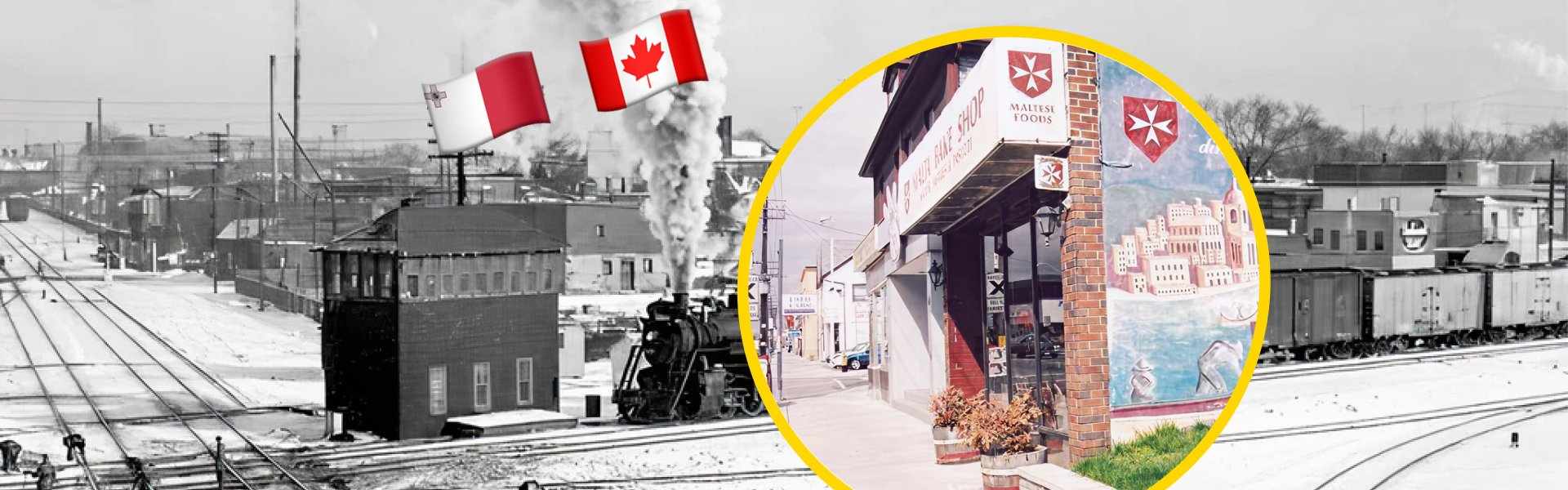
There is a street in Toronto where you can still walk into a bakery and order pastizzi. Where the church on the corner was built by Maltese hands, paid for with Maltese money, and has been hearing confession in Maltese since 1930. Where a small park is named after the island. Where the street signs, in two languages, announce that you have arrived somewhere specific: Little Malta.
Most people know that tens of thousands of Maltese sailed for Australia in the post-war decades. What is less told is the parallel story; the Maltese who turned not south and east, but west and north, into the cold, and built something just as remarkable in Toronto's West Junction.
There are today over 40,000 Canadians of Maltese ancestry. The community has been in Toronto since the early 20th century. It sent money home to Malta during the Blitz. It built a church before the post-war wave even arrived. And when the ships did come, the community was already there, waiting.
This is the story of why thousands of Maltese chose Canada, what they built when they got there, and why it still exists today.
The Man Who Got There First: A Shipbuilder From Senglea

Before there was a Little Malta, before post-war quotas and assisted passages, before the dockyard had begun its long contraction, a young man from Senglea arrived in Canada and became part of its history.
Louis Shickluna was born in Senglea on the 16th of June 1808, into a family with shipbuilding in its blood. He started work in the Royal Navy's shipyard in Valletta at the age of eleven. When the island's economy tightened and opportunity dried up, he left, the same calculation that would drive tens of thousands of Maltese over the century that followed. By 1835 he was building ships in Youngstown, New York. In 1838 he leased a shipyard on the Welland Canal at St. Catharines, Ontario, and purchased it outright in 1845.

What followed was one of the most impressive careers in Canadian maritime history. Between 1838 and his death in 1880, Shickluna's yard produced over 140 schooners, barkentines, steamers and other vessels for service on the Great Lakes. At its peak the yard stretched more than half a mile along the canal, employed over 300 men, many of them escaped slaves who had reached Canada via the Underground Railroad, and was arguably the finest shipbuilding operation on the entire Great Lakes system. He even named one of his ships Malta, launched in 1853. The Canadian Encyclopedia calls him simply 'perhaps the greatest 19th-century shipbuilder on the Great Lakes in Canada.'
Shickluna died in St. Catharines on the 24th of April 1880. His nephew Salvu Shickluna later operated a related yard in Port Colborne, employing workers brought directly from Malta, one of the earliest documented professional networks between Malta and Canada. Louis is commemorated today by a Heritage Ontario plaque and an active archaeological dig at the former yard site on Twelve Mile Creek that has already recovered more than 2,000 artefacts. He was the first Maltese to leave a mark on Canada. He would not be the last.
How Toronto Became Little Malta

The first Maltese families arrived in Toronto in the late 19th century. By 1916, some 200 Maltese had established themselves in two distinct communities, one around Dundas and McCaul Streets in the downtown, the other here in the West Toronto Junction, near present-day Malta Park, drawn by the meat-packing factories beside the Union Stock Yards and by work on the railway lines that gave the neighbourhood its name.
They were devout Catholics. They found English-speaking parishes and attended Mass. But something was missing: there was nobody to hear their confession in Maltese. When Maltese-speaking priests visited Toronto in the interwar years, they found themselves listening to several years' worth of accumulated confessions from people who had carried their sins in silence because they could not express them in any other language. The priests went home resolved that something had to change.
In September of 1922, five men met in a house on Simcoe Street, John Zammit, Joseph Vassallo Sr., Anthony Scicluna, Emmanuel Borg and Anthony DeBatisse, and founded the Maltese-Canadian Society of Toronto (MCST), the oldest Maltese organisation in North America. Their purpose was singular: build a Maltese church. They collected funds across the community, purchased land in the Junction, and in 1930 opened St. Paul the Apostle Church on Dundas Street West, one of the first Maltese churches in North America. For years the MCST was known simply as il-Kaźin tal-Knisja, the club of the church. The names of its founders and benefactors remain visible today, carved into a stone slab at the church entrance.
The church is run by the Missionary Society of St. Paul, who have served the parish since it opened. Fr. Lawrence Bonavia, a Franciscan friar, is long remembered as the driving force behind the expanded 1956 building, which was needed to accommodate the post-war immigration surge. He became a life member of the MCST.
By 1934, the Maltese community was visible and proud enough to enter a float in Toronto's centenary parade. The MCST's Knights of Malta Committee won first prize. The trophy sits today in the St. Paul's convent. The Maltese had been in Toronto for barely two decades as an organised community, and they had already outshone everyone else in the city's own celebration.

Not everything about Maltese Toronto was in the Junction. Just steps from St. Michael's Cathedral at 200 Church Street, Our Lady's Chapel was designed by Maltese-Canadian architect John Farrugia, and a large Maltese cross is embedded at the main entrance of the Cathedral itself. Malta left its mark on the city in stone, not just in memory.
The Wartime Bond: Canada's Gesture of Thanks

When the Second World War came, the Maltese in Toronto did not stand apart from it. The Malta Relief Fund, run by the MCST under president Angelo Cutajar, raised thousands of dollars from Maltese communities across all of Canada and sent supplies and money back to the besieged island. While Malta endured over 3,000 Axis air raids, her people in Toronto were doing what they could from the other side of the world.
Canada noticed. After the war, the Canadian government offered something that distinguished the Canada route from all others: on 1 March 1948, an agreement was reached to admit 500 Maltese men to Canada, described explicitly in government documents as 'a gesture of thanks' for Malta's wartime contributions. The Maltese had not just applied for entry. They had earned their welcome.

Migrants committed to two years of work. The scheme expanded in 1949–50 to admit 300 skilled workers at 50 per month from April 1950, placed directly by Canada's Department of Labour. The assisted passage fare was around $40 per person. The result: 1,607 Maltese arrived in Canada in 1951 alone, the peak single year. By 1960, nearly 9,000 had come. In total, approximately 18,000 Maltese emigrated to Canada between 1946 and 1981.
The Cold They Were Never Warned About

Australia had its shock of arrival, vast distances, relentless heat, the strangeness of an entirely different world. Canada's shock was more immediate: it was cold. Not Maltese-winter cold, which is brief and mild. Canadian cold: months of it, dark mornings, snow from November to April, temperatures that bore no resemblance to anything a person from Qormi or Żebbuġ had ever experienced.
But the Junction softened the blow. Unlike in Sydney or Melbourne, where the post-war arrivals had to build community institutions from the ground up, in Toronto the scaffolding was already in place. There was a church. There was a society. There were Maltese neighbours who had been there for decades and could tell you which factory was hiring, how the welfare system worked, where to find Maltese food. The 1956 expansion of St. Paul's, a new building on the same Dundas Street site, with a rectory and auditorium added four years later, was not the founding of a community. It was a community growing into itself.
Smaller communities formed in Montreal, London, Windsor, Hamilton, Guelph and Vancouver. London, Ontario in particular grew into the second-largest Maltese community in Canada after Toronto and remains today the only community outside the Greater Toronto Area with its own dedicated Maltese club building, at 70 Charterhouse Crescent. This was a direct result of the March 1948 agreement: before it, London's Maltese population was virtually zero. After it, the London area became a significant destination for incoming workers.
Little Malta: what Dundas Street became

Walk along Dundas Street West today between Keele Street and Runnymede Road and you are walking through what Toronto now officially recognises as Little Malta. The street signs say it. Malta Park, at St. John's Road and Dundas Street West, was named by the City of Toronto in recognition of the Maltese contribution to the neighbourhood. Heritage Toronto has placed a commemorative plaque on the site.

At its peak the strip had everything a Maltese family needed without leaving the neighbourhood. The Malta Bake Shop at 3256 Dundas Street West served hot pastizzi, tumpana and ftira, the flat Maltese bread topped with potatoes, anchovies, peppers and capers. The Buskett Bakery at 3029 Dundas Street West took its name from Malta's only forest. Travel agencies, real estate firms, restaurants and community clubs lined the street. On West Toronto's soccer fields, the Melita Soccer Club, active for over two decades, brought the community together around the sport Malta has always loved.
The Malta Band Club, formed in 1971, became one of the most visible institutions of Maltese-Canadian life, performing Maltese marches in High Park, leading parades, keeping the sound of the festa alive in a Canadian city. In the community's fiftieth anniversary year of 1972, thousands of Maltese-Canadians converged on the Junction for a spectacular parade. Marching bands. Festive floats. Clubs from across Ontario participating. It was the moment the community showed Toronto, and itself, what it had become.

The Maltese feasts of the liturgical calendar were transplanted whole. The Feast of St. Paul the Apostle on the 10th of February. Freedom Day on the 31st of March. The Feast of Our Lady of Sorrows in April, with statues carried outside St. Paul's in solemn procession. L-Imnarja on the 29th of June. Our Lady of Victory on the 8th of September. Independence Day on the 21st of September. Republic Day on the 13th of December. Christmas midnight Mass at St. Paul's. The Maltese calendar followed the community across the Atlantic and planted itself in the Canadian year.
The Numbers: 40,000 Canadians of Maltese Blood
Canada received around 13% of all Maltese assisted-passage emigrants between 1946 and the late 1970s, the third-largest share after Australia (57.6%) and the United Kingdom (22%). Approximately 18,000 Maltese emigrated to Canada between 1946 and 1981. The 2021 Canadian Census recorded 40,670 Canadians claiming full or partial Maltese ancestry, up from 37,120 in 2006. Of those, around 18,680 live in the Toronto area, making it the largest concentration of Maltese-origin people anywhere outside Malta itself.
The community has produced people who have shaped Canada. Charmaine Borg, of Maltese descent, became a Member of Parliament in 2011 at just 20 years old, representing Terrebonne–Blainville for the NDP, one of the youngest MPs in Canadian history. John Farrugia, the architect who designed Our Lady's Chapel in St. Michael's Cathedral, left a literal cross in stone at the heart of one of Canada's most significant Catholic buildings. Louis Shickluna built the ships that opened up the Great Lakes. The community he never lived to see built everything else.

The migration slowdown tells its own story. Between 1981 and 1996, only 991 Maltese arrived in Canada while 1,642 returned to Malta, a net outflow. By 1995, total Maltese overseas departures had fallen to just 107 people worldwide. Malta's accession to the European Union in 2004 removed most of the economic pressure that had driven emigration. The ships stopped sailing. The safety valve was no longer needed.
What Survived in the Cold
The Maltese language held longer in Toronto than many expected. Mass in Maltese, confession in Maltese, weddings and funerals in Maltese: the sacraments that had been the original reason for building the church in the first place continued across generations. Maltese Heritage Language classes were taught at St. Paul's itself, run by the Maltese Heritage Class Parents and Teachers Association, ensuring the language was passed deliberately rather than just overheard.
The pastizzi survived. The banda survived. The football survived. And the Maltese-Canadian Society of Toronto, founded in that house on Simcoe Street in 1922, the oldest Maltese organisation in North America, survived everything: two world wars, the great immigration wave of the 1950s, a difficult period of mismanagement in the mid-1970s, and its own sixtieth anniversary in 1982 when over 600 people gathered for an evening that somehow combined a Miss Malta pageant with a birthday party. A Wintario grant funded a sixtieth anniversary publication documenting the whole extraordinary run.
What contracted, naturally, was the tight geographic concentration. As prosperity arrived, Maltese families spread to Mississauga and the broader Toronto suburbs. The strip on Dundas Street is smaller than it was at its 1960s peak. Some of the old businesses are gone. But the church is still open. The Missionary Society of St. Paul is still there. Malta Park still carries the name. The Little Malta street signs went up in the 1990s and are still standing.
Canada and Australia: The Same Decision, a Different Place
The Maltese who went to Australia and the Maltese who went to Canada made the same fundamental decision: the island they loved could not hold them, so they would build Malta somewhere else. The same dockyard collapse. The same Emigrants' Commission. The same one suitcase, the same rosary beads, the same determination to find work and raise children somewhere better.
But the Canadian story has its own texture. The community was older, already built, already rooted, with a church and a society in place before the post-war wave arrived. The wartime gratitude quota gave Canada's welcome a moral weight that no other destination could claim. And the cold, the Canadian winter that no amount of preparation fully readies you for, became its own shared experience, a conversational landmark for every Maltese family that made the crossing. "Remember the first winter?" became a question with a universal answer.
Louis Shickluna left Senglea in the early 19th century and became the greatest shipbuilder on the Canadian Great Lakes. He named one of his ships Malta and built her in 1853 on a canal in Ontario. The men and women who followed him a century later left Żebbuġ and Birkirkara and Żejtun and became something else entirely: Maltese-Canadians, a hyphenated identity that managed to be fully both things at once.
If your family is part of this story, if your grandparents or great-grandparents came through the Junction, attended St. Paul's, worked the Toronto factories or the Windsor border, or settled in London or Hamilton, tell us about them in the comments. These are the stories that deserve to be told.

About Matthew Gollcher
Hi, I'm Matthew, an SEO Specialist and Content Writer at Yellow Pages Malta. I'm passionate about creating meaningful content and exploring AI's creative possibilities. When I'm not working, I enjoy the gym, time with friends, watching series and reading, and playing guitar. I'm always eager to learn and grow both personally and professionally.