Why Did 100,000 Maltese Leave? The Ships, the Suitcases, and the Promise of Australia


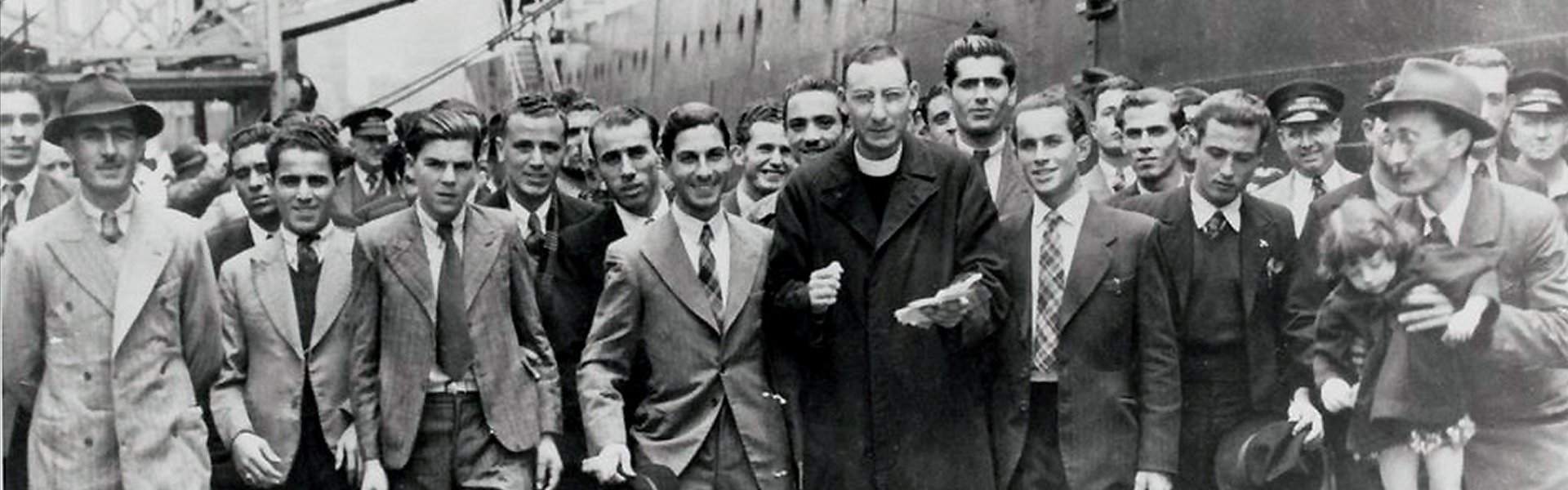
Somewhere in your family, there may be a photograph you have seen so many times it has become part of how you understand yourself. A black-and-white image of people standing on a dock, or leaning over the railing of a ship, waving at someone the camera cannot see. The clothes are from another era. The faces are recognisable. And behind them, pulling away from the quay at Grand Harbour, is the reason why you, or your parents, or your grandparents, grew up somewhere that was not Malta.
Between 1948 and 1967, net emigration from Malta was equivalent to roughly 30% of the island's entire population. In the years of the scheme's peak, more than 8,000 Maltese left in a single year. Over three decades from 1946, more than 140,000 people departed on assisted passages, over half of them bound for Australia. The island had a population of barely 300,000. It sent away almost half that number. And it did so in relative silence, because emigration was not a scandal but a necessity, not a failure but the only door that was open.
This is the story of why they went, what the journey was like, and what they built when they arrived.
Why They Left: The Dockyard, The Rubble, and No Other Option

To understand the emigration, you have to stand in post-war Valletta. Malta had survived more than 3,000 Axis air raids. The Three Cities, which surrounded the Grand Harbour and housed the workers of His Majesty's Naval Dockyard, had been reduced largely to rubble. And it was the dockyard that held everything together, or had, until it started contracting.

At its wartime peak, the dockyard had employed around 30,000 Maltese. By the early 1950s that figure had fallen to somewhere between 11,000 and 14,000, and the direction was unmistakably downward. Between November of 1947 and July of 1948 alone, 941 dockyard workers were discharged. In August of 1949 the Admiralty announced another 1,200 dismissals. In June of 1947, water was so scarce that the Royal Navy had shipped 6,000 tons of it from Portsmouth on a naval tanker.
Malta in 1946 had a literacy rate of 63%. It had no natural resources. It had a birth rate that kept climbing. And it had a British colonial government that, working with the elected Maltese administration, adopted an official policy: the island needed to export at least 12,000 people per year to keep the economy from collapsing under its own weight.
Both Dom Mintoff's Labour and Ġorġ Borġ Olivier's Nationalists agreed that emigration was unavoidable. The 1956 Suez Crisis accelerated the decline by stripping Malta of much of its remaining strategic value to Britain. By 1958, riots were breaking out over the dockyard cuts. In 1959, Britain revoked Malta's constitution and handed the dockyard to a Welsh civilian contractor, C. H. Bailey. The British military base finally closed on the 31st of March 1979.
The Maltese government established the Emigrants' Commission (Kummissjoni Emigranti) in 1950, working under the umbrella of Malta Catholic Action and the direct authority of Archbishop Mikiel Gonzi. Vocational training centres opened in Rabat, Mosta, Ħamrun, Sliema, Floriana, Żabbar and Paola, teaching motor mechanics, welding, plumbing, electrical work and more, the trades Australia was asking for. Mgr Philip Calleja, appointed National Director in 1958, devoted the rest of his life to the Commission's work, and Dar l-Emigrant on Castille Place in Valletta opened on the 3rd of December 1972 as a permanent home for the project.
The phrase many Maltese families would use to describe what happened was il-valv tas-sigurtà, the safety valve. It was not chosen lightly. The Government emigration report for 1954 noted that in the preceding years, the number of men who had emigrated equalled roughly one third of Malta's entire male working population. Husbands went first. Wives and children followed, sometimes years later. It did not feel like opportunity. It felt like the only door that was open.
Why Australia Wanted Them: Populate or Perish

On the other side of the world, Australia had emerged from the Pacific War with a population of 7.4 million and a genuine fear of invasion from the north. Arthur Calwell, Australia's first Minister for Immigration, appointed in July 1945, turned that fear into policy. His slogan was blunt: 'populate or perish.' His target was 1% annual population growth through immigration. His problem was that Britain alone could not supply enough people.
The Maltese were attractive in ways other nationalities were not. They were British subjects by birth, making them legally straightforward under the White Australia Policy. They were Catholic, which suited Australia's powerful Irish-Catholic bloc. They spoke serviceable English from colonial schooling. And their dockyard had trained precisely the tradesmen, carpenters, plumbers, fitters, riggers, electricians, that post-war Australia needed for its factories, dams and construction projects.
On the 31st of May 1948, Calwell and the Maltese Boffa government signed the Malta–Australia Assisted Passage Agreement, the first such agreement Australia had made with any country other than Britain. The terms were designed to be life-changing: adults paid £10 for their passage. Juveniles aged 14 to 19 paid £5. Children under 14 sailed free. The Australian and Maltese governments split the remaining cost. Social service, health, unemployment and maternity benefits were available from day one of arrival.
But acceptance had not always been the case. In October of 1916, a ship docked in Melbourne carrying 214 Maltese labourers at the precise moment Billy Hughes was fighting his conscription referendum. The Australian Workers' Union branded them 'coloured job jumpers.' Officials administered the Dictation Test in Dutch, a language nobody aboard spoke and all 214 failed. The men were detained, rerouted, and eventually released by March 1917. In Maltese memory they remain it-tfal ta' Billy Hughes, Billy Hughes's children. The 1948 agreement was the formal closing of that chapter.
The Ships: Four Weeks at Sea With One Suitcase

No object carries the memory of Maltese emigration like the ships. And no ship carries it like the SS Asturias.
Built by Harland & Wolff in Belfast and launched on the 7th of July 1925, the Asturias was at her launch the largest motor ship in the world, 22,071 gross tons, 655 feet from stem to stern. Torpedoed off Freetown in 1943, rebuilt after the war and refitted as an austere one-class migrant carrier, she made her first Malta voyage on the 20th of November 1947 and began regular service on the 23rd of April 1948. Between 1948 and August 1952 she made fifteen Malta–Australia voyages, carrying some of the earliest assisted migrants south, including a shipwright named Anthony Grima, who boarded on the 15th of July 1948 and stepped onto Station Pier, Melbourne, on his twenty-third birthday, the 10th of August 1948. His mother had been too distraught to come to the wharf to say goodbye.
The Asturias is the most famous, but not the most prolific. That record belongs to Flotta Lauro's SS Sydney, which made 39 Malta–Australia voyages between December 1951 and February 1966. The Lloyd Triestino trio of the Australia, Oceania and Neptunia, Sitmar's Castel Felice and Fairsea, the Cogedar Line's Aurelia and Flaminia, and later the P&O flagship Canberra all carried Maltese families. Between 1949 and 1982, 46,644 Maltese used the assisted passage scheme, rising to over 63,000 when dependants are counted.
The voyage took roughly four weeks via the Suez Canal, Port Said, Aden, Colombo, Fremantle, Adelaide, Melbourne's Station Pier, Sydney. When the Canal was closed during the Suez Crisis of 1956–57 and again from June 1967 to June 1975 after the Six-Day War, the route went via the Cape of Good Hope and took five to six weeks. Migrants were permitted £6 in currency plus up to £10 in other currency on board. One migrant who sailed in 1955 recalled Colombo to Melbourne's Museums Victoria: 'We were overwhelmed at the wharf by an all-pervading, enveloping aroma, which we discovered once on shore to be the smell of curries, from one of these we tasted real fresh coconut for the first time.'
What went into the suitcases is its own inventory of a life. Clothing, bed linen, rosaries, Madonna statues, photograph albums, family Bibles, tools of trade, Maltese lace, a single toy per child. The November 1949 voyage of the Columbia was particularly grim: she carried a record 1,075 Maltese, but three babies died en route and the ship was denounced in the Maltese Legislative Assembly as unsatisfactory. The Sitmar liner Skaubryn caught fire in the Indian Ocean on the 31st of March 1958. A four-year-old Maltese girl named Carmen Calleya-Capp was aboard with her parents, grandmother and aunts. Children were hoisted to the rescue ship in cargo nets. Carmen's family later recalled: 'We lost everything when the ship went down. My mother lost her jewellery, including her wedding ring and her treasured sewing machine. My father lost his tool set.' They eventually reached Station Pier on the P&O liner Orsova.
The departure scenes from Grand Harbour became their own genre. In every account, there are handkerchiefs. There is somebody who could not come to the dock because the grief was too much. There is somebody waving from the ship who does not know yet that they will not be back for twenty years, or forty, or ever.
What they found: Sunshine, Pendle Hill, and starting again

The first stop for most assisted migrants was a hostel. Bonegilla, near Wodonga, processed over 300,000 migrants between 1947 and 1971 in corrugated-iron huts that initially separated even married couples. In New South Wales, Maltese passed through Bathurst, Scheyville and Villawood. English skills helped but did not prevent being classified as general labourers regardless of the trade certificate earned in Rabat or Ħamrun.

Then came the suburbs. In Melbourne, Maltese filled the industrial west: Sunshine, St Albans, Albion, Brooklyn, Altona, Footscray, Broadmeadows, where the great H. V. McKay Sunshine Harvester Works (later Massey Ferguson) and dozens of smaller factories were hiring. In Sydney, the community formed around the Pendle Hill / Greystanes / Blacktown / Horsley Park / Smithfield belt in the west, where Maltese families, working alongside Italians, became the market gardeners of the Sydney basin. Llandilo, in outer western Sydney, recorded the highest proportion of Maltese ancestry anywhere in Australia at 27.9% in the 2021 census. In Queensland, the Maltese story reaches further back: the first organised group of 70 Maltese cane labourers arrived in Mackay in 1883.
What followed was the rapid construction of an alternative Malta. The Maltese Community Council of Victoria was founded on the 6th of July 1958 at St Mary's Mission House in Parkville. The Maltese Community Council of NSW followed in 1967. The La Valette Social Centre opened at Blacktown in October 1964. The Maltese Historical Association was founded in January 1987. The Maltese Herald newspaper launched on the 28the of July 1961 from Merrylands. SBS Maltese radio began on the 9th of June 1975 and continues today.

The Missionary Society of St Paul (MSSP), founded in Malta in 1910 expressly to accompany emigrants, sent some fifty priests to Australia. Parishes like Our Lady of Victories in Horsley Park (blessed in November 1961) and Our Lady Queen of Peace in Greystanes became the anchors of community life. The Good Friday procession at Horsley Park, revived in 1986 with statues imported from Malta, still draws 200 volunteers. The festa of Our Lady Queen of Peace at Greystanes has been celebrated every October since 1965.
There was also a wound in this story that took decades to acknowledge. Between 1950 and 1965, under a Catholic child-migration scheme, 259 Maltese boys and 51 Maltese girls were sent alone to institutions in Western and South Australia, many to Christian Brothers homes. Many were exploited, their education interrupted, their Maltese lost. Their story was eventually folded into the Forgotten Australians inquiry.
The Maltese Who Came the Long Way Round: Egypt and the Suez Crisis
The laqam tradition survives most robustly in Gozo. The island's fourteen villages are small enough that nearly everyone knows nearly everyone, and the combination of very common surnames, Vella, Attard, Camilleri, Grech, Portelli as the top five, with close-knit, not all of Australia's Maltese came straight from Malta. A distinct and less-remembered stream reached Australia via Egypt. By 1939 as many as 20,000 Maltese lived in Egypt, in Alexandria, Cairo, Suez, Port Said and along the Canal Zone, descended from workers on the Suez Canal construction of the 1860s and from traders, interpreters and administrators. They held British passports.
When the Anglo-French-Israeli action of October–November 1956 triggered Nasser's expulsion of British and French nationals, approximately 13,000 British subjects, including Maltese and Cypriots, were expelled with a maximum of £20 each, according to a Hansard record of the 26th of November 1956. Most went first to Britain; a significant number re-emigrated to Australia through the 1960s, arriving with a cosmopolitan sensibility, French-speaking, Italian-reading, urban and middle-class, that set them apart from village migrants coming directly from Gozo or Żejtun.
1954: The Year 8,470 Maltese Packed Their Bags
The single most extraordinary year in the emigration story is 1954. The Malta Government Emigration Report for that year recorded that 8,470 Maltese emigrated to Australia in those twelve months alone, a number equivalent to a substantial Maltese town simply ceasing to exist. Cumulative emigration from 1946 to 1954 stood at 49,758 people: 26,085 men, 10,659 women, 13,014 children. The report noted, with characteristic British understatement, that the number of emigrating men equalled roughly one third of Malta's entire gainfully-occupied male population.
The 2021 Australian Census recorded 35,413 Malta-born residents and 198,989 people of Maltese ancestry, a community almost two-thirds the size of Malta's current population living on the other side of the world. The peak of Malta-born residents in Australia was over 56,000 in the 1980s; the decline since then reflects an ageing first generation, three-quarters of whom are now over 65.
What Survived: Pastizzi, Festa, Language, and The Laqam

Language is the clearest test of survival. In 2021, around 27,000 people spoke Maltese at home in Australia, down from 34,000 a decade earlier. The language is retreating generation by generation. Ritual, however, has proven more durable. The Good Friday procession at Horsley Park, the Santa Marija festa at Doonside, L-Imnarja at La Valette, Our Lady of Victories at Camberwell and Horsley Park, these continue.
Pastizzi, perhaps the most portable piece of Maltese identity, have crossed every boundary. The Borg family's Handmade Pastizzi in Melbourne, Gatos Pastizzi in Carramar, the Pastizzi Cafe in Sydney's Newtown, the Original Maltese Pastizzi Co. in Sunshine North: a diaspora held together by ricotta and flaky pastry.
The laqam, the family nickname that in Malta told you everything about where someone came from and who their ancestors were, persists inside older families but rarely crosses into a third generation. The village community that made the laqam necessary is harder to maintain in Blacktown than in Żejtun. But many families still know it and still use it.
The Maltese-Australian community has produced figures who have made their mark on Australian life. John Aquilina AM, who arrived aged six in 1956, became NSW Speaker and Minister for Education. Tony Zappia has represented the South Australian electorate of Makin in Canberra since 2007. The comedian Shaun Micallef is Maltese by descent. So is the musician Joe Camilleri of The Black Sorrows. The novelist Lou Drofenik, whose family sailed from Malta and whose work explores the migrant experience, won Malta's National Book Council Award in 2008. The historian Dr Barry York OAM, whose Maltese father changed his name from Loreto Meilak after the war, has spent decades documenting the community he grew up in.
The Promise Kept
The statistics are extraordinary enough on their own. A nation of barely 300,000 people sent more than 100,000 of its children to the other side of the world and, through them, built something almost as populous as itself in Sunshine, Greystanes, Llandilo, Horsley Park and Melton.
Many of those who left said they were going għal ftit snin biss, just for a few years. Most never came back or returned only as visitors decades later to find an island they recognised but could no longer fully enter. Remittances kept Maltese villages running through the 1950s and 1960s. Cassette tapes of family news recorded in Żejtun kitchens played in Sunshine kitchens. Mgr Philip Calleja kept Dar l-Emigrant open to returning expatriates for half a century, until his death in 2022 at the age of 93.
What the era reveals, looking back, is that Maltese emigration was not a failure of the island but a wager on its future. Malta modernised, industrialised, joined the European Union, and became the nation that now receives migrants rather than supplies them. The promise of Australia, work, stability, a future for the children, was kept, on both sides of the ledger.
Every festa in Horsley Park, every batch of pastizzi in Brimbank, every Maltese passport claimed in Sydney by someone's Australian-born grandchild is evidence that the ships of the 1950s never fully docked. They are still arriving, in reverse, one generation at a time.
Do you have family who made this journey? Tell us their story in the comments.

About Matthew Gollcher
Hi, I'm Matthew, an SEO Specialist and Content Writer at Yellow Pages Malta. I'm passionate about creating meaningful content and exploring AI's creative possibilities. When I'm not working, I enjoy the gym, time with friends, watching series and reading, and playing guitar. I'm always eager to learn and grow both personally and professionally.