Why Malta Has So Many Churches and What They Mean to Locals


Why Malta Has So Many Churches and What They Mean to Locals
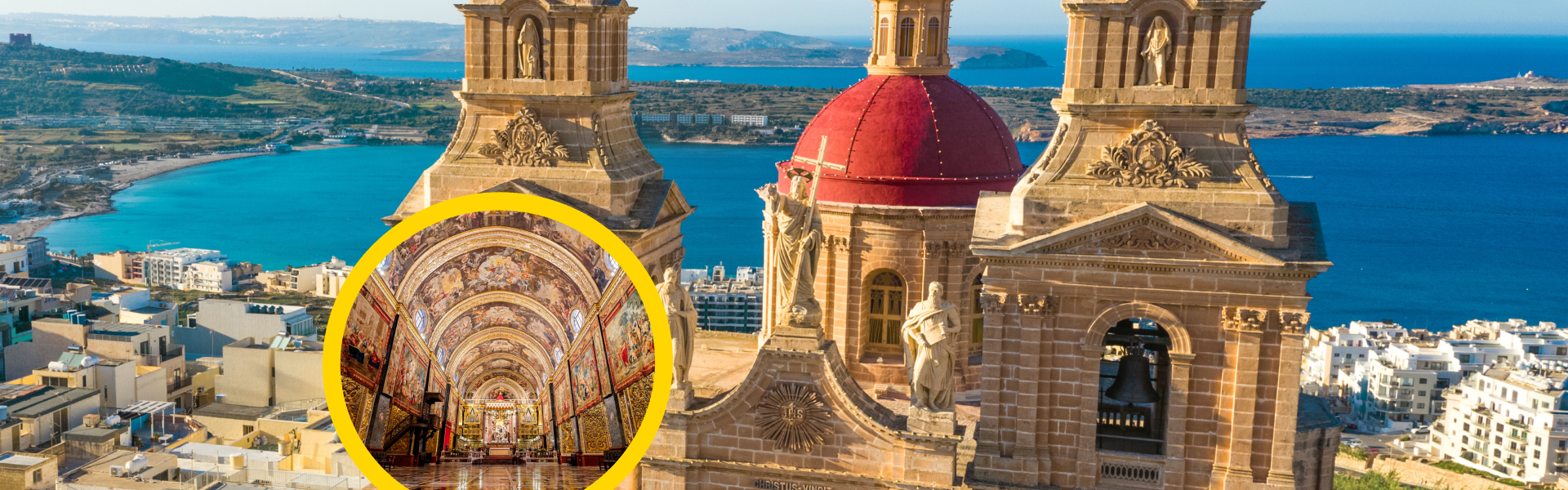
One of the first things visitors notice about Malta is the churches. They appear on hilltops and in village squares, at the end of narrow streets and along the waterfront. Their domes punctuate the skyline in almost every direction. Drive anywhere on the island and you will rarely be more than a few minutes from one.
The numbers are striking. Across Malta and Gozo there are 359 Catholic churches; 313 in Malta and 46 in Gozo, for a population of just over 500,000 people. That works out to roughly one church per square kilometre. The popular saying goes that Malta has a church for every day of the year, and while the precise count varies depending on how you define a church, the spirit of that claim is hard to argue with.
So how did a small Mediterranean island end up with so many? And what do these buildings actually mean to the people who live here today?
It Started with a Shipwreck

St Paul's Bay in the north of Malta marks the spot where, according to the Acts of the Apostles, the Apostle Paul was shipwrecked in AD 60, beginning nearly two thousand years of unbroken Christian tradition on the islands.
Malta's Christian story begins with a shipwreck. In AD 60, the Apostle Paul was being transported to Rome as a prisoner when his ship was caught in a violent storm and ran aground off the Maltese coast, in what is now known as St Paul's Bay. He and the other survivors swam ashore and, according to the Acts of the Apostles, were welcomed by the islanders with what the text describes as "unusual kindness."
Paul spent three months in Malta. During that time, he is said to have performed healings and preached to the local population, including converting Publius, the Roman governor of the island, who went on to become Malta's first bishop. That founding moment is celebrated every year on the 10th of February, a public holiday, and the chain it set in motion has never really broken. Malta has been Christian ever since.
The cave where Paul is believed to have sheltered and preached still exists in Rabat, known as St Paul's Grotto, and a church has stood over it since the 17th century. In Valletta, the Church of St Paul's Shipwreck on Triq San Pawl houses a relic said to be a fragment of the saint's right wrist bone. Nearly two thousand years later, the physical connection to that first arrival is still treated with reverence.
The Knights Built Them by the Hundreds

St John's Co-Cathedral in Valletta was built by the Knights of St John between 1573 and 1578 and remains one of the finest examples of Baroque architecture in Europe. The Knights were responsible for building or commissioning many of Malta's most impressive churches during their 268 years of rule.
While Christianity took root in Malta in the first century, the sheer density of churches the island has today owes much to a later period: the 268 years of rule by the Knights of St John, from 1530 to 1798. The Knights were a religious military order, deeply Catholic in identity, and they arrived in Malta with an ambition to make the island a powerful bastion of Christendom in the Mediterranean.
Under the Knights, church building became both a religious duty and a statement of power and prestige. Every language, the national groupings within the Order, commissioned its own chapel inside St John's Co-Cathedral. Every Grand Master sought to leave a permanent mark on the island's religious landscape. Religious orders established themselves across Malta and Gozo, each bringing their own churches and chapels. The result was an extraordinary concentration of ecclesiastical architecture on a very small piece of land.
St John's Co-Cathedral itself, built between 1573 and 1578, remains one of the most magnificent Baroque interiors in Europe. Its floor is a mosaic of marble tombstones commemorating knights, its walls encrusted with gilded carvings and paintings. Designed by Maltese architect Girolamo Cassar, it was commissioned as the Conventual Church of the Order and dedicated to St John the Baptist, the Knights' patron saint. Sir Walter Scott visited in 1831 and called it the most striking interior he had ever seen. Today it also houses two Caravaggio paintings: The Beheading of Saint John the Baptist, the largest canvas the artist ever painted and the only work he ever signed, and Saint Jerome Writing, both kept in the cathedral's Oratory.
Beyond Valletta, the period of the Knights also saw parish churches established in every locality across the islands. Malta's parish system, where each village is defined by and centred on its own church, dates largely from this era. It is a structure that has endured almost entirely intact to the present day.
Every Village has its own Church, and its own Saint

Every village and town in Malta is centred on its parish church, which forms the physical and social heart of the community. During the summer festa season, these churches become the focal point of weeks of celebrations honouring the village's patron saint.
Across Malta and Gozo today, there are 78 parish churches. Almost every locality, however small, has at least one. Larger towns like Sliema and Birkirkara have four each. Some villages celebrate two patron saints and have two parish churches to match, which is where things get particularly interesting.
Because where there are two churches in a village, there are usually two band clubs, two sets of decorations, two fireworks teams, and two fiercely loyal communities competing to outdo each other. The rivalry between parishes within the same village is one of the most distinctive features of Maltese social life, good-natured on most days, but deeply felt on all of them. Some rivalries stretch back generations and are still discussed at kitchen tables.
Each parish church is also far more than a building for Sunday Mass. It is the physical and symbolic centre of the village. Births, marriages and deaths all pass through it. Generations of families have their history written in its baptism records and memorial plaques. The church square is where people gather, where children play, and where old men sit in the evenings. Remove the church, and you would not just lose a building, you would lose the entire organising principle of the community.
The Festa: Where Religion and Community Become the Same Thing

The annual village festa brings together religion, community pride, music, fireworks and food in a celebration that has been recognised by UNESCO as part of the Intangible Cultural Heritage of Humanity. Devotees bid for the honour of carrying the statue of the patron saint through the streets, a privilege believed to bring blessings.
If you want to understand what Malta's churches mean to people, the festa is where to look. Every year, from roughly May to September, village after village across the islands holds a week-long celebration in honour of its patron saint. There are around 95 festas in Malta and another 10 in Gozo each year, meaning that on almost any summer weekend, somewhere on the island is decorated, alive with music, and lit up with fireworks.
In 2023, the Maltese village festa was officially inscribed on UNESCO's Representative List of the Intangible Cultural Heritage of Humanity, recognition of just how singular and deeply rooted the tradition is.
The structure of a festa builds over the days leading up to the feast day itself. The church and surrounding streets are decorated in the parish colours. Band clubs, known as kazin tal-banda, march through the streets playing lively pieces, their performances as much a source of community pride as any religious ceremony. Fireworks teams, some of which have been passing their craft down through families for generations, prepare displays that are judged and discussed across the island. The ground fireworks, known as nar tal-art, create spinning wheels and coloured mechanical patterns that are unlike fireworks displays found almost anywhere else in the world.
The climax of the festa is the procession of the patron saint's statue through the village streets. Devotees bid for the privilege of helping to carry it, a role considered a blessing. Confetti and streamers rain down from balconies. The square fills. And then the fireworks go up.
It is religious, but it is also social and competitive and deeply communal in ways that have nothing to do with formal observance. Some people who have long stopped attending weekly Mass will still travel back to their home village for the festa without a second thought. The connection runs deeper than doctrine.
Visitors can follow walking trails through the park while enjoying views of rocky coastlines, open landscapes and native plant life. The park also contains historical remains and rural heritage sites, giving it both environmental and cultural significance.
What Do the Churches Mean Today?

The Rotunda of Mosta is famous for the story of a Second World War bomb that pierced its dome on 9th April 1942 during an afternoon service, while around 300 worshippers were inside. The bomb did not explode and no one was killed. A replica of the bomb is displayed in the church today as a reminder of what locals call Il-Miraklu tal-Bomba, the Miracle of the Bomb.
Malta is changing. Church attendance has been declining for years, and younger generations are increasingly secular in their day-to-day lives. A 2021 State of the Nation survey found that 93% of Maltese still believe in God and 60% say religion is important to them, but the number of people actively practising their faith has dropped significantly compared to previous generations.
Yet the churches remain central to Maltese life in ways that go beyond whether anyone attends Mass on Sunday. They are the repositories of the island's history and art. St John's Co-Cathedral houses two Caravaggio masterpieces: The Beheading of Saint John the Baptist, the largest canvas he ever painted, the only work he ever signed, and one of the greatest paintings in Western art, and Saint Jerome Writing, which was stolen from the cathedral in 1984 and recovered two years later under mysterious circumstances. These works are irreplaceable, and they sit in a church, not a museum.
The Rotunda of Mosta tells another story. On 9th April 1942, during a German air raid, a 500-kilogram bomb pierced the dome and fell into the church while around 300 people were inside for an afternoon service. It did not explode. No one was killed. The real bomb was later defused and disposed of at sea by the Royal Engineers, but a replica is displayed in the church today as a testament to what locals call Il-Miraklu tal-Bomba, the Miracle of the Bomb. The event is still commemorated every year on the 9th of April.
These buildings hold the island's memory in ways that no museum could replicate. They are also still the places where the most important moments of life are marked. Christenings and funerals, confirmations and weddings still happen in parish churches across the islands, even for people who would not describe themselves as devout. The church remains the frame around the significant moments, regardless of what goes on the rest of the year.
And then there is the simple fact of what they look like. Malta's churches are some of the most beautiful buildings in the Mediterranean. Their limestone façades catch the afternoon light in ways that have made them a fixture of photography and art for centuries. The dome of the Mosta Rotunda, the Baroque grandeur of Mdina Cathedral, the painted ceilings of parish churches in towns you have never heard of, the architectural legacy of nearly two thousand years of building is extraordinary.
A Small Island with a Very Long Memory
The number of churches in Malta is not an accident or an anomaly. It is the physical record of a history that begins with a shipwreck, runs through centuries of Knights and bishops and warring band clubs, and arrives in the present day still shaping how communities organise themselves and how people mark the moments that matter.
Whether you are religious or not, whether you were born here or arrived last year, the churches are part of the landscape you inhabit. The dome you can see from your kitchen window. The bells you hear on Sunday morning. The square that fills with colour and noise every summer when the festa comes around.
Malta has 359 churches. And most of them are still very much alive.

About Matthew Gollcher
Hi, I'm Matthew, an SEO Specialist and Content Writer at Yellow Pages Malta. I'm passionate about creating meaningful content and exploring AI's creative possibilities. When I'm not working, I enjoy the gym, time with friends, watching series and reading, and playing guitar. I'm always eager to learn and grow both personally and professionally.