Il-Miraklu tal-Bomba: The Day a Bomb Fell Through the Mosta Dome and Didn't Explode


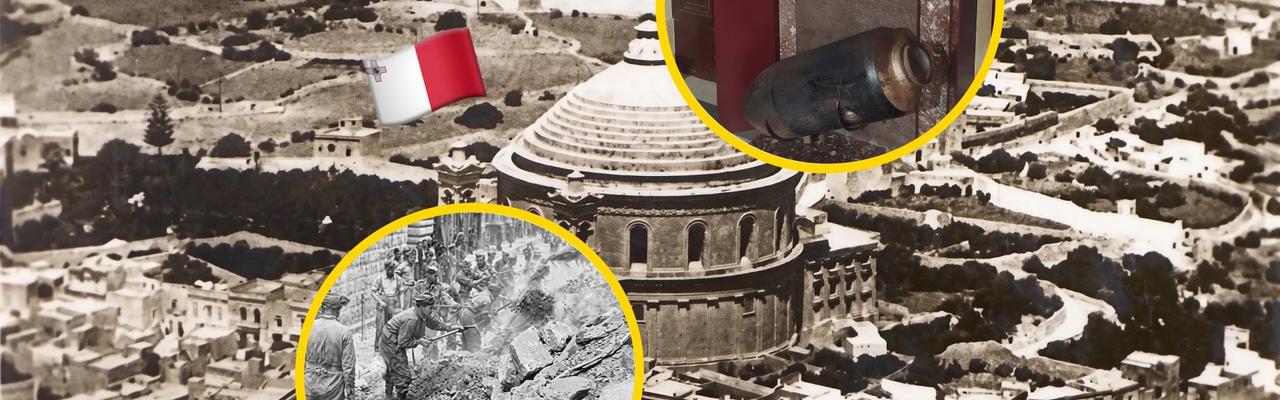
At 4:40 in the afternoon on the 9th of April 1942, Victor Delicata was inside the Mosta Rotunda when he heard a bomb pierce the dome above him with a loud crash. He saw something roll across the marble floor towards him. In the confusion and the noise, he ran towards it, because he thought it was an old woman in a faldetta who needed help.
He froze when he realised what it was.
The bomb had pierced the dome, grazed the corner of the lunette painting of Christ and the Apostles by Giuseppe Calì, hit the marble floor with a bang, and rolled towards the pulpit before coming to rest under the twelfth station of the cross. It was a 500-kilogram German SC500 demolition bomb. There were approximately 300 people inside the church. Father Salvo Sammut had just left the confessional. Several people rushed up to him and asked for absolution. The congregation scattered. Boulders rained down from the shattered dome. And the bomb did not explode.
Not one person was hurt.
This is the full story of Il-Miraklu tal-Bomba (the Miracle of the Bomb). What happened that afternoon, how it happened, who was inside, who defused it, where it went, and the question that has never been fully answered: why didn't it go off?
The Church the Village Built with its Own Hands

To understand why the bombing of the Mosta Rotunda shook Malta to its core, you first have to understand what the Rotunda meant to Mosta.
By the 1830s, Mosta's growing population had outgrown its old church. The parish priest Dun Feliċ Calleja formed a committee in August 1832 to plan a replacement. The design they accepted was proposed by Giorgio Grognet de Vassé, a Maltese architect of French descent and a former member of the Order of St John, who had never received any formal architectural training. His model was the Pantheon in Rome. Some objected that a pagan Roman temple was an inappropriate model for a Catholic church. The design was approved anyway.
Construction began on the 30th of May 1833. Rather than demolish the old church first, the new Rotunda was built around it, encasing the existing building so that the congregation continued to worship throughout the 27-year construction. When the new church was complete, the old one was demolished from within and removed. The population of Mosta at the time numbered no more than 1,500 people. They built the church themselves; voluntary labour on Sundays and public holidays. And funded it through community donations, legacies, benefices and a lottery. The entire project cost £21,000.
The dome they built has an internal diameter of 37.2 metres and rises to a height of 49 metres from the floor to the base of the lantern. The walls supporting it are 9.1 metres thick. It is one of the largest unsupported masonry domes in the world, the third largest by most measurements, after St Peter's Basilica in Rome and the Pantheon itself. An 1839 book written while the church was under construction described it as 'certainly the most magnificent, extensive and solid modern building' in Malta, and predicted it would 'immortalise the architect.' The church was officially dedicated on the 15th of October 1871.
On the 9th of April 1942, it was 109 years old and the people of Mosta still regarded it as the most important thing their town had ever produced. Which is why what happened that afternoon hit them so hard.
9th April 1942: What Was Happening Over Malta That Day

April 1942 was the most intense month of the entire Siege of Malta. In those 30 days, 6,728 tonnes of explosives fell on the island a tonnage that exceeded the entire London Blitz. The Royal Opera House in Valletta had been destroyed on the 7th of April. That same day, the first 47 Spitfires had arrived from HMS Eagle and HMS Argus, immediately thrown into the defence of the island.
On 9 April, Luftwaffe operations targeted RAF Ta' Qali, the airfield at the centre of the island. Over 60 Ju88s and a dozen Ju87 Stuka dive bombers took part in the attack, escorted by Me 109 fighter-bombers of 10/JG 53, each carrying small SD50 fragmentation bombs. Two of these aircraft; one Ju88 from 3/KuFlGr 606, one Me 109 — would create what the people of Mosta would call Il-Miraklu tal-Bomba.
The Ju88 was being driven off its target by the RAF's intensive air defences. Under pressure, with its bombs still fused, it jettisoned its load while flying over Mosta. The crew did not choose the Rotunda. They were simply trying to get home to Sicily.
4:40pm: Inside the Church

Father Salvo Sammut, who was inside the church that afternoon, later recalled the scene precisely. At 4:00pm, around 300 parishioners had gathered inside the Rotunda for the hour of adoration in the Chapel of the Holy Eucharist. Church bells were sounding, at this stage of the siege, bells signified an incoming raid, while sirens signalled the all-clear. Some parishioners left for nearby shelters. The majority stayed, moving towards the side walls as the attack intensified. Several people approached Father Sammut as he left the confessional and asked for absolution. He was giving it when the bomb struck.
The SC500, a thin-cased 500-kilogram demolition bomb, pierced the dome at 4:40pm. It grazed the corner of the lunette above the entrance, where Giuseppe Calì's painting of Christ and the Apostles was mounted, the face of Christ was smashed by the impact and would later be repainted by Calì's nephew Raphael. The bomb hit the marble floor with a loud bang, bounced, and rolled towards the pulpit, coming to rest under the twelfth station of the cross. Boulders from the shattered dome rained down around it. A large hole opened in the ceiling above.
Victor Delicata, seeing something rolling across the floor in the dust and confusion, ran towards it thinking it was an old woman in a faldetta who needed help. He froze when he saw what it was. He later recalled wanting to recite the act of contrition but finding he could not remember it.
Those trying to leave through the main door found another unexploded bomb on the parvis outside — one of the Me 109's SD50 fragmentation bombs, which had struck the top corner of the left bell tower, passing a few feet from a small group of boys sheltering under the large bell. Others trying to leave through the sacristy door found another small, unexploded bomb outside. Soldiers who had run inside the church, believing the large bomb was a time device, shouted at those too terrified to move to lie flat on the floor. The church emptied. The ARP Superintendent, Mr. Anthony Woods, arrived within minutes to find four small, unexploded bombs planted around the building.
Inside the church, on the marble floor under the twelfth station of the cross, the 500-kilogram bomb lay in silence. Not one person had been hurt.
The Men Who Defused It
A bomb disposal squad arrived under Lieutenant T.W.T. Blackwell, which included Corporal 'Busty' Brewer, Lance Corporal 'Rosy' Hillier, Sapper C.E. Reeves and Sapper W.D. Scott. The bomb was classified as a Priority, requiring urgent attention. Detonating it in situ was out of the question given its location in an irreplaceable building.
The threat was serious. German bombs of this type could be fitted with a delayed-action Type 17 Clockwork Fuse, a time bomb that would detonate anywhere between two and eighty hours after impact, or a Type 50 Anti-Handling Fuse, a booby trap that would detonate on the slightest disturbance. Either would require an extremely delicate operation.
Fortunately, the SC500 was fitted with a straightforward Series 5 Electric Impact fuse. Its thin casing had embedded it only four feet into the marble floor on impact. The bomb disposal officers defused it and filed their report: UXB Report No. 2175, marked 'defused and removed.' The report also noted a 50kg SD fragmentation bomb that had bounced off the dome's exterior and landed nearby. That too was discharged without incident.
All the bombs were transported to the Royal Engineers dump at Lintorn Barracks, Floriana, and later disposed of from the cliffs at Hal Far, dumped into the sea off the west coast. Sapper Scott recorded the aftermath in his diary. He wrote that when the bomb was being pushed down the church steps on a plank, the plank broke and the bomb rolled down and knocked over a lamp-post. The sappers were then entertained to a meal and drinks at the Nicolò Isouard Band Club. Scott's diary entry reads: 'Where they got the food from, I don't know; also plenty of Farsons Blues, went down wonderful, we all got well and truly drunk.'
On the 18th of April, the bomb disposal team returned to Mosta. An identical SC500 bomb had been found in the dump at Floriana. At the request of some parishioners, it was presented to the village band. That bomb, identical to the one that had rolled under the twelfth station of the cross, is what became the replica displayed in the sacristy of the Rotunda today. The original was at the bottom of the sea off Hal Far.
The Governor Who Watched It Happen
Governor Sir William Dobbie was outside watching the air raid when he saw a bomb strike the dome of the Mosta church. He drove to Mosta immediately, expecting, he later wrote, 'a great scene of desolation.' What he found was the church apparently intact.
In his 1944 memoir A Very Present Help, Dobbie wrote: 'I went in and then I saw lying on the marble floor of the church an enormous bomb. I looked up and saw that a neat hole had been bored in the dome. The bomb after boring this thick hole through the masonry of the dome had fallen perhaps 200 feet on to the hard marble and had not gone off. It had done no more than dent the floor. If it had gone off, there is no doubt that all the walls of the church would have collapsed on the ruins.'
He added: 'It is also extremely probable that the many people sheltering in the crypt underneath would have been killed. And they said: "It is a miracle!" We cannot but agree with them.'
The Pilot Who Came Back

For decades, the identity of the pilot who dropped the bomb was uncertain. Two German veterans came forward over the years, and their stories illuminate how memory and war intersect.
The first was Felix Sauer, a Catholic Me 109 pilot from Jülich, who visited Malta in 1975 and was relieved to learn that the Mosta bomb had not exploded. In May 1988 he returned to Malta and addressed the congregation inside the Rotunda during Sunday Mass, saying that as a Catholic he had been deeply troubled by the thought that he had destroyed the church. He told the Times of Malta that he and his fellow pilot Franz Scheffl had been flying over Mosta when Scheffl jettisoned his bomb and he saw a jet of flame and dust from the dome.
But Sauer's memory was wrong. Researcher Anthony Camilleri, who traced Franz Scheffl to Dorndorf in Thuringia in 1994, received a letter from Scheffl, then aged 76, stating that on 9th of April 1942 he had been in an air battle with two Spitfires over Malta, his aircraft was damaged, and he returned to base at Comiso. Luftwaffe records confirmed Scheffl did not drop the dome bomb. Sauer himself had pointed out that the bomb displayed in the church, an SC500, was too heavy for an Me 109 to carry, which was correct.
The man who actually dropped the dome bomb was almost certainly Leutnant Georg Vögerl, who came forward in August 2003 at the age of 82, during the 60th anniversary reunion of the Santa Maria convoy in Malta. He visited the Rotunda after learning that a bomb had pierced the roof and failed to explode. He recalled that one afternoon in early April 1942 he was flying a Ju88 of 3/KuFlGr 606 attacking Ta' Qali. His bombs had not yet been fused when the intensive RAF air defences drove him off his target. He was forced to release them over Mosta. Two weeks later, he made his 100th combat flight.
Vögerl did not know until 2003 whether the church had survived.
Why Did It Not Explode? The Question Malta Has Been Asking for 83 Years

The official answer is technical. The SC500 was fitted with a Series 5 Electric Impact fuse. These fuses required an electrical charge to detonate on impact. The fuse may have failed to function for any number of reasons, a faulty connection, a damp charge, a manufacturing defect, the angle of impact through the dome absorbing enough energy to prevent the electrical circuit completing.
The Maltese answer is different: it was a miracle. Il-Miraklu tal-Bomba. The phrase was in use within hours of the event. Governor Dobbie used it in his memoir. The people of Mosta had built that church with their own hands over 27 years, and they believed, with complete sincerity, that God had protected it.
But there is a third theory, and it is the most extraordinary of the three.
According to this account, when the bomb was examined after defusing, the explosive inside was not Amatol, the standard German bomb fill, but sand. And inside the bomb casing was found a note, written in Czech, reading: 'Greetings from Plzeň.'
Plzeň is the home of the Škoda Works, the great Bohemian armaments factory that Nazi Germany had seized in March 1939 and converted to war production using conscripted Czech forced labourers. Sabotage at the Škoda Works was documented throughout the war. Workers who were caught risked summary execution or deportation to concentration camps. The theory holds that Czech labourers, at enormous personal risk, filled at least some bombs with sand instead of explosive, and one of those bombs found its way into the bay of Georg Vögerl's Ju88 on the 9th of April 1942.
The evidence for this theory is strong enough to be taken seriously and uncertain enough to resist confirmation. The bomb's UXB report, No. 2175, notes no anomalies, and Royal Engineers Bomb Disposal Officers were required to log anything unusual. British historian Susan Hudson, daughter of Lt. George Carroll (one of the two BDOs serving Malta in 1942), has noted that if the bomb casing had been filled with sand and the fuse had still functioned, the detonation of the fuse would likely have split the casing and exposed the fill. No split casing was reported.
The absence of evidence is not, in this case, evidence of absence. The records from April 1942 were 'even more sparse than usual' because the bombardment was so intense. No weekly BD reports were submitted between 21st February and 27th March. In April 1942 alone, 6,728 tonnes of bombs fell on Malta. The paperwork could not always keep up.
What can be said with certainty is this: the Series 5 Electric Impact fuse should have worked. It was a straightforward mechanism. Whether it failed because of a manufacturing defect, a technical malfunction, or because someone in a factory in Plzeň had filled that casing with sand and written a message nobody was supposed to find, nobody alive today knows the answer.
What It Meant to Malta in 1942
The bombing of the Mosta Rotunda happened at what was arguably the single worst moment of the Siege of Malta. April 1942 was the month that broke records for destruction. The Royal Opera House was gone. The Three Cities were rubble. The dockyard was being hit day and night. Valiant Spitfires were being destroyed on the ground within minutes of landing because there were no dispersal pens to shelter them.
Into that darkness came the story of 300 people inside a church and a bomb that did not go off.
The effect on Maltese morale was immediate and profound. Governor Dobbie, a deeply religious man, described it as an act of divine intervention without hesitation. The story spread across the island within hours. For a people who had built their church with their own hands and now watched their island being destroyed around them, the survival of the Rotunda, and every person inside it, was confirmation that something was protecting them. It was a small fact in a catastrophic month, and it mattered enormously.
Restoration of the dome began almost immediately. The damaged painting by Giuseppe Calì was repaired by his nephew Raphael. The marble floor, dented by the impact, was temporarily patched with cement; Phyllis D'Arrò, who grew up in Mosta in the years after the war, recalls as a child making a point of walking over the repaired section of floor.
The Replica in the Sacristy: What You are Actually Looking At
When you visit the Mosta Rotunda today and walk through to the sacristy at the back of the church, you will find the bomb on display: a full-size SC500 casing, mounted against a bas-relief of the dome sculpted by Mosta-born artist Ganni Bonnici, with multilingual information panels and historic photographs showing the hole the real bomb made in the dome.
This is not the bomb that fell through the dome. That bomb was defused by Lieutenant Blackwell's squad, transported to Lintorn Barracks in Floriana, and dumped into the sea off Hal Far. It is still there.
The bomb in the sacristy is an identical casing found in the Royal Engineers' dump at Floriana, presented to the Mosta village band on the 18th of April 1942, nine days after the attack — at the request of some parishioners, when the sappers were entertained to dinner and drinks at the Nicolò Isouard Band Club. It was later mounted in the church as a permanent memorial.
Look at it carefully when you visit. It is about the size of a large man. It is what fell through the ceiling above you. It rolled across this floor. It came to rest under the twelfth station of the cross, which is still on the wall where it was on the 9th of April 1942. And 300 people walked out of this building that day without a scratch.
Whether that was God, or Czech saboteurs, or a faulty fuse on a factory line in Pilsen, or some combination of all three, the church is still standing.
The bomb is in the sacristy.
The hole in the dome was repaired.
And every year on the 9th of April, the people of Mosta remember.

About Matthew Gollcher
Hi, I'm Matthew, an SEO Specialist and Content Writer at Yellow Pages Malta. I'm passionate about creating meaningful content and exploring AI's creative possibilities. When I'm not working, I enjoy the gym, time with friends, watching series and reading, and playing guitar. I'm always eager to learn and grow both personally and professionally.