The Story Behind Malta's Luzzu Boats


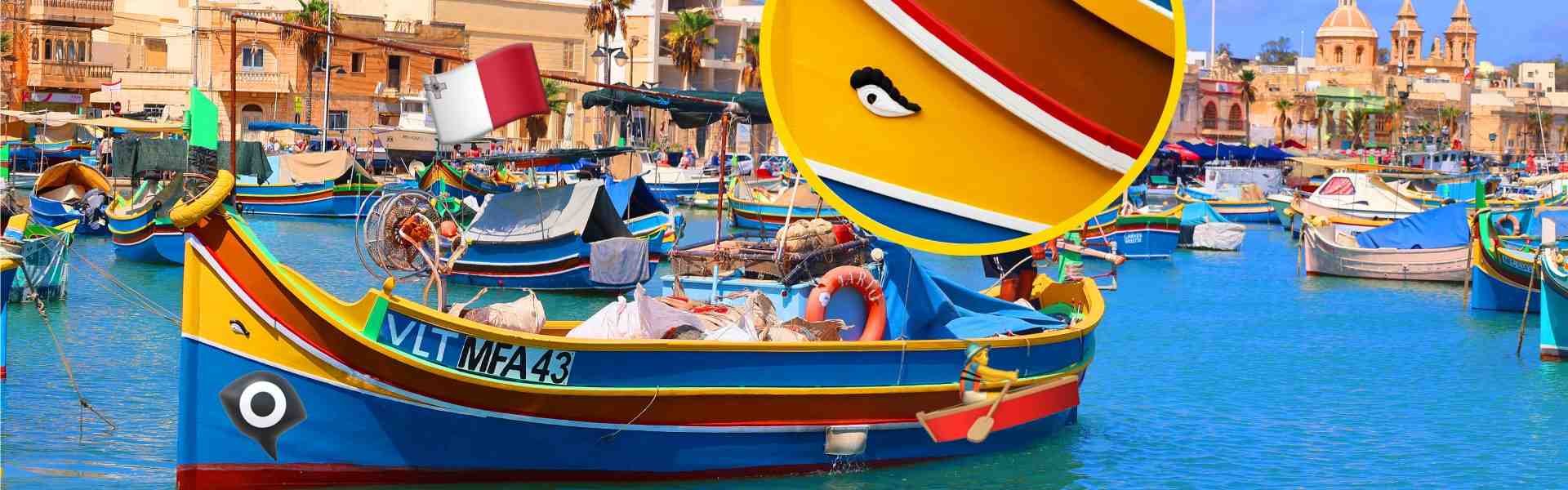
Few images are as closely associated with Malta as the colourful luzzu floating in a traditional harbour. For many people, the boat has become a symbol of the island itself, especially in places like Marsaxlokk, where rows of brightly painted fishing boats have become one of the most recognisable scenes in Malta. But while the luzzu is often treated as an ancient object, its real story is more interesting: it is a traditional Maltese working boat shaped by older Mediterranean influences, local craftsmanship and generations of fishing life.
More than just a picturesque boat

The luzzu is not simply a decorative part of Malta's coastline. Traditionally, it was a working craft, built for practical use at sea and closely linked to the fishing communities of the islands. Maritime scholarship from the University of Malta describes it as a traditional Maltese boat that became the principal fishing vessel around the islands by the first decades of the twentieth century. The modern luzzu is sturdy, double-ended in shape and was originally propelled by oars or sail before becoming largely motorised over time.
That practical background is important, because it explains why the boat has remained so central to Maltese identity. It was not created for tourism or visual appeal. It became iconic because it was part of daily life, especially in coastal villages where fishing shaped the local economy and rhythm of the day.
Where the Luzzu Came From

One of the most common assumptions about the luzzu is that it is directly Phoenician in origin. The truth is more nuanced. According to Joseph Muscat's Traditional Boats of Malta, the luzzu most likely evolved from the Italian gozzo, a type of boat that was seen around Malta in the late nineteenth century. By the early twentieth century, the luzzu had established itself as the principal Maltese fishing boat. It is also closely related to older local craft such as the ferilla, but its modern form is generally understood to be a later development rather than an unchanged survival from antiquity.
This makes the luzzu a particularly interesting part of Maltese history. It is traditional, but not in the simplistic sense people sometimes imagine. The boat reflects how local design evolved over time, borrowing from Mediterranean maritime traditions while adapting to Maltese needs and conditions.
Why the Design looks the Way it Does

The luzzu is known for its strong and elegant profile, but that shape developed for practical reasons. Maritime research from the University of Malta notes that compared with older local boats, the luzzu had a shorter fore stem, a higher freeboard and stronger timbers. These changes became particularly important once marine engines were introduced, since the boat needed to be able to handle extra weight and different working demands.
In other words, the luzzu is beautiful partly because it was built to do its job well. Its design reflects working life at sea, not just style. That combination of utility and character is one of the reasons it remains so admired today.
The Meaning Behind the Painted Eyes

Perhaps the most distinctive feature of the luzzu is the painted pair of eyes on the bow. These are widely associated with protection at sea and are often referred to as the Eye of Osiris or Eye of Horus. Popular and scholarly sources alike note that the symbol is widely believed to preserve a much older Mediterranean tradition, often linked in Malta to Phoenician influence, although the precise origin is difficult to prove with certainty.
What matters most is the meaning the eyes came to carry. They were understood as a protective symbol for fishermen heading out to sea, reflecting both superstition and deep respect for the dangers of maritime life. Even today, the eyes remain one of the clearest visual details that separate the luzzu from an ordinary fishing boat.
Why the Boats are so Colourful

The bright colours of the luzzu are another reason it has become so iconic, most are seen painted in strong primary shades such as red, blue, yellow and green. But the colours were not always chosen at random. Research cited in maritime references notes that certain painted details, including the mustaċċ, could traditionally signal locality or even personal circumstances. One cited example is that an ochre-yellow mustaċċ was associated with boats from Marsaxlokk and Marsascala, while black could indicate mourning in the family.
This gives the luzzu an added cultural dimension. Its appearance was not just decorative. In some cases, colour and pattern carried meaning, identity and a connection to place. That helps explain why these boats are remembered not only as fishing vessels, but as an expression of local tradition.
A Lasting Symbol of Malta
Today, the luzzu represents much more than fishing alone. It reflects Malta's relationship with the sea, the endurance of traditional craftsmanship and the way local culture has absorbed and reshaped wider Mediterranean influences over time. It is also one of those rare objects that feels both ordinary and symbolic at once: practical in origin, but deeply tied to how Malta sees itself.
For visitors, the luzzu may first appear as a colourful postcard image. But behind the bright paint and painted eyes is a richer story; one of working life, adaptation, belief and identity. That is what makes the luzzu more than just a beautiful boat. It makes it one of Malta's most enduring icons.

About Matthew Gollcher
Hi, I'm Matthew, an SEO Specialist and Content Writer at Yellow Pages Malta. I'm passionate about creating meaningful content and exploring AI's creative possibilities. When I'm not working, I enjoy the gym, time with friends, watching series and reading, and playing guitar. I'm always eager to learn and grow both personally and professionally.