The History of Malta's Salt Pans


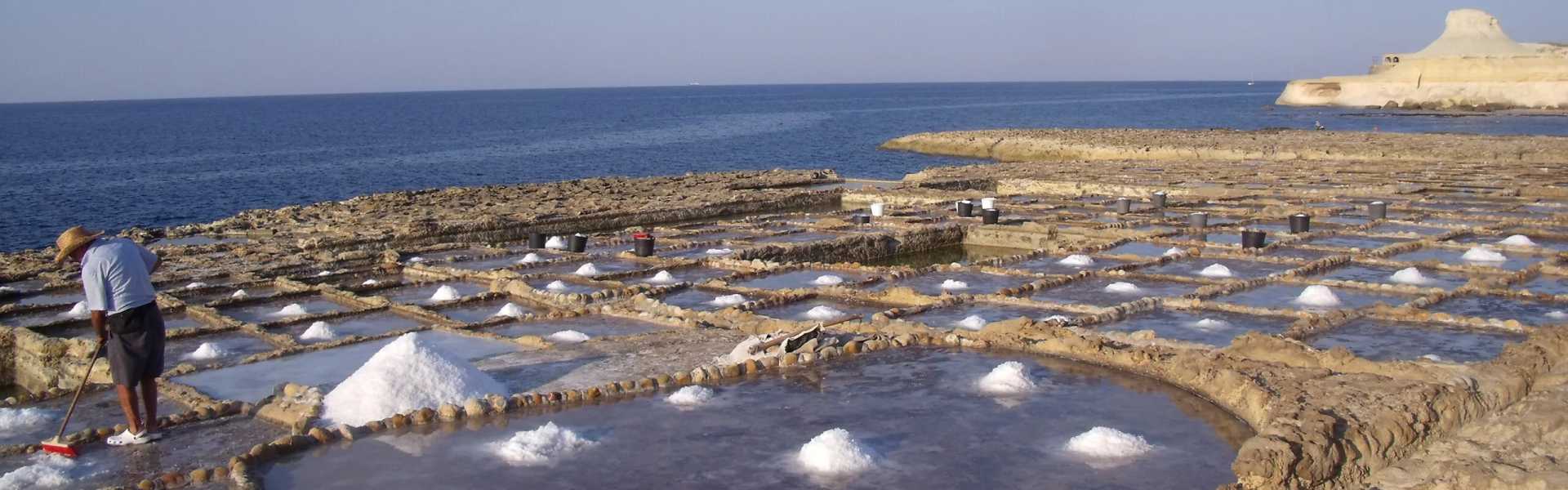
Drive along the northern coast of Gozo, just past the little resort of Marsalforn, and you come upon one of the strangest and most beautiful sights in the Maltese islands: a vast chequerboard of shallow pools, carved directly into the flat grey rock at the water's edge, stretching along the shore beneath a distinctive white hillock. In high summer they glitter; in the right light they mirror the sky; and if you come at the right moment you will see them dusted with what looks like snow. It is not snow. It is salt, and it is being made, right there, the same way it has been made for centuries.
These are the salt pans of Malta and Gozo, and they are one of the islands' quietest wonders. Salt was once one of the most valuable commodities on earth; a preservative, a medicine, a currency, the only reliable way to keep food through a Mediterranean winter, and the Maltese islands, ringed by sea and blessed with hot, dry, windy summers, were close to ideal for making it. For hundreds of years, salt was serious business here: a royal monopoly, an export industry, a source of real prosperity.
Today it survives as something rarer: a living craft, worked by a handful of families using methods that have barely changed in generations. This is the story of Malta's salt pans, how they were built, how the salt is actually made, the families still keeping the tradition alive, and why this centuries-old way of life is now genuinely endangered.
How Old Are They, Really?
Let's begin with the question every visitor asks, and give an honest answer, because the usual ones are shakier than they sound.
You will very often read that the Gozo salt pans are 'Roman', that they are '2,000 years old', or that salt-making here goes back to the Phoenicians. These claims are repeated on countless tourism websites, and it is easy to see why: they make a wonderful story. But the scholarly evidence tells a more modest tale. According to the detailed research of Pauline Dingli, whose 2019 study Salt Pans in Malta documented every salt pan on the islands, and the peer-reviewed work of geographers at the University of Malta, most of the typical Maltese salt pans date from the 16th and 17th centuries, that is, from the era of the Knights of St John, not from antiquity.
It is true that there are indications of more primitive salt-working in earlier periods, and it is perfectly plausible that people gathered salt from natural rock hollows here in Roman or even earlier times, salt is far too useful for an island people to have ignored. But the elaborate, engineered, chequerboard salt pans we admire today are overwhelmingly a product of the last five centuries, not two millennia. The famous Xwejni pans, for instance, were largely developed in the mid-1700s. So the honest formulation is this: Maltese salt-making may well be very ancient, but the salt pans you can actually see and touch are, for the most part, a few hundred years old, the work of the Knights and of the Maltese and Gozitan families who came after them. That is remarkable enough without inflating it.
The Knights' Salt Empire: Monopoly, Price-Fixing and Punishment

When the Knights of St John arrived in Malta in 1530, they quickly grasped what the islands' coastline was worth. Salt was money, and they treated it accordingly.
The earliest documentary record of salt-making in Malta, in fact, comes precisely from the Knights' determination to control it. Sixteenth-century Maltese documents record the Order establishing a monopoly over salt: fixing the price at which it could be sold, and imposing heavy penalties on anyone who made salt without authorisation. Salt was too valuable to be left to ordinary people. The right to make it, and the price it fetched, belonged to the state.
The Knights did not just regulate salt, they engineered it on an industrial scale. In the 17th century they took a natural saltmarsh at the mouth of the Burmarrad valley, at Salina Bay (near modern St Paul's Bay and Burħarrad), and artificially expanded it into the first great state-funded salt-pan system on the islands. The earliest detailed plans for the project survive in a manuscript compiled under Grand Master Jean Paul de Lascaris (who ruled from 1636 to 1657). The resulting Salini salt pans, designed by the Order's own European engineers, laid out in their characteristic grid, remain to this day the largest salt-pan system in the Maltese islands, an architectural jewel balanced, quite literally, on a reclaimed island of clay.
Security mattered too, because the harvest was precious. When the Salini Redoubt was built near the bay in 1715, it was later enlarged with a dedicated salt store and used as a guardroom to protect the salt harvest. Under this system, salt production reached its apex: Maltese salt was exported across the European continent and prized for its quality and taste, and for a time the trade helped make Malta a genuinely prosperous commercial centre. The 18th century saw the Knights expand the pans further still, and it was in this boom that most of the salt pans we see today, including those on Gozo, were built or enlarged.
How The Salt Is Actually Made

The genius of a salt pan is that it does almost nothing, it simply persuades the sun and the wind to do the work. The method used at Xwejni today is essentially the method used three hundred years ago, and it is worth walking through, because its simplicity is the whole point.
The pans themselves are shallow, roughly square pools, cut into the flat coastal rock or built up with low stone walls, arranged in the tessellating chequerboard that gives them their beauty. The process runs like this. Seawater is channelled or pumped into the pans, at Xwejni, the only concession to modernity is a rudimentary pump to lift the seawater up. Then nothing happens, for days, except evaporation: the fierce Mediterranean sun and the dry wind draw the water off, and the brine grows steadily more concentrated as it is moved through progressively shallower pools.
After several days the water is gone, and what remains is a crust of white salt crystals, so bright and thick across the pans that the Gozitans call it 'summer snow'. At Xwejni the salt is typically ready to gather about eight days after the pans are filled, and it is harvested once a week through the season. The final step is the hardest: the salt is swept up and collected entirely by hand, shovelled and carried in the full glare of the summer sun. There is no machinery in the harvesting, no hired labour to speak of, and no chemical treatment whatsoever. It is, as one harvester put it, just seawater, sun, wind and a great deal of time, and a great deal of back-breaking work.
The weather is everything, and it is merciless. Salt needs relentless sun and the right wind; a stormy or rainy day halts production entirely. And there is one particular enemy: when the wind swings round to the south and carries Saharan dust across the sea, it can settle on a gleaming white heap of finished salt and turn it yellow in minutes, contaminating the crop, forcing the pans to be emptied and cleaned, and turning a week's labour into, in the harvesters' own weary phrase, work in vain.
The Families Who Still Make Salt

What makes Malta's salt pans truly extraordinary is not that they are old, but that they are still working, kept alive by a handful of families for whom salt is not a heritage attraction but a livelihood and an inheritance.
On the two-acre stretch of Xwejni Bay, a small number of families still harvest the salt, and two names in particular are synonymous with the craft. The Attard family, who trade as Natural Xwejni Sea Salt, work the largest set of pans at Xwejni, with a salt tradition reaching back to the 19th century. And the Cini family have worked their pans at Xwejni since around 1860, five generations of the same family, tending some 300 salt pans, a number of which are over 160 years old.
The Cini family's story is, in miniature, the story of the whole tradition. Their salt, sold under the name Leli tal-Melħ, became known well beyond Gozo for its mineral richness, and the family's patriarch, Emanuel Cini, was for decades one of the great characters of the north coast, famous across the island (and, after a Netflix appearance, well beyond it) simply as Leli tal-Melħ — 'Manuel the Salt Man'. He worked the pans for some forty years, revived his wife's family business when the craft was already dying out, and in his later years welcomed school groups and visitors to explain a way of life most people had never thought about. When he passed away in early 2026, Gozo mourned him as the keeper of something precious. The tradition now continues through his daughter, Josephine, and her family, among the last still working the Xwejni pans by hand.
It is not only a Gozo story. On the Malta side, at Marsaskala, the Darmanin family are into their third generation of salt-making, with the octogenarian Żaren Darmanin still tending the family pans, supported by his son and grandson. These families are, quite simply, the living end of a chain that runs back through the British period, when the colonial government revived salt-harvesting by offering local people concessions to work and share-own the pans, to the Knights who first engineered them.
Why Maltese Sea Salt is Prized

There is a reason chefs seek this salt out, and it comes down to what the method does, and does not, do to it.
Ordinary table salt is heavily refined: stripped down to almost pure sodium chloride, often with anti-caking agents added. Maltese sea salt is the opposite. Because it is simply evaporated seawater, gathered by hand and left otherwise alone, it retains the natural minerals present in the Mediterranean, which is what gives good sea salt its more complex, rounded, less harshly 'sharp' flavour, and its slightly irregular, flaky crystal. It is coarser than refined salt, and it is a staple of Mediterranean cooking precisely because of that character. The Cini family's salt, harvested with no mechanisation and no chemical treatment, is a genuinely artisanal product, the reason it has found its way onto restaurant tables both in Malta and abroad, and the reason a mineral that costs almost nothing in a supermarket can, when it is made this way, be treasured.
There is a nice historical echo here. The very quality for which the Knights' salt was exported across 18th-century Europe, its taste, is the same quality that keeps a handful of Gozitan families in business today. Good salt, it turns out, has always been about more than just 'salty'.
A Tradition Under Threat
For all its beauty, the future of Malta's salt-pan tradition is far from secure, and the threats come from several directions at once.
The first is the sheer difficulty of the work. Harvesting salt by hand, in the height of a Maltese summer, is brutally hard, physically demanding, weather-dependent and, in pure financial terms, barely rewarding. It is exactly the kind of labour that younger generations, with easier options available, are understandably reluctant to take on. The craft depends on a small and ageing group of practitioners, and every retirement, every death, brings the knowledge closer to being lost.
The second is the sea itself. The pans are carved into the coast at the very edge of the water, which makes them beautiful and also makes them vulnerable. Storms and the constant erosion of the soft limestone steadily damage them, sections at Xwejni have been broken by the sea and patched back together with concrete and rock, and the months before each harvest season must be spent on painstaking maintenance and repair just to keep the pans usable. Some of the finest salt-pan systems, the researchers warn, live under a 'constant danger of being lost to the sea'.
The third is simple economics. Hand-harvested artisanal salt cannot compete on price with industrially-produced salt, and the pans occupy prime coastal land in a country under intense development pressure. Without a reason to keep them working, salt pans fall derelict, and a derelict salt pan very quickly becomes just another stretch of broken rock.
This is why researchers such as Pauline Dingli have argued that the salt pans deserve to be recognised and protected as an important part of Malta's cultural heritage, even suggesting that the Salini system and a few other outstanding sites are worthy of consideration as World Heritage, for their architecture, their uniqueness, their remarkable sustainability, and precisely because they are in danger. Some sites are indeed now protected: the Salina area, for example, has been established as a nature reserve within the Natura 2000 network, its 154,000 square metres of saltmarsh and pans conserved as much for their birds and habitat as for their history.
Summer Snow

Malta's salt pans are one of those rare pieces of heritage you can not only look at but watch in action, a working survival of the pre-industrial world, still turning seawater into 'summer snow' on the same rocks, by the same means, as three centuries ago. They are the product of an age when salt was precious enough for a knightly order to build an empire around it, and they endure today because a few families refused to let the craft die.
They are also, like so much of what makes Malta special, quietly at risk, caught between the hardness of the work, the hunger of the sea, and the economics of a modern island. Whether the chequerboard pans of Xwejni are still being worked by hand in fifty years' time will depend on whether Malta decides they are worth keeping: as a living craft, as a piece of history, and as one of the most beautiful things on the islands' coast.
For now, the tradition holds. Next time you are on Gozo's north coast in summer and you see that white crust glittering across the rock pools, stop for a moment, and perhaps buy a bag of the local salt from the little roadside stall above the pans. It is the cheapest way imaginable to own a genuine piece of Maltese history: a handful of the sea, dried by the Maltese sun, gathered by hand, exactly as it always has been.

About Matthew Gollcher
Hi, I'm Matthew, an SEO Specialist and Content Writer at Yellow Pages Malta. I'm passionate about creating meaningful content and exploring AI's creative possibilities. When I'm not working, I enjoy the gym, time with friends, watching series and reading, and playing guitar. I'm always eager to learn and grow both personally and professionally.