The George Cross: How Malta Became the Most Bombed Place on Earth


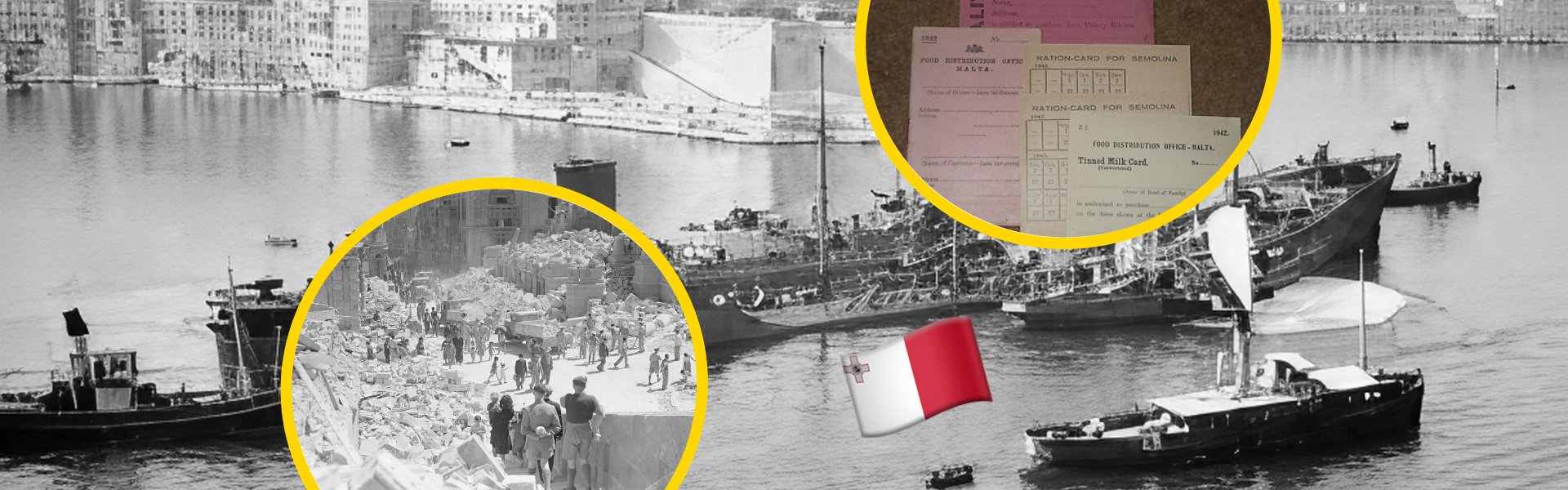
Look at the Maltese flag. In the upper left corner, on a white background, is a small symbol: the George Cross, a plain silver cross with the words 'For Gallantry' around its centre. It is the only national flag in the world to display thismedal. It was put there in 1943, by royal decree, in recognition of what the people of Malta had endured for the previous three years.
The George Cross is Britain and the Commonwealth's highest award for civilian gallantry. It is normally given to individuals, bomb disposal experts, police officers, rescue workers who have performed acts of exceptional heroism outside armed combat. On the 15th of April 1942, King George VI did something that had never been done before: he awarded it not to a person, but to an island. To its quarter of a million inhabitants. To every man, woman and child who had lived through what the Second World War had brought to their doors.
This is the story of why he did it.
Why Malta Mattered: An Unsinkable Aircraft Carrier

Malta is a small island. Its total area is roughly 95 square miles, about the size of the Isle of Wight. In 1940 it had a civilian population of around 275,000 people, crowded mainly around the Grand Harbour in Valletta and the villages surrounding the three airfields. It had no significant natural resources, could not feed itself, and had to import almost everything it needed to survive.
What it had was location.
Sitting almost exactly halfway between Gibraltar and Alexandria, Malta was the only Allied base in the central Mediterranean. Aircraft and submarines operating from its harbours and airfields could attack the sea routes along which Germany and Italy were shipping men, fuel, weapons, and supplies to their armies in North Africa. Without those supplies, Field Marshal Erwin Rommel's Afrika Korps could not fight. Rommel understood this with brutal clarity. In May 1941 he warned his superiors: "Without Malta the Axis will end by losing control of North Africa."
Winston Churchill, who had blocked proposals to hand Malta to Mussolini as a diplomatic concession in the months before Italy entered the war, called the island an "unsinkable aircraft carrier." The phrase captured what Malta represented: a fixed, unsinkable base in the heart of the Mediterranean from which the Allies could threaten Axis supply lines. For the Axis powers, it was therefore a target that had to be neutralised.
On the 10th of June 1940, Italy declared war on Britain and France. The following morning, the first Italian bombs fell on Malta.
Faith, Hope and Charity: Malta's First Defenders

On the morning of the 11th of June 1940, 55 Italian bombers and 21 fighters flew over Malta and dropped 142 bombs on the island's three airfields. The entire fighter defence of the island at that moment consisted of three Gloster Sea Gladiator biplanes, assembled from crates, flown by pilots who had no experience of fighter combat, and already obsolete compared to the aircraft attacking them.
In practice, up to six Gladiators were available at different times, used interchangeably three at a time while the others were kept as spares and sources of parts. The Maltese press gave them names that caught the public imagination: Faith, Hope and Charity. They could not stop the raids. They could barely match the speed of the Italian bombers. But their presence in the sky, the visible fact that something was fighting back, mattered enormously to the population below. They were also effective enough to force Italian aircraft to fly higher, making their bombing less accurate.
As the months passed, Hurricanes arrived to reinforce the Gladiators, and eventually, in 1942, Spitfires. But the resources were never enough. Malta was not the priority; Britain itself was under threat, and every aircraft sent to Malta was an aircraft not defending the homeland. The island would have to endure.
154 Days and Nights: The Most Bombed Place on Earth

The Luftwaffe arrived in January 1941, sent to Sicily to reinforce the Italian air campaign after a string of Italian defeats. Their arrival transformed the nature of the bombardment. The Italians had conducted high-altitude attacks; the Germans added dive-bombing and night raids and brought with them a determination to reduce the island to rubble.
Between June 1940 and November 1942, German and Italian aircraft flew a total of more than 3,000 bombing raids against Malta, the combined Italian and German total reaching over 73,000 individual sorties. In 1942 alone, there were 2,031 air raids, more than five every day on average. In the spring of 1942, the assault reached a scale unlike anything seen elsewhere in the war.
In April 1942, Malta endured 154 consecutive days and nights of aerial attack, a record for sustained bombing that has never been broken. During the entire period from January to June 1942, there was only one single 24-hour stretch without a bombing alert. In April 1942 alone, the island's most terrible month, 282 separate air raids were recorded, and more than 6,500 tonnes of bombs were dropped on the Grand Harbour area alone. By comparison, approximately 18,000 tonnes of bombs fell on London during the entire Blitz, and London is more than five times the size of Malta.
The destruction was extraordinary. Some 30,000 buildings were destroyed or damaged. Around 50,000 people were made homeless. The Royal Opera House in Valletta was gutted. Entire streets in the harbour towns of Senglea, Cospicua and Vittoriosa were reduced to rubble. Royal Engineers dealt with 7,433 unexploded bombs. The island's infrastructure, its roads, its water systems, its hospitals, its bakeries, was a constant target.
The people went underground. Maltese civilians dug air-raid shelters into the limestone rock beneath their homes and villages, carving out tunnels and chambers that became their homes during the worst of the raids. Families slept underground. Children were taught in improvised classrooms below ground. The sick was treated in underground hospitals. Above them, the bombs fell.
By the spring of 1942, 1,581 Maltese civilians had been killed by enemy action. Thousands more had been wounded. But beyond the physical destruction, there was a quieter threat that may have been the most dangerous of all.
Hunger: The Siege Within the Siege

Malta could not feed itself. Before the war, local farmers could produce only around a third of the food the island needed; the rest had to be imported by sea. Under the Axis naval blockade, those imports were being systematically cut off.
In 1941 and into 1942, British convoy after convoy was attacked, turned back, or sunk. Between February and June 1942, only two out of 24 merchant ships sent to Malta managed to unload their cargoes. The rest were sunk or forced to turn back. Fuel for the aircraft defending the island ran critically low. Ammunition was rationed. Food was rationed to starvation levels: by the summer of 1942, the daily ration for a Maltese civilian was around 1,500 calories, barely half of what a working adult requires.
Military commanders quietly began calculating dates: how long could the island hold out at current rates of consumption? The question was no longer whether Malta was under threat. The question was whether it could survive at all.
It was against this backdrop, the bombs, the hunger, the siege, that King George VI wrote his letter.
The Letter: 15th of April 1942

In early April 1942, Leopold Stennett Amery, Britain's Secretary of State for India, suggested that Malta should receive the Victoria Cross, the highest British military honour. The problem was that the Victoria Cross is a military decoration, awarded for valour in the face of the enemy. It could not be given to a civilian population.
King George VI had established the George Cross in September 1940 specifically for acts of great heroism by civilians. On the 15th of April 1942, he awarded it collectively to the Island Fortress of Malta. His message, sent by cable to the island's Governor, Lieutenant General Sir William Dobbie, read:
"To honour her brave people I award the George Cross to the Island Fortress of Malta to bear witness to a heroism and devotion that will long be famous in history."
Dobbie's reply was equally plain: "By God's help Malta will not weaken but will endure until victory is won."
The bombing was so relentless that the formal presentation ceremony had to be postponed. By the time the medal arrived on the island, Dobbie himself had been replaced by Lord Gort due to ill health; he never saw the cross he had helped earn. The public ceremony finally took place on the 13th of September 1942, in the bomb-damaged Palace Square in Valletta, with rubble still lining the edges of the square. Chief Justice Sir Gorg Borg received the medal on behalf of the Maltese people.
The George Cross was then taken on a tour of every town and village in Malta, so that the entire population could see it. The cross and the King's original letter are now preserved at the National War Museum inside Fort Saint Elmo in Valletta. In 1943, the George Cross was incorporated into the Maltese flag, where it remains today.
Operation Pedestal and the Ohio: The Convoy That Saved Malta
The George Cross had been awarded. The island was starving. The question of survival had not been answered.
By the summer of 1942, military commanders had reached a conclusion that was not discussed publicly: without a major convoy getting through before the end of August, Malta would be unable to continue operations, and surrender would have to be considered. The fuel available was so low that aircraft could no longer fly offensive missions.
Churchill ordered Operation Pedestal. It was the largest convoy operation the Royal Navy had yet assembled: 14 merchant ships, protected by two battleships, three aircraft carriers, seven cruisers, 32 destroyers, and seven submarines. The convoy sailed from Britain on the 3rd of August 1942 and passed through the Strait of Gibraltar on the night of 9–10 August.
The Axis knew it was coming. Every available submarine, aircraft, and torpedo boat in the Mediterranean was directed against it.
The destruction began almost immediately. On the 11th of August, the aircraft carrier HMS Eagle was hit by four torpedoes from the German submarine U-73. She sank within minutes, taking 260 men with her. Over the following days, the convoy was attacked continuously, by aircraft, by submarines, and by Italian torpedo boats operating at night. By the time the shattered remnants reached Malta, nine of the 14 merchant ships had been sunk, along with the carrier Eagle, one cruiser, and three destroyers.
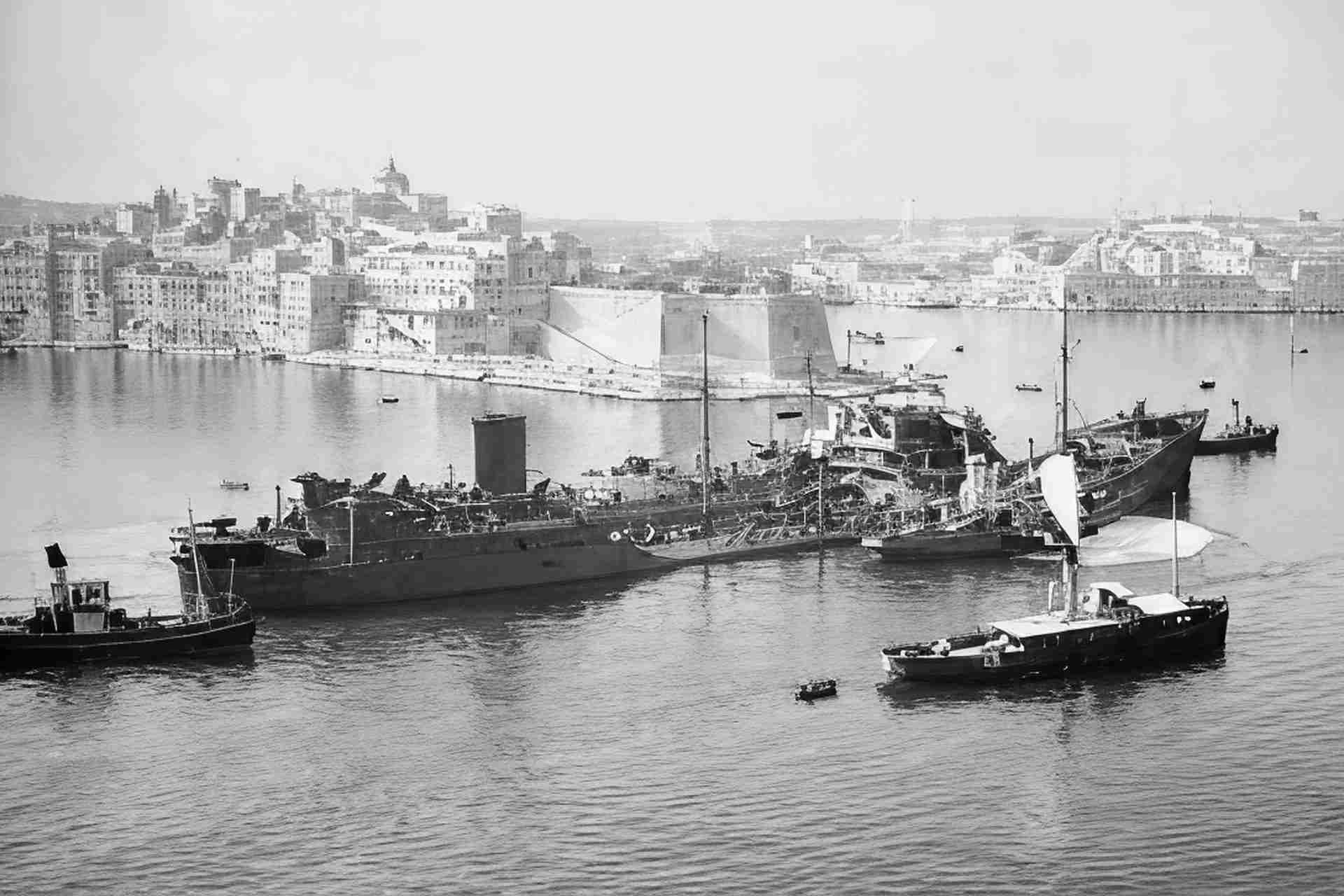
The most important ship in the convoy was not the largest or the most heavily armed. It was the SS Ohio: an American-built oil tanker, launched in April 1940 at Chester, Pennsylvania for the Texas Company, loaned to Britain with a British crew under the command of Captain Dudley Mason. Ohio was carrying over 10,000 tonnes of fuel, the kerosene and diesel without which Malta's aircraft could not fly.
Ohio was torpedoed by an Italian submarine on the 12th of August. She was bombed repeatedly. A crippled German Stuka dive bomber crashed directly onto her deck. Her keel was broken. Her engines failed. At various points she appeared to be finished. Each time, her crew fought to keep her moving.
In the end, unable to move under her own power, Ohio was lashed between two Royal Navy destroyers, HMS Penn and HMS Ledbury, which provided both the buoyancy to keep her afloat and the engines to move her. In this extraordinary formation, the three ships crossed the last miles of Mediterranean and entered Grand Harbour.
Ohio arrived on the 15th of August 1942 , the feast of the Assumption of the Virgin Mary, one of the most important religious celebrations in the Maltese calendar. The Maltese, who had prayed throughout the siege, called it the Convoy of Santa Marija. Many regarded the timing as miraculous. Ohio discharged her cargo and then sank into the shallow water near Fort Ricasoli. She was so badly damaged that she never sailed again. She was finally scuttled in 1946, and her nameplate, ship's wheel and ensign are preserved at the National War Museum in Valletta.
Captain Dudley Mason was awarded the George Cross for his actions during Operation Pedestal. He was the first member of the Merchant Navy ever to receive that honour.
The End of the Siege and the Turning of the Tide

Operation Pedestal had bought Malta time. It had not broken the siege.
The final relief came from the land. In late October and early November 1942, the Allied victory at the Second Battle of El Alamein ended Rommel's threat to Egypt and began the long Axis retreat along the North African coast. With Allied forces advancing westward and recapturing airfields in Cyrenaica, it became possible for the first time to provide continuous air cover over convoys approaching Malta from the east. On the 20th of November 1942, the Stoneage convoy arrived from Alexandria without loss. The Siege of Malta was officially over.
The numbers, compiled after the war, give some sense of what the island had endured. More than 3,343 air raids. A total of approximately 15,000 tonnes of bombs dropped on the islands. More than 1,581 civilians killed. Around 30,000 buildings destroyed or damaged. Over 7,000 civilians and service personnel killed in total across the siege. Three hundred and sixty-nine British fighter aircraft shot down in the island's defence.
Malta went from siege to springboard. In July 1943, it served as the staging post for Operation Husky, the Allied invasion of Sicily, the first major Allied landing on European soil. King George VI, Winston Churchill, and President Roosevelt all visited the island after the siege was lifted, each paying tribute to what had been endured there.
Rommel had been right about the strategic importance of Malta. The island's survival, and the operations conducted from it, had been decisive in disrupting Axis supply lines to North Africa. By August 1942, 35 percent of Axis convoys to North Africa were being sunk. In September 1942, Malta-based forces sank 100,000 tonnes of Axis shipping, including 24,000 tonnes of fuel destined for Rommel's army. The island that had been targeted for destruction had instead destroyed the ability of Axis forces in North Africa to fight.
What Remains
The cross on Malta's flag is not decorative. It is the record of a specific event, in a specific place, during specific years: of what happened to a quarter of a million people on a small island in the Mediterranean between 1940 and 1942, and of the judgement, expressed in the most formal language available, that what they endured and how they endured it was of the highest order of human courage.
The George Cross and the King's handwritten letter are in the National War Museum at Fort Saint Elmo in Valletta, in the same fort that stood at the entrance to Grand Harbour throughout the siege, and into whose harbour Ohio limped on the feast of Santa Marija in the worst summer of the war.
Victory Day is commemorated every 8th of September in Malta, marking the date in 1565 when the Great Siege ended, the date in 1800 when the French capitulated, and the date in 1943 when the Italian fleet surrendered under the guns of Fort Saint Elmo. The Second World War siege has its own places of remembrance: the war rooms under Valletta, the bomb-shelters carved into the limestone of the villages, the churches that were damaged and rebuilt, and the wrecks that still lie on the seabed of the approaches to Grand Harbour.
The Ohio was scuttled in deep water after the war. But everything else about her story, her name, her wheel, her flag, the account of how she arrived, is preserved in Valletta. Malta does not forget what was done for it, or what was endured within it.

About Matthew Gollcher
Hi, I'm Matthew, an SEO Specialist and Content Writer at Yellow Pages Malta. I'm passionate about creating meaningful content and exploring AI's creative possibilities. When I'm not working, I enjoy the gym, time with friends, watching series and reading, and playing guitar. I'm always eager to learn and grow both personally and professionally.