How General Elections Affect Maltese Businesses: The Data Leading Up to the 30th of May 2026


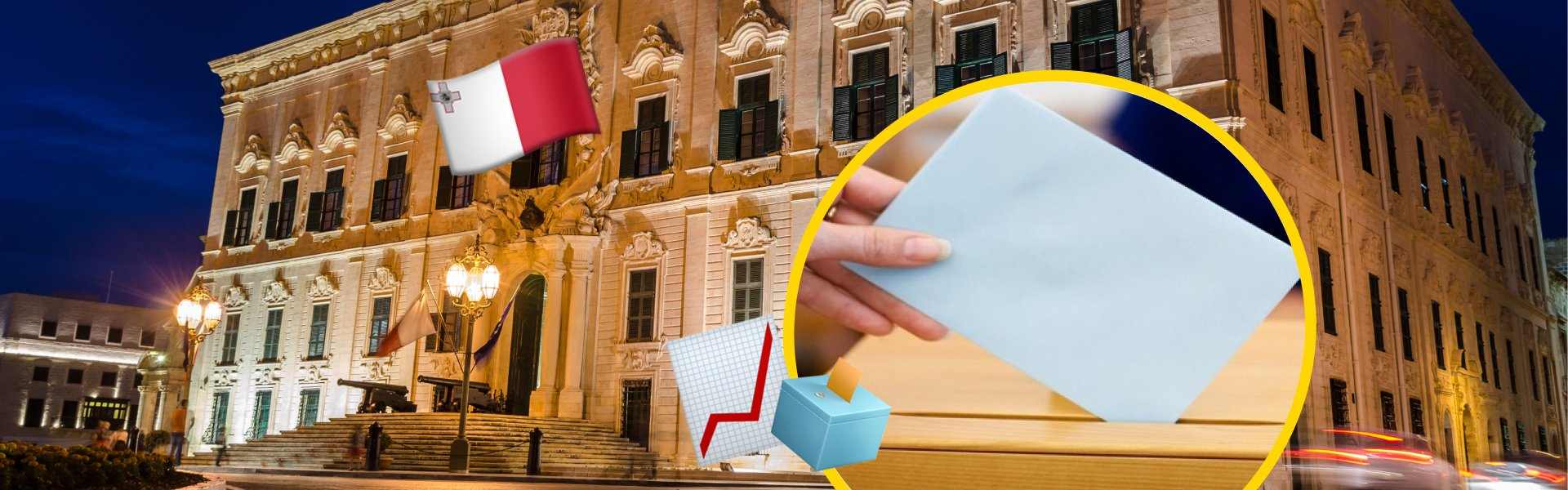
On the 30th of May 2026, Maltese citizens will go to the polls for the country's 14th general election since Independence. Polling stations will open across the 13 electoral districts. The Labour Party, in office since 2013, is seeking a fourth consecutive term under Prime Minister Robert Abela. The Nationalist Party, with its new leader Alex Borg in place since September 2025, is contesting under the slogan 'Nifs Ġdid' ('A Breath of Fresh Air'). The election was called nearly a year ahead of schedule by Abela on the 27th of April 2026, citing the need for 'a safe pair of hands' amid global instability.
For Maltese businesses, the politics matters less than the pattern. Three decades of peer-reviewed research from the world's most respected economic institutions, the National Bureau of Economic Research, the Journal of Finance, the European Central Bank, the OECD; show that general elections produce a consistent, measurable economic pattern. Investment slows. Deal-making slows. Hiring slows. Government spending expands. Markets get more volatile. The effects are biggest where the underlying business decision is expensive to reverse, and biggest in small open economies that depend heavily on cross-border capital, services exports, and tourism. Malta ticks every one of those boxes.
This article sets out what the data says about how general elections affect Maltese businesses, grounding the international academic evidence in Malta's own statistics, in the Central Bank of Malta's and NSO's data series, and in the public interventions already made by the Malta Chamber of Commerce and the Malta Chamber of SMEs during the current 2026 campaign.
The Maltese Context: Why Elections Matter More Here than in Most Jurisdictions
Malta is, by international standards, an active democracy. Voter turnout in Maltese general elections has been one of the highest of most democracy in the world for several decades. In 2003 it reached 95.7%; in 2013, 93.0%; in 2017, 92.1%; in 2022, even with the lowest turnout since 1955, it was still 85.5%. The Electoral Commission of Malta publishes the full historical record. The University of Malta's Malta Elections project provides detailed historical data on every parliamentary election since 1921.
This matters for businesses because every Maltese election is, by international standards, a high-engagement event in which a substantial majority of staff, customers, suppliers, and counterparties are personally involved. Election day in Malta is not background noise. It is, for most of the population, a personal event. That increases the size and the predictability of the economic effects discussed below.
Malta is also, again, by international standards an extremely small, extremely open economy. GDP is around €21 billion. The economy is dominated by services: tourism, financial services, online gaming, ICT and professional services together account for the great majority of value added. According to NSO Malta's direct investment data, the stock position of foreign direct investment in Malta stood at €479.7 billion at end-2024, a figure that reflects Malta's status as a financial services hub, with financial and insurance activities accounting for over 98.2% of FDI stock. The real-economy FDI; manufacturing, hospitality, real-economy services, is much smaller in headline terms but is the part most exposed to electoral cycle effects. Two structural features of Malta make the international election research particularly relevant:
First, Malta's economy is hyperdependent on continued growth. As MaltaToday's recent analysis showed, government revenue has risen from €2.8 billion in 2012 to a projected €8.4 billion in 2026. Recurrent spending now approaches €9 billion. The state's capacity to fund pensions, health, education, and the in-work benefit depends on continued GDP expansion. Any politically-induced slowdown in business investment has outsized fiscal consequences in Malta.
Second, Malta is subject to an active EU Excessive Deficit Procedure. After the 2023 deficit reached 4.9% of GDP, well above the EU's 3% limit, the European Commission opened an Excessive Deficit Procedure against Malta in 2024. The Commission's fiscal surveillance documents for Malta are publicly available. This means the next government, whichever party forms it, will face binding EU fiscal constraints that significantly limit the room for the campaign promises being made by both major parties.
The Maltese Political Budget Cycle: Pre-Election Spending is Real and Documented
Across democracies, the most reliably documented election effect is the political budget cycle: incumbent governments expand fiscal spending in the year before an election. This pattern was formally identified by Yale economist William Nordhaus in his 1975 paper 'The Political Business Cycle', and has been replicated in dozens of country-level and cross-country studies since.
Maltese data supports the pattern. According to the standard published economic history of Malta, by 2007, the year before the 2008 general election, Malta's deficit-to-GDP ratio had been brought 'comfortably below 3%' as required for eurozone membership (Malta joined the euro on 1 January 2008). But due to pre-election spending the deficit rose to 4.4% of GDP in 2008 and 3.8% in 2009. The Central Bank of Malta's own analyses, including its 2014 Quarterly Review study of the cyclically adjusted budget balance, confirm that 'the main changes in the budget balance in Malta between 2000 and 2013 were a result of discretionary government policy rather than the economic cycle', the technical formulation of the political budget cycle hypothesis.
In 2026, the pattern is repeating in real time. Both major political parties have made expansive spending commitments during the seven weeks leading up to the 30th of May vote. The Malta Independent's daily coverage of the campaign documents the running list: tax cuts, child bonuses, pension increases, student stipend rises, housing support measures, full-time employee bonuses, healthcare investments, and inheritance tax abolition (on the PN side) or expansion of in-work benefit (on the PL side). One headline measure, a €1,000 annual bonus for all full-time employees, has been estimated to cost €200 million per year.
The Maltese business community has responded publicly. The Malta Chamber of Commerce, Enterprise and Industry issued an open letter to both Robert Abela and Alex Borg. Its president, William Spiteri Bailey, warned that some campaign proposals were 'not only misguided, they are reckless'. He continued: 'They risk undermining competitiveness, discouraging investment, and weakening Malta's economic resilience at a time when global pressures are already intensifying.' The Chamber's position is that 'populism cannot be allowed to dictate economic policy', and that the four-to-five-year political cycle is fundamentally mismatched with the longer planning horizons of Maltese businesses.
The Malta Chamber of SMEs separately warned that several pledges had been announced 'without prior consultation with social partners' and would fall disproportionately on micro and small enterprises, the majority of Maltese businesses by number. Malta Employers added their concerns, as did several economists publicly. The convergence of major business bodies in the same direction, in the same week, is itself a measurable signal: this is a campaign that is testing Maltese business community confidence.
Investment Slows Down in Election Years: Malta is Unlikely to be an Exception
The clearest finding in the international academic literature is that corporate investment falls in election years. The foundational study is Brandon Julio and Youngsuk Yook's 2012 paper in the Journal of Finance, 'Political Uncertainty and Corporate Investment Cycles'. They examined 248 national elections in 48 countries and found that, during election years, firms reduce investment expenditures by an average of 4.8% relative to non-election years, controlling for growth opportunities and economic conditions.
Three findings from that study are directly relevant to Malta:
- The effect is larger in countries with parliamentary political systems (Malta has one);
- The effect is larger when election outcomes are closer (Maltese elections have been narrow margin races in certain cases such as 2008); and
- The effect is larger in firms with a lower proportion of export revenue. Many Maltese businesses, particularly in retail, hospitality, construction, and consumer services, derive nearly all their revenue domestically and therefore have minimal export buffer.
Subsequent research has confirmed and extended these findings. Brandice Canes-Wrone and Jee-Kwang Park's 2012 paper in the American Political Science Review, 'Electoral Business Cycles in OECD Countries', documented what they call 'reverse electoral business cycles': a substantial portion of OECD economies experience real declines in the pre-election period, driven specifically by investments with high costs of reversal. The National Bureau of Economic Research found in 2020 that Economic Policy Uncertainty, a news-based measure published by the Federal Reserve Bank of St Louis on its FRED database, is 13% higher in the month of and the month before an election across 23 countries, controlling for country, time, and country-specific time trends.
The foundational EPU methodology, developed by Baker, Bloom and Davis and published in the Quarterly Journal of Economics in 2016, is now used by central banks worldwide, including the European Central Bank, as a standard macroeconomic indicator. Subsequent work has shown that uncertainty raises stock-price volatility, reduces investment and employment in policy-sensitive sectors, and produces measurable macroeconomic effects across panels of countries.
The translation to Malta is straightforward. If a Maltese business is considering building a new hotel, opening a new manufacturing line, expanding a financial services office, acquiring a competitor, signing a long lease, or committing to a major IT system change, the academic literature predicts that decision is more likely to be delayed in March, April and May 2026 than it would have been in the same months of a non-election year, and more likely to be revived in July, August and September after the new government settles in. The Malta Chamber's public position, that 'businesses plan for the long-term' and need 'stability and predictability' is a direct echo of this academic literature.
Mergers, Acquisitions and Deal-Making Slow Down Too
The same logic applies to mergers and acquisitions. Alice Bonaime, Huseyin Gulen and Mihai Ion's 2018 paper in the Journal of Financial Economics, 'Does policy uncertainty affect mergers and acquisitions?'; is the standard reference. Their conclusion: political and regulatory uncertainty is strongly negatively associated with M&A activity at both the macro and firm levels. The effect is strongest for uncertainty regarding taxes, government spending, monetary and fiscal policies, and regulation, exactly the categories that dominate Maltese election campaigns.
For Malta, this matters in two specific ways. First, the Maltese financial services sector, the country's second-largest export industry after tourism, regulated by the Malta Financial Services Authority, is intensively deal-driven. Mergers, fund mergers, licence acquisitions, redomiciliations, holding-company restructurings and similar transactions are the routine business of Maltese financial services. Many of these involve cross-border counterparties whose own boards make decisions on a global timetable. A Maltese election does not delay every deal, but it does add a marginal disincentive at exactly the point when a counterparty is choosing between Malta and another jurisdiction.
Second, the Maltese real-estate market, the largest single store of household wealth in the country, has its own electoral cycle. Property transactions historically slow in the months immediately before a Maltese election and accelerate after, as buyers wait to see what stamp-duty regime, planning policy, and capital-gains treatment the new government will choose. The current campaign has already produced specific real-estate-related promises from both major parties, the PN's proposal to cover half the interest on home loans for the first ten years for young buyers, for example, that are likely to be reshaping buyer behaviour right now.
Foreign Direct Investment and Tourism: Malta's Two Great Vulnerabilities
Where Malta differs from most economies is in its extreme exposure to two flows that are particularly sensitive to electoral uncertainty: foreign direct investment and tourism.
On FDI, Julio and Yook's follow-up 2016 paper in the Journal of International Economics, originally published as a Federal Reserve Board working paper in 2013, established that FDI flows from US companies to foreign affiliates drop significantly during the period just before an election in the destination country, with the FDI election effect being larger than the election effect on domestic investment. The mechanism is straightforward: an investor who is choosing between Malta and a competing jurisdiction is more likely to defer the decision when the destination is in an electoral phase, because the regulatory, fiscal, and policy environment of the destination is by definition uncertain.
Malta's real-economy FDI, the part that funds manufacturing plants, hotel construction, gaming operator licences, financial services back offices, and similar tangible operations is, in absolute terms, modest. But it is the difference between Malta growing at 4-5% per year (the rate that the Central Bank of Malta's Q4 2025 Quarterly Review projects) and Malta growing at the EU average of 1-2%. The marginal FDI is the marginal growth.
On tourism, the academic literature is less developed but the mechanism is intuitive. Tour operators, hotel groups, airlines, and conference organisers book Maltese capacity months ahead. A government in caretaker mode, as Malta's current government formally is between dissolution of Parliament and the swearing-in of the new one, has limited capacity to make immediate decisions about destination marketing, route subsidies, tourism tax structures, or major-event hosting. The Malta Tourism Authority continues to operate, but strategic decisions that require ministerial sign-off are paused. For Malta, which depends on a tourism sector that contributes significantly to the GDP, any pause matters.
Hiring Decisions and Wage Commitments
The international literature documents a smaller but real election effect on hiring decisions. The reasoning is identical to the investment finding: a permanent hire in Malta involves substantial employment-law obligations, training cost, and severance exposure. In high-uncertainty periods, firms shift towards temporary contracts, freelance arrangements, agency labour, and probation periods, while delaying permanent senior hires.
Nicholas Bloom's foundational 2009 paper in Econometrica, 'The Impact of Uncertainty Shocks' established the canonical mechanism: high uncertainty raises the option value of waiting, prompting firms to freeze hiring and firing decisions until the uncertainty resolves. Once it does, firms catch up by hiring rapidly. This is the 'wait-and-see' pattern.
In the Maltese context, two specific election effects on hiring are worth flagging:
First, public-sector hiring. Maltese election campaigns have a long history of pre-election public-sector employment expansions, a pattern that is particularly visible in employment in government-controlled entities. According to standard published analyses of Maltese fiscal practice, after the election of the Labour Party in 2013, 'the number of people receiving unemployment benefits dropped by 75%', a figure that combines real labour market improvement with an active relabelling of recipients into the in-work benefit scheme. The political incentive in 2026 is for whichever party forms the government to repeat this pattern. Private-sector employers competing for the same skilled labour pool need to plan accordingly.
Second, the gender-quota system. Under Article 52A of the Maltese Constitution, introduced before the 2022 election, up to 12 additional seats are allocated to the under-represented sex in Parliament. This means the post-election parliamentary composition will be larger than the elected seat count, with material implications for committee work, ministerial appointments, and the speed of legislative production. For businesses with regulatory dossiers awaiting parliamentary attention, in financial services, gambling, and pharmaceutical sectors particularly, the post-election processing time may be longer than under a non-quota system.
Stock Market and Financial Volatility: The Maltese Context
Internationally, Bialkowski, Gottschalk and Wisniewski's 2008 paper in the Journal of Banking & Finance established that the country-specific component of stock-index variance can roughly double during the week around a national election, across 27 OECD countries. Several factors significantly contribute to the magnitude of the shock: a narrow margin of victory, a change in the political orientation of the government, and the failure to form a government with a parliamentary majority.
Malta's domestic equity market is small, the Malta Stock Exchange has a market capitalisation around €4 billion and trades a limited number of listed equities and corporate bonds. The direct election volatility effect on Maltese listed securities is therefore modest in absolute terms. But there are two real Maltese financial-market consequences worth flagging:
- Maltese banks' funding costs are tied to European reference rates and to country-specific sovereign yields. The European Commission's Excessive Deficit Procedure, ongoing election-related fiscal commitments, and rating agency assessments combine to put upward pressure on Maltese sovereign spreads in the pre-election period. Maltese businesses borrowing at floating rates may experience this transmission directly.
- The Euro since the 1st of January 2008, is not subject to election-related currency volatility (since the European Central Bank, not the Maltese government, controls monetary policy). This is a substantial advantage relative to non-euro EU member states, whose currencies have historically been more volatile around national elections.
What Maltese Businesses Should Practically Do
With 11 days to go before the 30th of May 2026 vote, and the inevitable post-election government formation process to follow, what should Maltese business leaders practically do? The academic literature, the Malta Chamber's public positions, and the standard frameworks used by major consulting firms converge on a small number of actions:
1.Mapping Decisions
Decisions that are reversible (short-term inventory purchases, temporary hires, marketing campaigns) carry minimal election risk and can proceed. Decisions that are difficult to reverse (long-term leases, capital equipment, permanent senior hires, M&A transactions, multi-year contracts) are the ones the academic literature predicts will be delayed, by you and by your counterparties. Make the list and prioritise accordingly.
2. Scenario Planning
The Malta Chamber's LEAD proposals published on the 14th of May 2026 set out a coherent business-community view of the 2026-2031 legislative period. Whichever party forms the next government, you should have a planned response to each of the major scenarios. Build at least three: a continuation scenario, a PN-government scenario, and a worst-case fiscal-tightening scenario in which the Excessive Deficit Procedure forces post-election austerity.
3.Stress Testing
Whichever party forms the government, the European Commission's 0.5%-of-GDP annual fiscal consolidation requirement will constrain the deliverability of the most expansive campaign promises. Your business plan should not assume that every promised tax cut, every promised subsidy, every promised expansion of in-work benefit will fully materialise.
4. Managing Liquidity
Julio and Yook (2012) found that firms also increase cash holdings by an average of 5.4% in the year leading up to an election. There is academic and practitioner consensus that election years are not the moment to run minimum cash balances. Build a buffer for May, June and July.
5. Communicate with Stakeholders
Banks, key customers, key suppliers, your own employees, and your board will all be reading the same political news you are. Address the election explicitly in your communications. The Malta Chamber's public letters to Robert Abela and Alex Borg are a model: clear, evidence-based, focused on the long-term interests of the business community, declining to take a partisan side.
6. Watch the Regulated Sectors
Businesses in Malta's most regulated sectors, financial services, gambling, healthcare, pharmaceuticals, real estate, energy; face the largest election effects, because government changes hands directly affects licensing, regulation, taxation, and supervisory practice. The MFSA, the Malta Gaming Authority, and the Planning Authority are unlikely to issue major guidance documents between now and the swearing-in of the new government. Plan around the regulatory pause.
7. Do Not Overreact
The international academic literature consistently shows that election effects on businesses are predictable and bounded. They are not the same as a financial crisis, a pandemic, or a war. Most Maltese businesses will come through the 30th of May 2026 vote with their growth trajectory intact, provided they understand the patterns, plan for the scenarios, and resist the temptation to make panic decisions in the heat of the campaign.
General Election Cycles
It is worth ending with a note of perspective. The election effects documented here are real, but they are bounded. They are also, in the Maltese case, considerably smaller than the structural forces that actually drive Maltese business outcomes: the country's membership of the EU and the euro, the strength of its institutional framework, the productivity of its workforce, its position in international financial services regulation (particularly post-greylisting in 2022), and the long-run structural composition of its economy.
Maltese politics is famously polarised, but Maltese policy is largely path-dependent. Whichever party forms the next government will inherit Malta's EU obligations, its eurozone constraints, its existing regulatory architecture, its existing trade agreements, and its existing demographic and labour-market profile. The Maltese election will produce a change of personnel, of emphasis, of tone, and of specific spending commitments. It will not produce a change in the fundamental economic environment in which Maltese businesses operate.
The Malta Chamber's LEAD proposal document of 14 May 2026; emphasising productivity, innovation, and sustainable growth over short-term electoral promises, is the right frame for the business conversation. Whoever wins on the 30th of May, the structural agenda for Maltese businesses will be the same: productivity, value-added activity, integration with European markets, attention to the long-term fiscal sustainability of the state, and the maintenance of Malta's reputation as a credible, predictable place to do business.
Plan for the election. Manage the uncertainty. But do not let it dominate the strategic conversation. The Maltese economy has survived 13 general elections since Independence, every single one bringing its own version of the patterns described above and has emerged from each with the long-run growth trajectory intact. There is no reason to expect the 14th to be different.

About Miguel Soler
Mr Miguel Soler is the Managing Director of Yellow Pages Malta, leading the company's commercial strategy, digital growth, and continued evolution.