What Malta Was Like Under the Phoenicians


When we picture Malta's history, we usually begin somewhere in the middle: with the Knights of St John, or the Romans and the shipwreck of St Paul, or the great prehistoric temples. But between the age of the temple-builders and the arrival of Rome, there is a long, quieter chapter that shaped the islands profoundly, the centuries when Malta belonged to the Phoenicians, the greatest seafarers and traders of the ancient Mediterranean.
For something like six hundred years, from roughly the 8th century BC until the Roman takeover in 218 BC, Malta was part of the Phoenician, and then the Carthaginian, world. It was under these eastern Mediterranean traders that Malta first became literate, that its harbours filled with merchant ships, and that the islands acquired a name and a place in the wider ancient world. And it was on Malta that one of the single most important artefacts in the history of archaeology was found, the object that finally unlocked the lost Phoenician language.
This is the story of what Malta was like under the Phoenicians. It comes with an important honesty warning, though: the written sources for this period are extremely scanty, and much of what we know comes from archaeology rather than history books. So where the evidence is thin, or where a popular story turns out to be a myth, we will say so plainly. Every fact below has been checked against the archaeological and scholarly record.
Who Were the Phoenicians and When Did They Come?

The Phoenicians were a Semitic, seafaring people from the eastern Mediterranean coast, the region of what is now Lebanon, with great city-states such as Tyre, Sidon and Byblos. From around the start of the first millennium BC they became the master mariners and traders of the ancient world, sailing the length of the Mediterranean and beyond, as far north as Britain and down the coast of Africa, setting up trading posts and colonies as they went. They were also the people who gave the world its alphabet, the ancestor of the Greek and Latin scripts we still use today.
Malta, sitting almost exactly in the centre of the Mediterranean with a cluster of superb natural harbours, was an obvious prize for such a people. The Phoenicians appear to have first used the islands simply as a port of call, a safe stopping point on the long sea route between the eastern Mediterranean and the west before gradually establishing permanent settlements. The best scholarly evidence places their arrival in the second half of the 8th century BC (around 700 BC), which belongs to the very earliest phase of Phoenician colonial expansion. Malta's Phoenician chapter thus began around 2,700 years ago.
One point needs to be made clearly, because it is so often muddled: the Phoenicians did not build Malta's famous megalithic temples. Those extraordinary structures, Ġgantija in Gozo, Ħaġar Qim, Mnajdra and the rest, were raised by a completely different, prehistoric people around 3600 BC, some three thousand years before the Phoenicians ever set foot on the islands. By the time the Phoenicians arrived, those temples were already unimaginably ancient ruins. What the Phoenicians found was not the temple-builders, but a later Bronze Age population and, remarkably, the evidence suggests the two peoples lived side by side, peacefully.
A Peaceful Settlement, and a Literate Island

Unlike so many colonial encounters in history, the Phoenician arrival in Malta seems not to have been a conquest. The pottery record which shows the craftsmanship of the local Bronze Age people combined with the new skills brought by the Phoenicians, indicates that the two communities coexisted peacefully, with the local population gradually absorbed, culturally and linguistically, into the Phoenician world.
The single most transformative thing the Phoenicians brought was writing. Before them, Malta had no written language at all; with their arrival, the islands became literate for the first time in their history. The Phoenician (and later Punic) inscriptions found on Malta, the earliest of which date from around the 6th century BC, mark the true beginning of the island's written record. Malta had stepped out of prehistory.
The Phoenicians settled in places that made sense for a trading people: near good harbours such as Marsaxlokk in the south, and inland around the natural high ground of Mdina and Rabat, which offered a defensible, central strongpoint (and which would remain Malta's capital region for millennia to come). The concentration of Phoenician tombs in the Rabat–Mdina zone suggests this was a major centre of their population.
Wealth, Trade and the Cult of the Dead

What was life actually like for the Phoenicians of Malta? The archaeology paints a picture of a prosperous, sophisticated, well-connected community, even if the details of everyday life are hazy.
The clearest evidence comes, as it so often does for the ancient world, from the way they treated their dead. The Phoenicians of Malta buried their dead in elaborate rock-cut chamber tombs, sometimes with a bed-like platform, or bier, for the body — and the contents of these tombs speak of real wealth. Excavations have turned up imported bronze and silver jewellery, a Cypriot bronze tripod lamp, fine imported cups from the Aegean, and, strikingly, almost the full range of vessels used for wine-drinking at the time: large transport amphorae, elegant cups, flasks and jugs. This points to an aristocratic, prosperous elite that had adopted the refined wine-drinking customs of the wider Mediterranean world. Some of these tombs contained clay sarcophagi in an Egyptian-Rhodian style, a reminder of just how far the Phoenician trade networks reached.
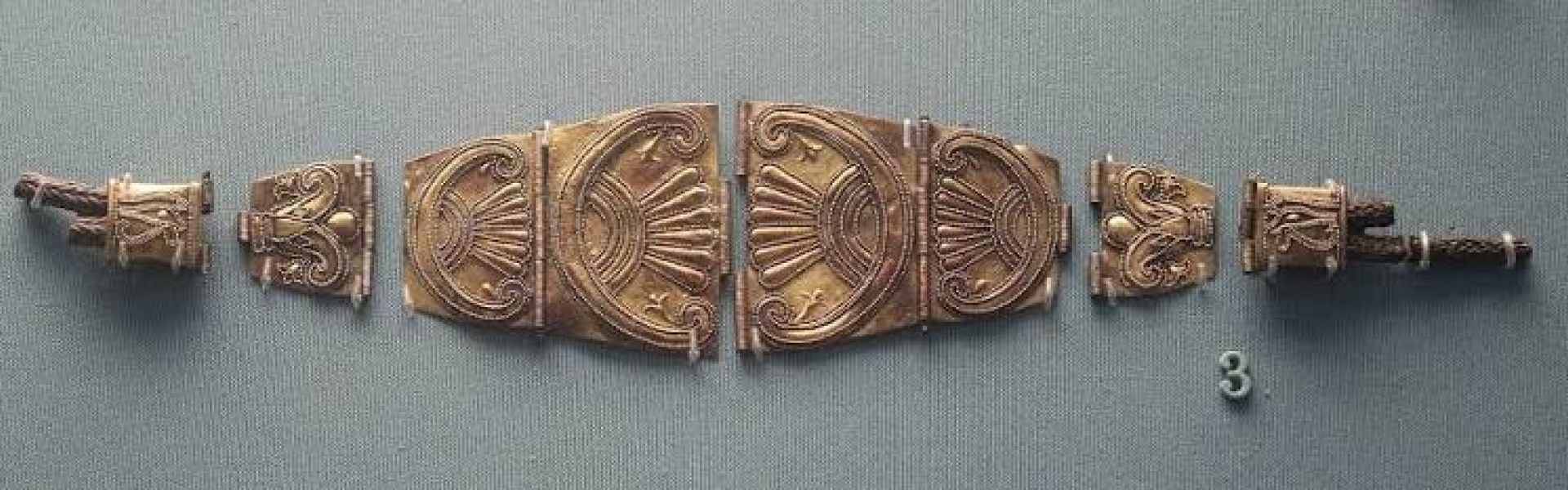
That Egyptian flavour runs through the Phoenician material from Malta. The National Museum of Archaeology in Valletta holds Phoenician gold and silver amulets with a marked Egyptian influence, not because they came from Egypt, but because the Phoenicians were great admirers of Egyptian style and loved to adorn themselves with Egyptian-looking ornaments. Malta, in other words, was plugged into a vast, cosmopolitan trading system that stretched from the Levant to Egypt to the Aegean to the far western Mediterranean and the islands prospered as a node within it, a stopping-point and trading post linking Sicily and southern Italy to the North African coast.
The Gods of Phoenician Malta: Tas-Silġ and Melqart

Religion was central to Phoenician life, and it has left some of the most important traces on Malta above all at the sanctuary of Tas-Silġ, on a low hill overlooking Marsaxlokk harbour in the south-east of the island.
Tas-Silġ is one of the most remarkable sacred sites in the whole Mediterranean, because worship there continued, on the same spot, across thousands of years and several completely different religions. The Phoenicians established a cult site there that succeeded an earlier prehistoric one, building their sanctuary on ground that had already been sacred to the temple-builders millennia before, and the site would later become a Roman temple and then, in Byzantine times, a Christian church with a baptistery. At Tas-Silġ the Phoenicians worshipped Astarte, the great Phoenician goddess (whom the Romans would later identify with Juno). The site's continuous sacred use, from prehistory through the Phoenicians and Romans to the Christians, makes it a kind of religious palimpsest, layer upon layer of the divine on a single Maltese hilltop.
The other great Phoenician deity connected with Malta was Melqart, the patron god of the city of Tyre, the mother-city of much of the Phoenician diaspora. Melqart, whose name means roughly 'King of the City', was so important that the Greeks came to identify him with their own hero-god Heracles (the Roman Hercules). And it is to Melqart that Malta owes its most famous contribution to world knowledge.
The Cippi of Melqart: Malta's 'Rosetta Stone'

In the late 17th century, a pair of marble cippi, small pillars or columns, used as votive monuments, were discovered in Malta, probably in the south near Marsaxlokk. Dating to the 2nd century BC, each bore an identical inscription in two languages and two scripts: four lines of Phoenician and three lines of Greek. They recorded a religious dedication to the god Melqart by two brothers, Abdosir and 'Osirshamar, sons of a man from Tyre.
That doubled, bilingual text turned out to be priceless. Because the Greek could already be read, and the Phoenician could not, the cippi provided scholars with a parallel text, the same words in a known and an unknown script, side by side. In 1758, the French scholar Abbé Jean-Jacques Barthélemy used exactly this to crack the code, correctly identifying 18 of the 22 letters of the Phoenician alphabet and effectively beginning the modern decipherment of the entire Phoenician and Punic language. It is for precisely this reason that the Cippi of Melqart are known as the 'Rosetta Stone of Malta' — a small island's enormous gift to the study of the ancient world. (Their inscription is still known to scholars as the Melitensis prima, the 'First Maltese' inscription.)
The two cippi have had a wandering history since. In 1782, the Grand Master of the Knights of St John, Emmanuel de Rohan-Polduc, presented one of them to King Louis XVI of France as a diplomatic gift; it entered the collections of the Louvre, where it remains on display in Paris to this day. Its twin stayed in Malta and is now one of the treasures of the National Museum of Archaeology in Valletta. In 2023 the two were reunited for the first time in around 240 years, first at the Louvre Abu Dhabi and then back home in Valletta, a moving reunion of the two halves of Malta's greatest ancient gift to the world.
From Phoenician to Punic: The Coming of Carthage
Here we need to draw a distinction that is often blurred, but matters. 'Phoenician' and 'Punic' are not quite the same thing.
The original Phoenician homeland in the east; Tyre, Sidon and the rest, fell into decline from the 8th century BC onwards, ground down by the great land empires of the Assyrians and then the Neo-Babylonians. As the eastern cities weakened, power in the Phoenician world shifted decisively west, to the greatest of all the Phoenician colonies: Carthage, in what is now Tunisia. The civilisation of Carthage and its dependencies is what historians call 'Punic' (from the Latin word for Phoenician).
Around the middle of the 6th century BC (roughly 550 BC), Malta, like most of the western Phoenician settlements, came under the sway of Carthage. Here again, the Maltese evidence suggests the transition was peaceful: there is a striking Phoenician-to-Punic cultural continuity on the islands, perhaps unmatched anywhere else in the Mediterranean, with no sign of violent rupture. Malta simply passed from the orbit of the declining eastern cities into the orbit of their thriving western daughter-city. Under Carthaginian rule the islands continued to prosper as a trading station, and increasingly absorbed Hellenistic (Greek) influences in their art, pottery and architecture, reflecting Malta's position at the crossroads of the Punic and Greek worlds. Punic remains from this era survive at sites such as the tower at Żurrieq and the sanctuary of Ras il-Wardija in Gozo.
This Punic Malta endured until the Second Punic War, when, in 218 BC, Rome took the islands from Carthage. Even then, Punic culture did not vanish overnight, the language and customs lingered for centuries under Roman rule, but Malta's political future now lay with Rome. The Phoenician-Punic chapter, some six hundred years long, was drawing to a close.
A Famous Myth: The Maltese Language
No article about Phoenician Malta would be complete, or honest, without addressing one of the most persistent beliefs in Maltese culture: the idea that the Maltese language descends from Phoenician. It is a lovely story. It is also, according to the clear consensus of modern scholarship, not true.
The modern Maltese language is a Semitic language and because both Phoenician and Arabic are Semitic, the two can sound superficially similar, which is where the confusion begins. But Maltese does not descend from the ancient Phoenician-Punic tongue that died out on the islands. It descends from Siculo-Arabic, a medieval dialect of Arabic, introduced after the Arab period, when Malta was repopulated by Siculo-Arabic-speaking settlers, and which then evolved, in isolation and under heavy Italian and Sicilian influence, into the distinct language spoken today. Maltese is, in effect, the last living descendant of Siculo-Arabic, a genuinely remarkable thing to be, but its roots lie in the medieval Arabic world, not the ancient Phoenician one.
The 'Phoenician' theory has a traceable history. It appears to have been launched in 1536 by a scholar named Jean Quintin, who saw the ancient Punic inscriptions on Malta and leapt to the conclusion that the local language must be their survival. The idea was later taken up, in good faith but mistakenly, by pioneering Maltese linguists including Giovanni Pietro Francesco Agius de Soldanis and Mikiel Anton Vassalli (often called the 'father of the Maltese language'). The theory was attractive for understandable reasons: it connected the Maltese to a prestigious, ancient, non-Arab civilisation, and for a Christian people it felt more comfortable than acknowledging an Arabic origin. But it was built on vague impressions rather than evidence, crucially, it was proposed before the Phoenician script had even been deciphered (in 1758, using Malta's own Cippi, as we have seen), and no serious linguistic comparison ever supported it. Modern linguistics has settled the question decisively.
None of this diminishes the Phoenician achievement in Malta, it simply means their deepest legacy is not the one folklore assigns them. The Phoenicians really did make Malta literate, really did connect it to the wider ancient world, and really did leave the Cippi that unlocked their own lost language. That is legacy enough, without the language myth.
The Islands between the Worlds
What was Malta like under the Phoenicians? The honest answer is that we see it only in fragments; in tombs and amulets, in a few precious inscriptions, in the sacred layers of Tas-Silġ, in a pair of inscribed pillars and much of the daily texture of those six centuries is lost to us. But the fragments tell a consistent and rather wonderful story.
They tell of a small, prosperous, cosmopolitan island community, living peacefully alongside the descendants of the temple-builders, plugged into a trading network that spanned the entire Mediterranean. They tell of an island that gained writing, wealth and a place in the wider world; that worshipped Astarte and Melqart on hills that had been sacred since prehistory; that buried its elite with imported jewellery and fine wine-cups; and that passed, gently and without apparent violence, from the Phoenician east to the Carthaginian west and finally into the hands of Rome.
Above all, Phoenician Malta is the moment the islands stepped out of the silent world of prehistory and into recorded history; the moment Malta began, for the first time, to write things down. Everything that came after, the whole long documented story of the Maltese islands, begins here, with the traders from the eastern sea who made a small central-Mediterranean archipelago literate, and left behind, in two inscribed pillars, the key to their own forgotten voice.

About Matthew Gollcher
Hi, I'm Matthew, an SEO Specialist and Content Writer at Yellow Pages Malta. I'm passionate about creating meaningful content and exploring AI's creative possibilities. When I'm not working, I enjoy the gym, time with friends, watching series and reading, and playing guitar. I'm always eager to learn and grow both personally and professionally.