The Tile Floors of Maltese Homes: Where They Came From and Why They're Vanishing


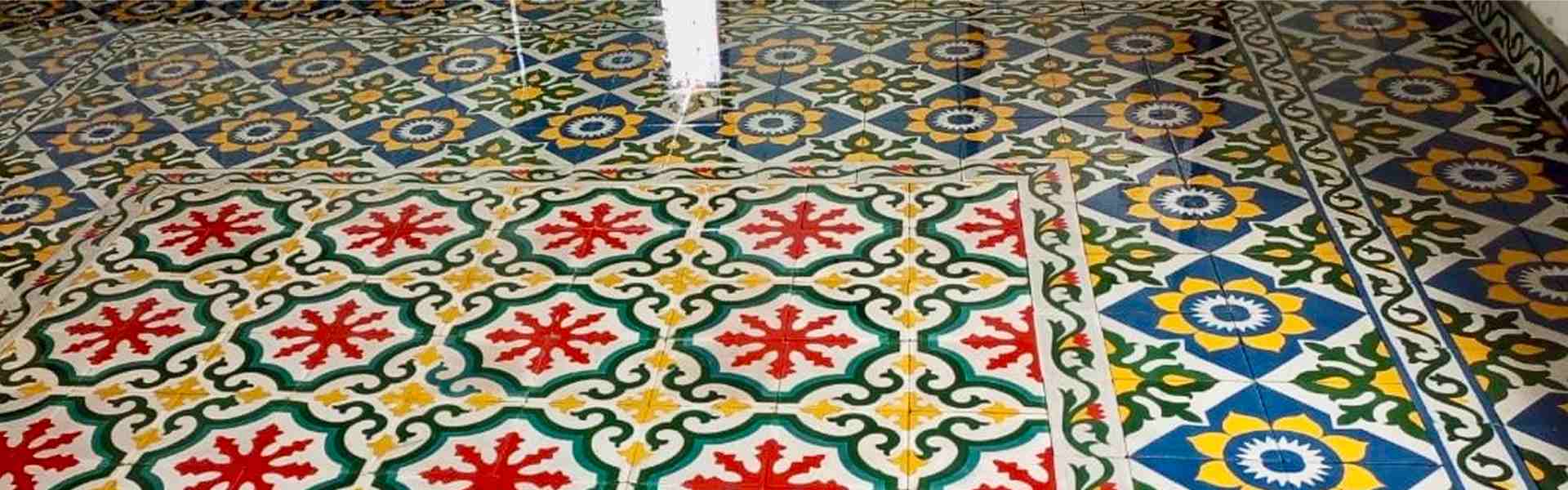
Step inside an old Maltese townhouse; a dar tal-karattru, a house of character, and look down. The floor will very likely be one of the loveliest things in the building: a carpet of patterned tiles in deep greens, reds, greys, ochres and blacks, laid out in geometric stars, swirling vines, concentric shapes or floral medallions, often bordered like a rug so that the whole room seems gently 'carpeted' in stone. These are the famous Maltese tiles — in Maltese, il-madum, maduma ta' Malta and for many people they are as much a part of the Maltese home as the limestone walls and the carved wooden balconies.
They are also, quietly, disappearing. Across the islands, as old houses are gutted and renovated, these handmade tiles are being ripped up and thrown into skips by the thousand. At the same time, a small but passionate movement of artisans, artists and salvagers is fighting to save them.
So where did these beautiful floors actually come from and why are they vanishing? There is a lot of romantic folklore attached to the Maltese tile, and not all of it survives scrutiny. This article tries to tell the honest story: what these tiles really are, where the craft genuinely came from, why they are disappearing, and who is working to bring them back. Where the popular accounts and the actual history disagree, we'll say so.
First, What They Actually Are: Encaustic Cement Tiles

To understand the Maltese tile, you have to understand what it is not. It is not a ceramic tile. With an ordinary glazed ceramic tile, the pattern and colour sit in a thin glaze on the surface, baked on top of a clay body; scratch through the glaze and the colour is gone.
The Maltese tile is something different and, in a way, far more durable: it is an encaustic cement tile. Here the colour is not a surface glaze but a whole solid layer of pigmented cement, often several millimetres thick. The pattern is not painted on it is built into the body of the tile. This is why a well-made cement tile can be walked on for a century and, rather than wearing away, can actually look better with age; and it is why giving an old, dull tile an abrasive polish, togħrku in Maltese, brings the original colour blazing back to the surface, because that colour runs right through the top layer.
The ingredients are simple and humble: cement, powdered marble, and coloured pigment, over a backing of coarser sand and cement. (Older accounts say beach sand was originally used in place of the powdered marble, before marble dust became standard.) Crucially, unlike ceramic tiles, they are not fired in a kiln, they are formed under pressure and left to cure slowly. That single fact is the key to the whole history of these tiles, as we will see.
How They Are Made: A Craft of Pressure and Patience

The making of a Maltese tile is a genuine craft, and it has changed remarkably little. The tools have Maltese names that tilemakers still use. The plakka is the metal mould that holds the design, divided into compartments, one for each block of colour in the pattern. The kwadru is the frame that holds everything together as it sets, and the tampun the plate used to apply pressure.
The process runs roughly like this. The tilemaker prepares small batches of cement mix in each of the colours the pattern requires, blending cement, marble powder and pigment. These coloured mixes are poured, one colour at a time, into the appropriate compartments of the mould a slow, careful business, since the colours must not run into one another. (Tilemakers use particular cements for this: putraxx, which soaks up excess water to stop the colours bleeding, and milanc, which helps the tile set.) A backing layer of coarser sand-and-cement is added to give the tile its body. Then the whole thing is compressed under great pressure, and finally removed from the mould and left to cure slowly not baked, but dried in carefully managed conditions, because the humidity, the temperature and the viscosity of the mix all affect whether the finished tile is flawless or cracked. Maltese tiles are usually about eight inches square.
Every single tile is made individually, by hand. A floor is built up tile by tile, pattern by pattern, like assembling an enormous mosaic. It is exactly this the slow, skilled, physically demanding, one-at-a-time nature of the work that explains both why these floors are so treasured and why, as we'll see, the craft is now so endangered.
Where The Tiles Originate From

Now for the contested part. If you read the popular accounts of the Maltese tile, on property websites, in tourism articles, on artisan blogs, you will encounter two claims again and again: that the tiles are of Ottoman or Turkish origin, inspired by the mosaic tiling of mosques and palaces; and that they have been used in Malta for 'around 300 years'. Both claims deserve a closer and more honest look, because the technical history of the tiles complicates them considerably.
Here is the key fact. The encaustic cement tile, as a manufactured object, is not ancient. It is a 19th-century invention. The technique depends on two things that simply did not exist before the 1800s: modern Portland cement (patented in 1824 and refined through the following decades) and the hydraulic press needed to compress the tiles. The first European cement-tile production is generally traced to Spain, Catalonia, around the 1850s with the south of France close behind, and from there the craft spread rapidly across the urbanised Mediterranean and beyond: to Italy, Portugal, North Africa, the Levant, Latin America and the French and Spanish colonies, becoming hugely fashionable in homes, villas, palaces and public buildings from the late 19th century into the mid-20th.
This has a clear and unavoidable implication for the Maltese story. A tile that requires Portland cement and a hydraulic press cannot have been made in Malta 300 years ago; that would place it around 1720, more than a century before the technology to make it existed. The widely-repeated '300 years' figure, however charming, cannot be literally correct for these cement tiles. The most reasonable conclusion, consistent with the technical history, is that patterned cement tiles arrived in Malta as part of the same Mediterranean-wide wave, most likely in the late 19th or early 20th century, during the British period, which fits the observation, made in several accounts, that Malta's much older houses and farmhouses used stone slabs and limestone flagstones, not patterned tiles, and that decorative tiling became widespread only in more recent centuries.
What about the 'Ottoman origin'? Here a careful distinction is needed. The decorative impulse behind patterned tiling, the love of geometric and floral pattern covering a surface, does have deep roots in the Islamic and Mediterranean tiling and mosaic traditions, and the 19th-century European fashion for such tiles was bound up with Orientalism, the era's fascination with the design of the East. So it is fair to say the aesthetic draws on older eastern Mediterranean traditions. But the specific object, the encaustic cement tile, is a Victorian-era industrial product, and the consensus among those who have looked at the technique is that the Maltese version most closely resembles the Spanish method. One honest Maltese source puts it best: the true origins of Malta's tile tradition 'will probably never be fully understood'.
So the most accurate thing we can say is this: the Maltese tile is a local expression of a 19th-century Mediterranean craft, most technically akin to the Spanish tradition, carrying a decorative DNA that reaches back to older eastern tiling and which took root in Malta, probably in the British era, deeply enough that Maltese tilemakers developed their own distinctive patterns and style. It is genuinely 'Maltese' not because it was invented here, but because Malta made it its own.
In the Home: Where the Tiles Were Used, and Why?

Within the traditional Maltese house, the patterned tiles were not used everywhere and where they were used tells you something about how Maltese families lived.
The finest tiled floors were generally laid in the entertaining spaces: the formal dining room, the reception room, the main hall, the rooms where guests were received and the family displayed its taste. The patterns were often arranged exactly like a carpet, with a decorative 'field' in the centre and a contrasting 'border' running around the edge of the room, deliberately mimicking a rug laid on the floor. The effect was to bring colour, richness and a sense of occasion into a home whose walls were the plain honey-coloured local limestone.
Tellingly, the tiles were usually not used in kitchens and bathrooms, and there is a practical reason. Cement is porous: it readily absorbs spilled liquids and stains quickly, which makes it poorly suited to the wettest, messiest rooms of the house. (This is also why new cement tiles need to be polished and sealed, and why a damp-proof underlay is recommended beneath them.) The beautiful patterned floors were for the rooms of display and gathering, not for hard daily scrubbing. Common colours were greens, reds, greys and blacks; common motifs ran from the simple, squares, the Maltese cross, to the dazzlingly intricate: floral medallions, twisting vines, eight-pointed stars and dizzying concentric geometries.
Why They're Vanishing

If these tiles are so beautiful and so durable, why are they disappearing? Several forces have combined against them.
The first is renovation and redevelopment. Malta is in the grip of an intense, decades-long construction and renovation boom. Old houses of character are routinely gutted or demolished, and when they are, the original tiled floors are very often simply broken up and thrown away. Anyone who follows the salvage scene will tell you the same thing: these tiles end up in skips outside construction sites across the islands, by the thousand, treated as rubble rather than heritage.
The second is changing fashion. For a long stretch of the modern period, the old patterned tiles fell out of favour, seen as old-fashioned, associated with the cramped homes of the past, and swept aside in favour of large-format modern ceramic, porcelain, marble and terrazzo tiles, which were cheaper, mass-produced, easier to lay and easier to keep clean. A whole generation of Maltese homeowners actively wanted rid of the old tiles. Many irreplaceable floors were lost in exactly the decades when they were least appreciated.
The third, and perhaps most serious in the long run, is the decline of the craft itself. Making these tiles by hand is, as we have seen, slow, skilled and physically demanding work. The number of artisans still practising it has dwindled dramatically. As one Maltese source puts it plainly, the number of artisans still making these tiles is now very small, and it is hard to find dedicated people with the patience to take on such time-consuming and physically demanding work. When a craft depends on a handful of ageing practitioners and few young people are entering it, every retirement is a step closer to the knowledge being lost altogether.
The Fightback: Saving the Maltese Tile

Here, though, the story turns more hopeful, because alongside the losses, a genuine revival is under way, driven by a small movement of people who refuse to let the Maltese tile die.
There are the salvagers, who rescue old tiles from the skips and the doomed houses and give them a second life. The best-known is Thomas Camilleri, who founded a project he called Lazarus Tiles, the name says it all, after becoming fascinated by the tiles during his own home renovation. He hunts down discarded tiles across the islands (friends and family tip him off whenever they spot an interesting skip), painstakingly cleans and restores them; chiselling the old cement off the back, washing, gentle scraping to preserve the patina, then a wax finish that brings out the colour without sealing the tile so it can still 'breathe', and mounts them in frames as works of art, so that floors which can no longer be walked on can still be hung on a wall and loved.
There are the artists, above all Stephanie Borg, who since 2008 has been photographing and faithfully reproducing the patterns of old Maltese cement tiles, describing her aim as reviving appreciation for a 'dying craft' and keeping its patterns alive by putting them on everyday objects, prints, textiles, stationery, ceramics; so that the designs survive even where the original floors do not.
And there are the makers, the family workshops and businesses, such as those trading today under names like Malta Tiles, who keep the actual craft of handmaking cement tiles alive, producing new tiles by the traditional method for homeowners restoring old properties or wanting a touch of authentic Maltese heritage in a new one. Because new cement tiles are still made, a homeowner who has lost their original floor, or who is building from scratch, can still have a genuine handmade Maltese tiled floor laid today, bespoke, in traditional or custom patterns.
Underpinning all of this is a broad shift in appreciation. After the decades when the tiles were unfashionable, Maltese homeowners restoring houses of character increasingly want the original tiles, prizing them for the authenticity, character and sheer beauty they bring, and for the way they root a home in the island's past. Estate agents now list intact patterned-tile floors as a selling point. The tiles that a previous generation threw into skips are, increasingly, the very thing buyers are looking for.
A Floor Worth Saving

The Maltese tile is a small, beautiful example of how heritage actually works, and how nearly it can be lost. It is not, as the romantic stories claim, an ancient Ottoman art three centuries old. It is something arguably more interesting: a 19th-century Mediterranean craft, born of cement and pressure and the fashions of the Victorian age, that Malta adopted, adapted, and made so thoroughly its own that it became one of the defining features of the Maltese home.
For a while, the islands nearly threw it all away; into the skips, in the rush to modernise. That so much survives, and that the craft is being revived rather than mourned, is down to a handful of dedicated salvagers, artists, artisans and homeowners who looked at those patterned floors and saw not something old-fashioned, but something worth saving.
The next time you stand in an old Maltese house and look down at a floor of greens and reds and intricate, hand-poured pattern, it is worth remembering what you are looking at: hundreds of individual tiles, each one made by hand, each one the work of a craft that came across the sea and put down roots here, and each one a small piece of a heritage that was very nearly lost and is, slowly, being brought back to life.

About Dr Hillary Hopkins
Dr Hopkins is a Maltese lawyer, with a love for Malta's historic stories, forgotten corners, and little cultural rabbit holes.