The Maltese Families Who Spent Years Living Underground During World War II


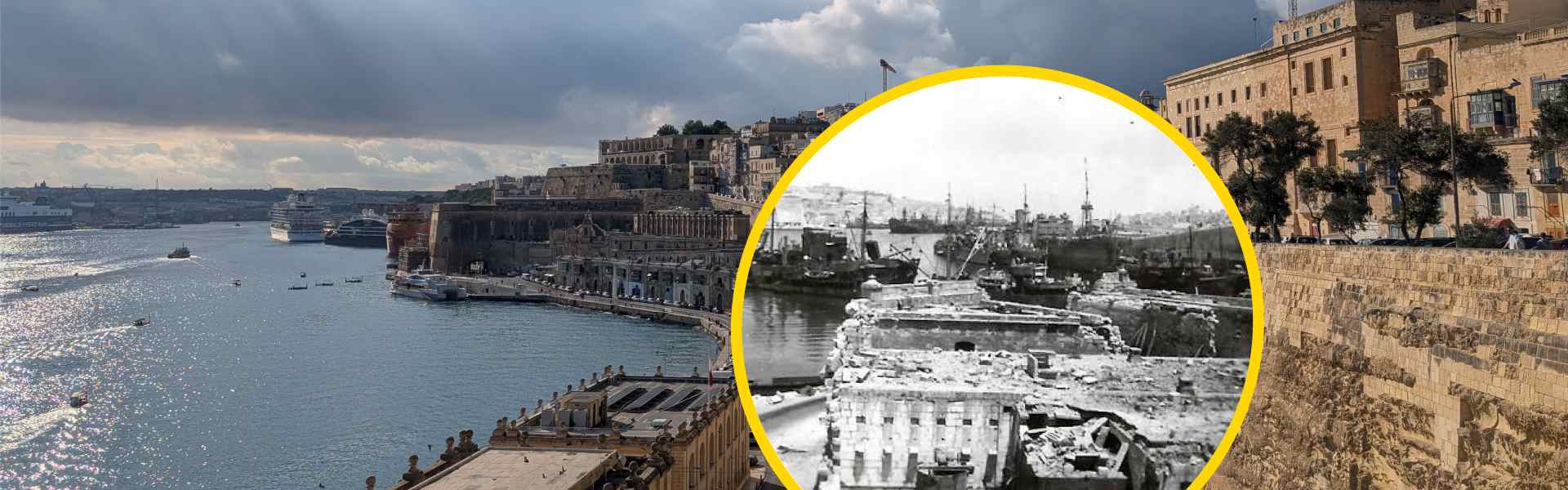
When the bombs came; and between 1940 and 1942 they came down on Malta more heavily than on almost anywhere else on earth, the Maltese did the only thing they could. They went underground.
Beneath the honey-coloured towns of Malta lies soft globigerina limestone, the same stone the islands are built from: easy to cut, yet solid enough to stop a bomb once there was enough of it overhead. Into that rock, using little more than pickaxes, hand-drills and sheer determination, the Maltese carved hundreds of air-raid shelters and then, as the siege ground on through its worst months, they went further, and made those shelters their homes. They slept underground night after night, dug out private rooms for their families, cooked, prayed, fell ill, gave birth and, sometimes, died beneath the rock. For a period of the war, a great part of the population of Malta effectively lived below ground.
This is the story of that underground world: how it was built, what life was like inside it, and the families who spent the darkest years of the war beneath the surface of their island. Every figure and detail below has been checked against the historical record including an account of what 'living underground' really meant.
Why They Went Below: The Most Bombed Place on Earth

To understand the shelters, you have to understand the scale of what was happening above them. Malta's position in the central Mediterranean, astride the sea lanes between Italy and North Africa, made it one of the most strategically vital, and therefore most relentlessly attacked, places of the entire Second World War.
Between June 1940 and the end of 1942, German and Italian aircraft flew more than 3,000 bombing raids against the tiny archipelago, making Malta, by common reckoning, the most heavily bombed place on earth. The bombardment reached an almost unimaginable intensity in the spring of 1942: in April 1942 alone the island's worst month there were 282 separate raids, and there was a stretch during that year when, there was only a single 24-hour period without bombs falling between the start of January and late July. It was for enduring this that the entire island was awarded the George Cross by King George VI on the 15th of April 1942.
At the start of the war, ordinary Maltese homes offered almost no protection. People were advised to shelter in cellars, under staircases, or beneath sturdy tables padded with mattresses and they quickly discovered that the masonry of their houses simply could not withstand a direct hit or even a near miss. The turning point in the popular mind came with the Illustrious Blitz of January 1941, when the Luftwaffe's ferocious attacks on the aircraft carrier HMS Illustrious in the Grand Harbour brought a new and terrifying level of destruction to the surrounding towns. After that, one thing was clear to everyone: the only safe place was underground.
Carving a Refuge from the Rock

The digging became a national effort. The colonial government, under the Governor, made bomb-proof shelter a matter of the greatest urgency, and over 2,000 miners and labourers were set to work hewing out shelters in key locations. But official effort was only part of it: all across the islands, ordinary people men, women and children, and teams of volunteers — took up tools and dug, often giving their labour freely in return for knowing their own neighbourhood would have enough refuge.
The results were remarkable. By June 1941, there were 473 public rock shelters complete, with a further 382 under construction, together offering protection for around 138,000 people with thousands more sheltering in concrete or private shelters. The pace never let up, and at the end of November 1941 the Governor was able to make an extraordinary announcement: there was now space available in a shelter for the whole population of Malta. By the end of the war the islands were honeycombed with these refuges by one count, some 900 shelters across Malta.
The shelters were dug deep enough to survive almost anything the enemy could drop. Ten to twelve metres of solid rock overhead was common; some shelters descended as much as eighty feet into the living stone. A British serviceman, writing home at Christmas 1942, told his family that Malta's shelters were, in his opinion, 'the finest in the world'. They were entered through staircases protected by 'bomb-proof hoods' designed to stop falling rubble from burying the entrance and some were fitted with anti-gas doors, in case the enemy ever resorted to poison gas.
Life in the Rock: From Shelter to Home

For most Maltese, most of the time, the shelters were a place to endure an air raid; an hour, or several hours, of darkness, noise and prayer, before the 'all clear' sounded and people climbed back into the daylight to see whose house was still standing. But as the raids grew more frequent and more prolonged, sometimes continuous, day and night, the distinction between 'sheltering' and 'living' underground began to dissolve. By February 1942, with raids often lasting through the night, the shelters were becoming congested with the chairs, bedding and belongings that people brought down for comfort and rest. For many families, the shelter was now, in every meaningful sense, home.
A striking feature of the Maltese shelters was the private family cubicle. Once the government had ensured there was enough basic shelter space for the whole community, it allowed private individuals and families to excavate their own rooms off the main public corridors, at their own expense, work often carried out by the women and children of the family, since so many men were engaged in war work. These cubicles, typically around six feet wide and spaced a safe distance apart, could not be sealed off with solid doors, the authorities forbade anything that would block the free flow of air through the shelter, so families screened them off with curtains or gated frames instead.
Within these little rock rooms, people tried, movingly, to recreate the dignity of home. The more enterprising families furnished their cubicles with personal belongings, laid down tiles on the rough floor, painted the walls, fitted makeshift wooden-plank doors, and, where the erratic wartime power supply allowed, wired them for electricity, installing the fixtures themselves. In the shelters beneath the Wignacourt Museum in Rabat, families paid to have numbered rooms dug out of a pre-existing network of ancient catacombs, then made them 'homely' with paint, tiles and plank doors. Where there was no electricity, and Malta's single power station in Floriana was bombed again and again, people lit their world with crude homemade lamps: a bowl hewn into the rock, filled with water topped by a layer of oil or fat, with a floating wick set alight.
Order was imposed as far as possible. Shelters were placed under the charge of Shelter Wardens or Supervisors, often drawn from the civil service, the professional classes or the clergy, who allocated places, kept the spaces clean, and regulated shelter life; as an inducement for the voluntary role, a warden was given free use of a cubicle for his own family. Notices were posted on the rock walls reminding people not to spit, smoke, or 'commit nuisances'. And through it all ran the sound that so many survivors remembered above any other: the murmur of the rosary, recited over and over in the darkness of the corridors as the bombs fell above.
Born Underground, and the Sickness in the Dark

Perhaps nothing captures the reality of underground living more than this: in the shelters of wartime Malta, babies were born.
So many people were living below ground for so long that, in 1942, the government issued a decree requiring all major public shelters to include a 'birth room' a cubicle set aside as a makeshift maternity ward, where expectant mothers could give birth in some small measure of privacy, beneath the rock, while the raids went on overhead. The larger shelter complexes, such as the great tunnels at Mellieħa, had their own maternity hospital and clinic. A generation of Maltese quite literally began their lives underground.
But the same crowding that made the shelters safe from bombs made them dangerous in another way. Packed with people for hours or days at a time, damp, poorly ventilated, and increasingly filled with the malnourished as the food ran short, the shelters became breeding grounds for disease. Survivors and historians record that scabies, remembered by many as the worst affliction of all, spread rampantly, along with dysentery, tuberculosis, typhoid, and the lice, fleas and bedbugs that thrived in the cramped conditions. Hunger made everything worse: under the Axis naval blockade, rations fell to desperate levels, with an adult man allotted only around 1,400 calories a day when he needed more than twice that. To live underground in Malta in 1942 was to be safe from the bombs, but exposed to sickness, darkness, hunger and fear.
The Families Who Truly Lived Below
So did Maltese families really spend years living underground? The honest answer is that it varied and the truth is remarkable enough without exaggeration.
For the majority, 'living underground' meant something intermittent but relentless: retreating below ground for every raid, and, during the worst stretches of 1942, sleeping in the shelter night after night for weeks and months on end, while spending daylight lulls above ground tending to what remained of ordinary life. The shelter was where you slept, where your bedding and your few belongings were, where your family gathered when the sirens went. Over the roughly two and a half years of heaviest bombing, the cumulative time spent below ground, for a family in one of the harbour towns, ran not into days but into months.
Whole communities relocated below ground. In the northern village of Mellieħa, diggers began in July 1941 to hollow out what became one of the longest shelter complexes on the island, over 500 metres of hand-cut tunnels, twelve metres down in the limestone, dug entirely by hand. These tunnels were designed to house not only the 3,842 people of Mellieħa itself but also 1,117 more displaced from other, more heavily bombed parts of the island, each person allocated as little as two square feet of space. The complex had its private family rooms, its maternity section, and, a poignant detail, a guarded room in which the treasures of the national museum in Valletta were hidden for safekeeping. Similar stories played out across the islands: over a kilometre and a half of corridors beneath Couvre Porte in Birgu; more than a hundred people sheltering below the noble house of Casa Rocca Piccola in Valletta; some four hundred beneath what is now a restaurant in Mġarr; the ancient hilltop Cittadella in Gozo honeycombed with refuges.
The Rock that Saved a Nation
When the siege finally eased in the latter half of 1942, after the arrival of the battered Operation Pedestal convoy in August, and the turning of the wider war, the Maltese slowly came back up into the light for good. They emerged into a landscape of extraordinary devastation: some 30,000 buildings destroyed or damaged, around 50,000 people made homeless, whole streets of the harbour towns reduced to rubble. But they had survived. And a great part of the reason they had survived was the rock beneath their feet.
It is worth pausing on the sheer scale of what was achieved. A small, poor, hungry island population, under one of the most intense bombardments in the history of warfare, dug themselves an entire second city underground; hundreds of shelters, thousands of family rooms, maternity wards, chapels, and kilometres of corridor, largely by hand, largely themselves. The shelters are the physical proof of the quality for which Malta was given the George Cross: not a passive endurance, but an active, collective, determined refusal to be destroyed.
Many of those shelters survive today, and several are open to visitors, the great tunnels at Mellieħa, the Malta at War Museum shelter at Couvre Porte in Birgu, the Wignacourt Museum catacomb-shelters in Rabat, the shelters beneath Casa Rocca Piccola in Valletta, and the recently-opened refuges under the Cittadella in Gozo. To walk down into them now, into the cool, damp, silent dark, past the hand-cut family cubicles with their niches and their scratched-in names, is to stand inside one of the most moving of all Maltese historical spaces. On the walls of the Mellieħa tunnels, among the messages left by those who sheltered there, one inscription reads, simply: 'We wait in silence.'
That is what a generation of Maltese did, beneath their island, through the worst years of the war. They waited, in the silence and the dark, in rooms they had cut from the rock with their own hands, slept there, prayed there, were born there, fell ill there, and held on, until at last the bombs stopped, and it was safe to climb back up into the Maltese sun. The families who spent those years underground are the living heart of the island's George Cross story: ordinary people who, quite literally, went into the earth to keep their families alive, and came back up to rebuild a nation.

About Dr Hillary Hopkins
Dr Hopkins is a Maltese lawyer, with a love for Malta's historic stories, forgotten corners, and little cultural rabbit holes.