The Lazzaretto of Manoel Island: Inside Malta's Forgotten Quarantine Station


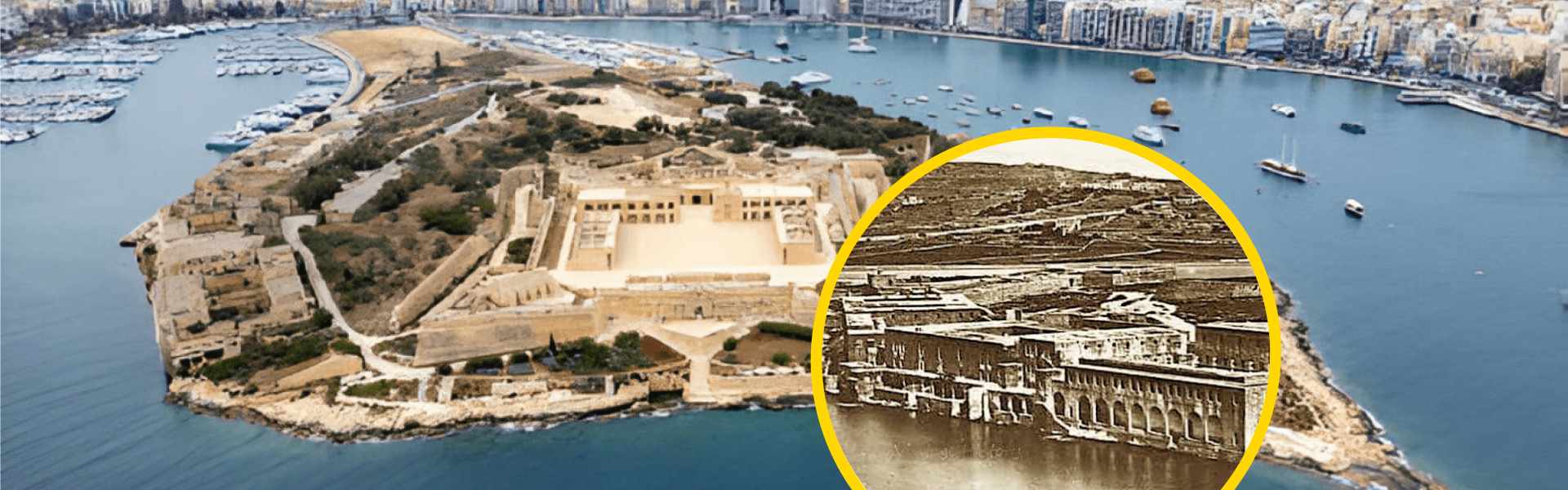
Look out across Marsamxett Harbour, from the Valletta bastions, from Sliema, from Ta' Xbiex or Gżira, and your eye will be caught by a long, low, honey-coloured building on Manoel Island, its ground floor an elegant run of arches rising sheer out of the sea. Today it is crumbling, roofless in places, half-forgotten, overshadowed by the yacht marina and the star-shaped fort beside it. But for more than two and a half centuries, this was one of the most important, and most feared, buildings in all of Malta.
This is the Lazzaretto, in Maltese il-Lazzarett: Malta's great quarantine station. For over 250 years, anyone who arrived on these islands by sea, merchant or sailor, pilgrim or nobleman, and their cargo and even their letters, could be confined here, cut off on this island in the middle of the harbour, for weeks on end, to prove they were not carrying one of the deadly plagues that periodically swept the Mediterranean. It was the island's front line of defence against contagion, and in an age before germ theory, it worked.
Its story runs from the plague-terrified world of the Knights of St John, through the golden age of Mediterranean travel, it held Lord Byron, and a future cardinal, and others whose names you will know, to a Second World War submarine base, and finally to the crumbling, derelict shell that awaits restoration today. This is the forgotten story of the Lazzaretto of Manoel Island. Every fact below has been checked against the record.
Why an Island? Malta and the Terror of the Plague

To understand the Lazzaretto, you have to understand the fear that built it. Malta sat at the crossroads of the Mediterranean, a busy hub for merchant ships, naval squadrons, pilgrims and captives moving between Europe, North Africa and the Levant. That traffic brought prosperity, and it also brought the constant, terrifying risk of plague, which could arrive on any ship from an infected port and, in a matter of weeks, kill a substantial part of the population.
The Knights of St John, who took over Malta in 1530, were a Hospitaller order with a long maritime and medical tradition, and they understood the danger acutely. The answer, developed across the Mediterranean and embraced hard in Malta, was quarantine, from the Italian quaranta, 'forty', for the forty days of isolation originally imposed. The principle was simple and, for its time, brilliant: hold new arrivals in isolation for long enough that, if they were carrying disease, it would show itself before they ever mixed with the population. And the ideal place to hold them was somewhere they could not escape from: an island within the harbour.
From around 1526, the waters of Marsamxett Harbour around a small islet, then known as the Isolotto, or Bishop's Island, because it belonged to the Cathedral of Mdina, began to be used as a quarantine anchorage. During the devastating plague of 1592–93, a temporary quarantine hospital of wooden huts was thrown up on the island, reportedly housing as many as 900 patients, along with a small chapel dedicated to Saint Roch, the patron saint of the plague-stricken. When the epidemic passed, the huts were pulled down, but the idea had taken root.
The Knights build a Permanent Lazzaretto

In 1643, the Grand Master Jean Paul de Lascaris made the arrangement permanent. He acquired the island outright from the Cathedral Chapter of Mdina, trading it for Order lands at Tal-Fiddien, near Rabat, and built a permanent Lazzaretto to cope with the recurring waves of plague and cholera arriving on Mediterranean shipping.
Over the following century, successive Grand Masters enlarged and improved it into the sprawling complex whose ruins survive today. The main building took its present form under the grandmasterships of Nicholas Cotoner (from 1670), Gregorio Carafa (1683) and António Manoel de Vilhena (1726), with further additions under later Grand Masters. It was de Vilhena, too, who between 1723 and 1733 built the great star-shaped Fort Manoel at the other end of the island, which is how the Isolotto came to be known, ever after, as Manoel Island.
The oldest surviving part of the Lazzaretto is believed to be that striking arched terrace at ground-floor level, rising straight out of the sea, the building's most conspicuous feature, visible clear across the harbour. And to make sure no one under quarantine could simply slip away and spread contagion into the population, the whole complex was ringed on its landward side by a triple line of high walls. A visiting English navy chaplain in 1675 noted the system of walls and remarked, approvingly, that the place was 'extremely neatly kept'. This was a serious, well-run institution, not a prison exactly, but not far off, either.
Life in Quarantine: Boredom, Bureaucracy and the Pratique

What was it actually like to be held here? For most, the answer was: tedious, and occasionally frightening.
When a ship arrived, it and everyone aboard were placed under quarantine for a period set by the authorities according to how dangerous the point of departure was thought to be, anything from a few days to the full forty, or even longer for the worst-suspected ports. Passengers and crew were confined in the Lazzaretto's great arched halls; goods were unloaded, aired and fumigated; and everyone waited. Only when the quarantine period expired without sickness appearing was pratique granted, clean papers, and permission to enter Malta proper.
The complex grew to accommodate all this: isolation wards, additional halls, warehouses for airing cargo, pens for livestock, quarters for visitors, and even, for the wealthier inmates, a restaurant, a welcome improvement on the earlier arrangement whereby the rich had to order their meals from a hotel in Valletta and have them ferried across the harbour by dgħajsa, the traditional Maltese water-taxi. The halls were vast: one traveller noted that an empty ward made 'an excellent tennis court'.
But mostly there was boredom, long, empty days of idling in the courtyard, sunning oneself, reading whatever books and newspapers could be had, and waiting for the clock to run down. A marble tablet set above the main portico spelled out one firm rule, in Italian: anyone who dared to deface or damage the walls of the Lazzaretto would have their quarantine doubled to eighty days. It is a telling detail, because it tells us exactly what bored people locked up for weeks on end tended to do to pass the time, and, as we'll see, they did it anyway.
The Writing on the Walls

For all the threat of double quarantine, the inmates of the Lazzaretto could not resist leaving their mark, and the result is one of the most extraordinary and moving features of the building: its graffiti.
Across the walls and terraces, generations of the quarantined scratched their names, sketched ships, and carved inscriptions in a dozen languages, some dating all the way back to the time of the Knights, the earliest surviving examples going back to around 1681. These marks are a genuine historical treasure: a bored Spanish mariner, for instance, inscribed verses in 1795 recounting how his ship La Perla, sailing from plague-ridden Constantinople, had been caught in a terrible storm before limping into Malta, only to be confined, as he put it, 'in this theatre of purging'. Each scratch is a tiny human record of a real person, marooned in the harbour, marking the slow passage of their days.
The graffiti reveal, better than any document, what the Lazzaretto really was: not just a medical institution but a strange, involuntary, cosmopolitan meeting-place, where sailors, merchants and travellers from every corner of the Mediterranean were thrown together behind the same walls, jabbering across barriers in languages they did not share, all of them waiting out the same sentence of time.
The Famous Names

Because quarantine spared no one, not even the rich and famous, the Lazzaretto's guest list over the years reads like a roll-call of 19th-century celebrity. And several of its more literary inmates left records of their frustration that survive to this day.
The most famous was Lord Byron, the great Romantic poet, who was held here in 1811 on his way back from his travels in the eastern Mediterranean. Byron loathed it, and said so in verse: in his poem 'Farewell to Malta' he grumbled, 'Adieu, thou damnedst quarantine / That gave me fever and the spleen'. A name scratched on the wall of the veranda reserved for important passengers is, by tradition, said to have been etched by Byron himself, though, as with much graffiti, we cannot be entirely certain.
A gentler inmate was the Reverend John Henry Newman, the future Cardinal and one of the most important religious figures of the Victorian age, who was quarantined here in the winter of 1832–33. Newman made the best of it: he read Homer and Virgil, wrote letters to his sister, and composed six poems during his confinement, including one poignantly dated 'Malta, December 25th' a Christmas spent in quarantine, far from home. Other literary travellers passed through or near the quarantine over the years, among them William Makepeace Thackeray and a young Benjamin Disraeli, the future British Prime Minister, along with the French painter Horace Vernet and the French poet-statesman Alphonse de Lamartine.
One famous name is often added to this list but deserves a small correction. When Sir Walter Scott, the celebrated novelist, arrived in Malta in November 1831, with a cholera quarantine in force on arrivals from Britain, he did his nine days of isolation not in the Lazzaretto itself but in the nearby Fort Manoel, together with his family. He belongs to the island's quarantine story, but not, strictly, to the Lazzaretto's. It is the kind of detail worth getting right.
Even the Letters were Quarantined
One of the most remarkable things about the Lazzaretto is that quarantine applied not only to people and goods, but to something you might never think of: the mail.
Because it was feared that disease could travel on letters and paper, incoming mail was disinfected at a special section of the Lazzaretto known as the Profumo Office. Letters were slit or pierced to let the fumes penetrate, then exposed to disinfecting smoke and vapours, in the later, more scientific era, the fumes of nascent oxygen produced by adding formaldehyde to potassium permanganate, before being sealed up and sent on their way. Disinfected letters were marked with distinctive red wax seals and special cachets showing they had been 'purified' at the Lazzaretto of Malta.
This practice ran through much of the 19th century, the red wax seals date from around 1814 to 1844, with large-scale mail disinfection continuing until the 1880s, and used in rare cases as late as the 1930s. Today those 'disinfected mail' covers from Malta are prized by postal historians and stamp collectors around the world, a small, unexpected afterlife for the Lazzaretto's war on contagion.
From Quarantine to Submarines: The Lazzaretto at War
The Lazzaretto served as Malta's quarantine hospital for an astonishing span of time through the Knights, through the brief French occupation, and deep into the British period, during which it was enlarged again in 1837–38 and pressed into service as a military hospital during the Crimean War, nursing British, French and Italian soldiers. It saw Malta through the great plague of 1813–14, a cholera outbreak in the 1860s, and further scares right up until the 1930s, when it was used during Malta's last plague episode.
But as modern medicine advanced and the age of maritime quarantine drew to a close, the Lazzaretto's original purpose faded. In 1939, its health functions ended, and the buildings were taken over by the British Admiralty for military use and here the Lazzaretto entered the most dangerous chapter of its long life.
During the Second World War, Manoel Island and its fort became a Royal Navy base, home to the celebrated 10th Submarine Flotilla, and was commissioned under the name HMS Talbot (also known as HMS Phoenicia). From here, British submarines slipped out to devastate the Axis convoys carrying fuel and supplies to Rommel's army in North Africa, a campaign of enormous strategic importance. But the submarines had no covered pens; they were moored in the open, and the base became a magnet for enemy bombers. The Lazzaretto was, in the words of one account, damaged so heavily that to call it 'damaged' is a gross understatement. In March 1942, at the height of the siege, a direct hit by Luftwaffe bombers destroyed the island's Chapel of St Anthony. The building that had spent centuries protecting Malta from one kind of death was now being torn apart by another.
Ruin and the Promise of Rescue
After the war, the battered Lazzaretto was patched up enough to reopen, briefly, as a hospital, admitting its first post-war patients in 1949. But its great days were over. When the British forces finally left Malta, the last institutional use of the Lazzaretto went with them, and the long, sad decline began. For decades the complex stood abandoned, exposed to the sea and the weather, its roofs falling in, its walls eroding under salt, its halls vandalised. The building that had once been the busiest gateway to Malta became one of its most conspicuous ruins, visible to hundreds of thousands of people across the harbour, and known to almost none of them.
The Lazzaretto's future is now bound up with the wider, and much-debated, redevelopment of Manoel Island. Under a concession agreement, the developer MIDI, which has already restored the neighbouring Fort Manoel and Fort Tigné to considerable acclaim, has long been committed to restoring the Lazzaretto as part of the island's regeneration. The plans for the island as a whole have been the subject of intense public discussion and campaigning in Malta about how much of it should be public open space, and the Lazzaretto itself, at the time of writing, remains substantially a derelict shell awaiting the full restoration that has been promised for years. What is not in doubt is that the building is worth saving: it is a Grade-1-scheduled monument of genuine historical importance, and one of the most evocative structures on the islands.
The Island that Guarded Malta
The Lazzaretto is easy to overlook now, a crumbling row of arches across the water, upstaged by the marina and the fort. But it deserves to be remembered, because for two and a half centuries it did something quietly heroic: it stood between Malta and the plague. Every merchant, every sailor, every pilgrim, every letter that might have carried death onto these crowded islands passed first through its walls and its long, boring, life-saving weeks of waiting.
And it holds, in its scratched and salt-eaten stones, one of the most human archives in Malta; the names and ships and complaints of thousands of ordinary travellers, and a few extraordinary ones, all of them stuck on the same island in the middle of the harbour, all of them counting down the same days. Byron cursed it in verse; Newman wrote poetry to survive it; a Spanish sailor carved his shipwreck into the wall; and countless forgotten others simply scratched their names, so that someone, someday, might know they had been there.
If the long-promised restoration finally comes, Malta will get back one of its most remarkable buildings. Until then, the Lazzaretto waits, as it always did, out on its island in the harbour, keeping its long, patient watch over the entrance to Malta.

About Matthew Gollcher
Hi, I'm Matthew, an SEO Specialist and Content Writer at Yellow Pages Malta. I'm passionate about creating meaningful content and exploring AI's creative possibilities. When I'm not working, I enjoy the gym, time with friends, watching series and reading, and playing guitar. I'm always eager to learn and grow both personally and professionally.