Nearly 200,000 Maltese-Australians: How Much of Malta Still Remains?


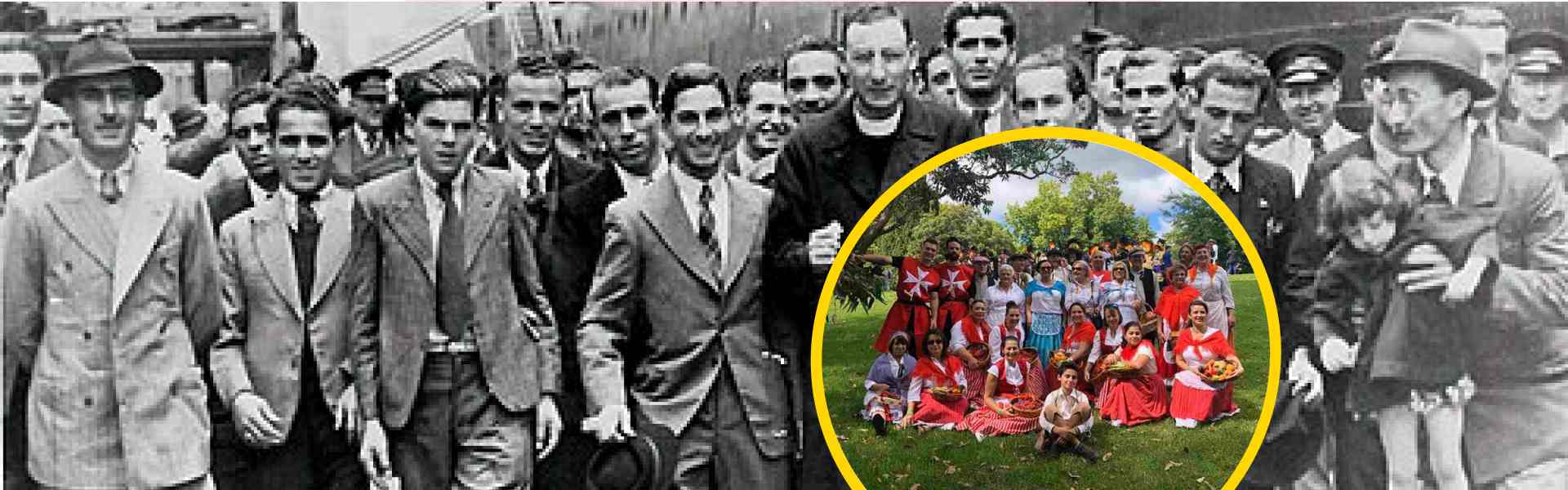
We have already told the story of why they went; the poverty and overcrowding of the post-war islands, the government schemes, the six-week voyage, the suitcases, the promise of Australia. That article ends where this one begins: with a Maltese family standing on a dock at the other end of the world, about to become something new.
This is what happened next, and it is a harder, more interesting question than the leaving. Because the leaving was a single decision. What came after was seventy years of small ones: whether to speak Maltese to your children, whether to marry within the community, whether to drive an hour to the festa, whether the grandchildren would know what a ġbejna was.
Today, Australia is home to the largest Maltese diaspora on earth. But the community is at a genuine turning point, and the numbers tell the story with unusual clarity. So: how much of Malta still remains? We went to the census data, the linguistic research and the community's own scholars for an honest answer, and it turns out to be part loss, part stubborn survival, and part something nobody expected.
The Numbers & a Widely-Repeated Error
Start with the headline figure. In the 2021 Australian Census, 198,989 people reported Maltese ancestry, and 35,413 people living in Australia had actually been born in Malta. That makes Maltese-Australians roughly 0.78% of the Australian population, and it makes Australia, comfortably, home to the world's largest community of Maltese descent, far ahead of Canada (around 40,670 by ancestry in 2021) or the United Kingdom.
Here a small correction is worth making, because it appears in some surprisingly official places. You will frequently see the figure 234,402 quoted for Maltese-Australians, including on the Australian Government's own Department of Foreign Affairs and Trade country brief. But that number is a double-count. DFAT's own briefing document explains its arithmetic: it takes the 198,989 people with Maltese ancestry, adds the 35,413 people born in Malta, and totals them at 234,402. The problem is that almost everyone born in Malta and living in Australia would also report Maltese ancestry, so the two groups overlap almost entirely, and adding them counts most of those people twice. Tellingly, DFAT's own 'fast facts' box on the same page gives the correct figure of 198,989.
The honest number, then, is just under 200,000, which is remarkable enough. It means that for every two people living in Malta today, there is roughly one person in Australia who claims Maltese descent.
The Clock that is Running Out

Beneath those headline numbers is a demographic fact that shapes everything else in this article, and it is a poignant one.
Of the 35,413 Malta-born people counted in Australia in 2021, 27,140, some 76.6%, were aged 65 or over. Their median age was 72. At the other end of the scale, just 0.3% were children under 15. This is not a population with a next generation coming through; it is a single cohort growing old together, the men and women who sailed in the 1950s and 1960s, now in their seventies and eighties.
And there is no replenishment. Migration from Malta to Australia has, for practical purposes, stopped. In Victoria, the state with the largest Maltese community in Australia, only 0.4% of the Malta-born population arrived in the five years to 2021. The reasons are entirely happy ones: Malta's independence brought better economic prospects at home, and EU membership in 2004 opened Europe to Maltese workers, making a job in Brussels or Berlin far easier than a new life twelve thousand miles away. The great emigration is simply over.
The Malta-born population is therefore shrinking with each census: roughly 41,300 in 2011, 37,600 in 2016, 35,413 in 2021. Which means the question 'how much of Malta remains?' is really a question about what the second and third generations have kept, because within a couple of decades, they will be all there is.
Where Malta Lives on the Australian Map

Malta did not scatter evenly across Australia. It concentrated, and it stayed concentrated, which is one of the main reasons anything survived at all.
The two great centres are Melbourne and Sydney. Victoria has the largest Maltese community in the country, with 81,542 people of Maltese ancestry and 16,844 born in Malta; among the Malta-born nationally, some 47.6% live in Victoria and 38.1% in New South Wales, with about 7% in Queensland. Greater Sydney alone counted 11,336 Malta-born residents in 2021.
Zoom in further and the map becomes strikingly specific. In Melbourne, Maltese migrants settled first in the western suburbs, above all Sunshine and St Albans, and then, as families prospered, moved outward into newer neighbouring suburbs such as Caroline Springs, Taylors Lakes and Hillside, the last of which now records the highest rate of Maltese ancestry in Melbourne. In Sydney, the community clustered in the west too, particularly around Greystanes and Horsley Park.
This clustering matters enormously. A community spread thinly across a continent loses its language and customs within a generation. A community that lives in the same suburbs, attends the same parishes, joins the same clubs and marries within its own circles can hold on for three or four. Western Sydney and western Melbourne are, in a real sense, where Malta went.
The Language: The Clearest Measure of Loss

If you want a single number for how much of Malta remains, the language is the bluntest one available and it is sobering.
Against nearly 199,000 people of Maltese ancestry, only around 27,000 people speak Maltese at home in Australia, according to the 2021 Census. That is roughly one in seven. Put another way: about six out of every seven Australians who call themselves Maltese do not speak the language in their own house.
The trend is downward and well documented. Ethnologue reported around 36,000 Maltese speakers in Australia in 2006, down from a considerably higher figure in the 1990s; the 2021 figure of roughly 27,000 continues that decline, and it will fall further as the Malta-born generation passes. Malta itself accounts for most of the world's roughly half a million Maltese speakers; the entire global diaspora contributes something in the order of 79,000.
What is striking is that Maltese has fared worse than some comparable community languages in Australia. Research by the linguist Borland (2005) into Maltese as a community language found that the children of Maltese migrants typically did not continue speaking Maltese at home as often as children in other ethnic communities did with theirs.
Why? Several factors combined. The Maltese arrived already bilingual, Malta has been officially bilingual in Maltese and English since 1934, and English was the language of the colonial administration many migrants had grown up under. Unlike Greek or Italian migrants, they did not need to hold on to their language in order to function; they could integrate immediately. Many actively wanted their children to speak flawless Australian English, and consciously chose not to pass Maltese on, a decision made with love, and regretted by many later. And Maltese is a small language with no great international leverage: there was no obvious practical argument for keeping it.
The Surprise: Australia Grew its own Maltese

Here, though, is the thing almost nobody expects. Before Maltese in Australia began to fade, it did something remarkable: it started to evolve into something new.
Linguists have documented a distinct Australian variety of the Maltese language, known as Maltralian, in Maltese, Il-Maltraljan. It is what linguists call an ethnolect: a form of Maltese shaped by decades of contact with Australian English, marked by code-switching, borrowed vocabulary and structural shifts that set it apart from the Maltese spoken in Malta. The term was coined by the linguist Roderick Bovingdon, himself of Maltese descent, who went on to produce the first full academic documentation of the variety in his book on the Maltese ethnolect of Australia.
And it is not a recent phenomenon. The earliest traces appear in the writings of Charles Parnis, the first Maltese journalist in Australia, whose publications from 1929 already contained expressions and vocabulary not found in standard Maltese, which means the Australian variety was taking shape even before then, among a community that was still tiny.
There is something rather moving in this. The Maltese language, itself the last living descendant of Siculo-Arabic, a language that survived a thousand years of Mediterranean upheaval, landed in Australia and immediately began doing what it has always done: absorbing, adapting, becoming local. Malta did not simply preserve itself in Australia. For a while, it kept growing.
The Three Generations: An Honest Pattern

Academic work on Maltese associations in Australia describes a clear generational pattern, and it is the single most useful framework for answering our question.
The first generation, those who left Malta after the war, spoke Maltese as their everyday language and carried the culture whole: the food, the faith, the festas, the village loyalties, the whole texture of the islands they had left.
The second generation, born in Australia, typically understands Maltese, often very well, from hearing it at home and from grandparents, but has neither much opportunity nor much need to speak it outside the family. Crucially, though, this generation has largely kept the culture alive: they run the clubs, organise the festas, cook the food, and maintain the institutions.
The third generation, raised in a thoroughly cosmopolitan Australia, typically does not speak Maltese at all, but keeps what the researchers carefully call 'remnants' of the culture. And this is where the answer to our question gets interesting, because 'remnants' sounds like very little, and in practice it is not nothing at all. A third-generation Maltese-Australian may not be able to hold a conversation in Maltese, but may still go to the festa every August, still know exactly how their grandmother made her rabbit, still cross themselves at the same moments, still call themselves Maltese without hesitation, and still feel a jolt of recognition at the sight of a Maltese cross.
Identity, it turns out, is more durable than language. It is also thinner.
What Actually Survives: The Festa, The Faith, The Clubs

If the language is the measure of what has been lost, three things stand out as what has been kept.
The first is the festa. The Maltese village feast, the statue, the procession, the band, the food, the fierce local pride, travelled to Australia and stayed. Maltese communities across the country still stage festas dedicated to the same patrons celebrated back home, from Santa Marija in August to San Nikola, organised by dedicated festa committees under the community councils. For many second- and third-generation families, the festa is the single most important annual expression of being Maltese — and, tellingly, it works perfectly well in English.
The second is the Church. An overwhelming 91.6% of the Maltese community in Australia identifies as Catholic, and the parish has been central to Maltese settlement since the earliest years. Maltese chaplaincies, Maltese-language Masses and parish networks provided the community's original infrastructure, and the faith has proved considerably more transmissible across generations than the language has.
The third is the club and council network. The Maltese Community Council of New South Wales and the Maltese Community Council of Victoria, together with dozens of local clubs and associations, remain the organisational backbone of Maltese-Australian life, running festas, cultural events, welfare services for ageing members and language programmes. Maltese-language radio has broadcast on Australia's ethnic community stations for decades. Maltese-language schools have operated since the late 1960s.
The diplomatic scaffolding is substantial too: Malta has maintained a High Commission in Canberra since 1964, with Consulates-General in Sydney and Melbourne and honorary consulates in Queensland, South Australia, Victoria and Western Australia, a diplomatic footprint far larger than a country of half a million people would normally justify anywhere, and one that exists precisely because of the diaspora. In 2024 the two countries marked sixty years of diplomatic relations.
The Fight for the Language

The decline of Maltese in Australia has not gone unresisted, and one story captures the effort particularly well.
In the mid-1990s, a second-generation Maltese-Australian in Sydney named Rhonda Balzan attended a conference in Malta where she heard research presented on the Maltese community of Toronto, its migration patterns, its assimilation, its language loss across the second and third generations, the grief around cultural identity, and the way the culture had thinned into a few tokens. She was struck by how exactly the Toronto story matched Sydney's: you could, she said, simply substitute one city for the other.
She came home and, in 1996, formed a 'Friends of the Maltese Language Interest Group' with two other women, and set about building a proper Maltese language school. It took three years of persuasion, and the obstacle was not the young. It was the community's own elders, who were convinced there was 'no interest from the youth' and that the language was already lost. The Maltese Language School of New South Wales exists today because somebody refused to accept that.
It is a small story that says something larger. The most common reason a heritage language dies is not that the grandchildren reject it, it is that everyone assumes they will.
Pastizzi, and the Maltese-Australian Face

There is one piece of Malta that has travelled better than any other, and it will surprise nobody: the food.
Maltese communities in Australia have been producing pastizzi, the flaky ricotta and pea pastries that are Malta's national snack, for generations, and they remain one of the most reliable markers of Maltese identity in the country. When the Oxford English Dictionary formally admitted the word pastizz to English in January 2026, it specifically noted that both the food and the word have travelled internationally with the Maltese diaspora, with Australia named first. The pastizz outlasted the grammar.
And then there are the faces. Maltese-Australians have become thoroughly woven into Australian public life. Joe Camilleri, born in Malta on 21 May 1948, the third of ten children, brought to Australia at the age of two and raised in Port Melbourne, became one of the genuine legends of Australian rock as Jo Jo Zep, and was inducted into the ARIA Hall of Fame in 2007; his 2021 album with The Black Sorrows was his fiftieth release. Tash Sultana, born in Melbourne in 1995 and of Maltese ancestry on their father's side, became one of Australia's most distinctive musical exports, a one-person band playing up to fifteen instruments. Maltese surnames; Azzopardi, Camilleri, Bonnici, Buttigieg, Vella, Tedesco, Cassar, turn up across Australian newsrooms, football codes, politics and business.
There is a nice symmetry in that surname list, incidentally. These are the same names we have traced in our surname articles back to medieval Arabic nicknames; the poulterer, the man with the moustache, the grey-haired one. Those names survived the Arab period, the Knights, the British, and then crossed the Indian Ocean to end up in the credits of Australian television. Maltese surnames have proved to be the single most durable Maltese export of all.
So How Much of Malta Still Remains?
The honest answer has three parts.
Less than there was, and the decline is real and measurable. The language is going: one in seven, and falling. The generation that was actually born in Malta is in its seventies and eighties, and there is no new migration behind it. Within twenty or thirty years, Maltese-Australia will consist almost entirely of people who have never lived in Malta, and mostly of people who cannot speak its language.
More than you would expect, and more than the language figures alone suggest. Nearly 199,000 people still actively claim Maltese ancestry on a census form, a deliberate act of identification, not an accident of birth. The festas still fill suburban streets. The clubs still run. The councils still organise. The pastizzi are still made. The parishes are still Maltese. And the third generation, most of whom cannot say more than a few words of Maltese, still overwhelmingly call themselves Maltese, which is, in the end, a choice they did not have to make.
And something genuinely new. This is the part that the language-loss story misses. Malta in Australia did not simply erode; for a period, it created, a distinct Australian dialect of Maltese, documented by linguists, that existed nowhere else on earth. Maltese-Australians are not a diluted version of Maltese people. They are their own thing: a community with its own history, its own institutions, its own accent, its own hybrid identity, and its own claim on the islands.
Which is, when you think about it, exactly what Malta has always done. The Maltese identity was itself assembled out of Phoenician traders, Arab settlers, Sicilian nobles, French Knights and British administrators, absorbing everything, becoming something new, and remaining unmistakably itself throughout. That a Maltese community twelve thousand miles away should do the same thing, absorb Australia, change, and still insist on being Maltese, is not a betrayal of the tradition. It is the tradition.
They left with suitcases. What they carried has been worn down by three generations of distance, and it is thinner than it was. But it is very far from gone, and every August, in the suburbs of Sydney and Melbourne, you can hear it: a Maltese band, playing for a Maltese saint, in front of families who have never seen the island they are singing about.

About Matthew Gollcher
Hi, I'm Matthew, an SEO Specialist and Content Writer at Yellow Pages Malta. I'm passionate about creating meaningful content and exploring AI's creative possibilities. When I'm not working, I enjoy the gym, time with friends, watching series and reading, and playing guitar. I'm always eager to learn and grow both personally and professionally.