Why Water Polo Is One of the Great Sporting Passions of Malta


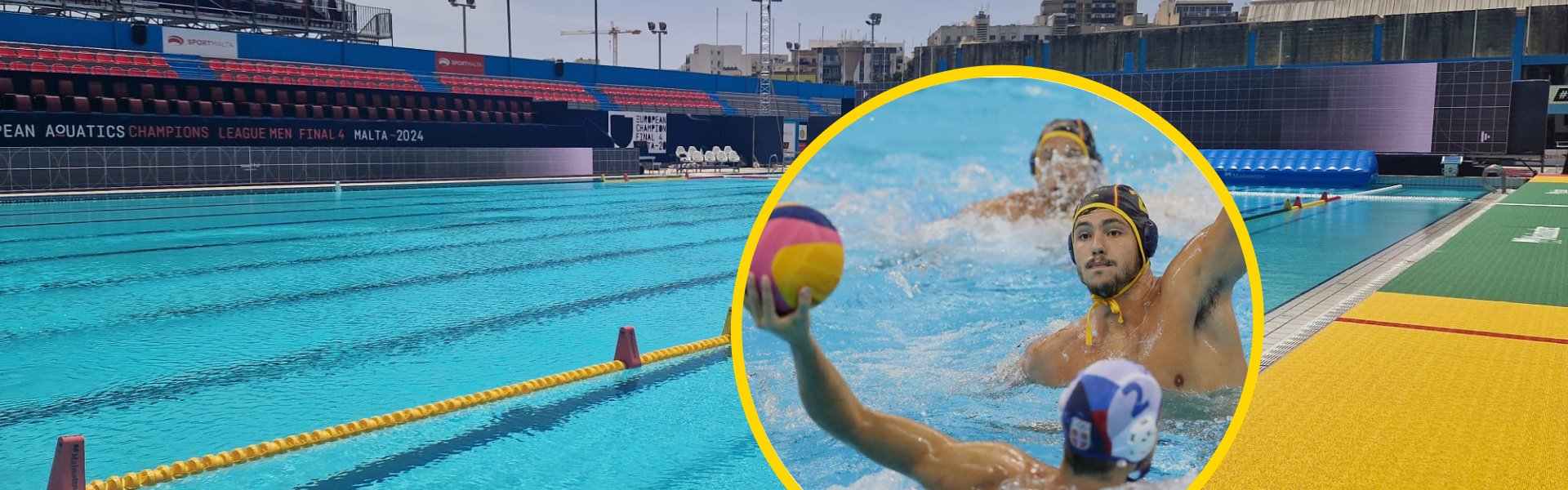
Ask a visitor to name Malta's sporting passions and they will probably say football, like most of Europe. Ask a Maltese, and you will get a second answer, delivered with just as much feeling: water polo.
For an island nation where almost everyone grows up within sight and reach of the sea, water polo is, in a sense, the perfect national game, a sport that, as one Maltese sports writer neatly put it, combines the islander's passion for the water with the islander's passion for football. Every summer, the poolside lidos around the coast fill with roaring, partisan crowds. Club rivalries that began before the Second World War still divide towns. And a small country of well under half a million people has, for a century, punched far above its weight in a demanding Olympic sport.
Whether Malta loves water polo 'more than almost any country on earth' is the kind of claim that is impossible to measure precisely, but what is beyond doubt is that water polo is one of the genuine, deep, defining sporting passions of the Maltese islands, woven into the rhythm of the Maltese summer in a way few other countries can match. This is the story of how that came to be: the history, the clubs, the rivalries, and the place the sport holds in Maltese life. Every fact below has been checked against the historical and sporting record.
From the British Services to the Maltese: The Early Years
Water polo came to Malta, as so many things did, with the British. The sport was played on the island around the turn of the twentieth century, initially by teams from the British 'Three Services', the Army, the Navy and the Air Force , stationed in Malta. The early matches between the services were played in the sheltered waters of Marsamxett harbour, or at Għar id-Dud along the Sliema coast, below the Sliema Point Battery known as Il-Fortizza.
From around 1910, water polo was taken up by the Maltese themselves, and it caught on quickly. At first there were no proper pitches and no stands for spectators at all; the Maltese learned the game largely by closely studying how the British service teams played it, before forming their own clubs in Valletta and Sliema and arranging friendly matches against the servicemen. The public began to take an interest, and a distinctively Maltese water-polo culture started to grow.
By the 1920s the sport was well established and well contested. It had a powerful patron, too: Lord Plumer, the Governor of Malta in the early 1920s, was keen enough on the islanders' progress that he considered the possibility of entering a Maltese team in the 1924 Summer Olympics. The governing body of Maltese aquatic sport was founded in 1925 as the Amateur Swimming Association of Malta, explicitly, in part, to enable Maltese participation in Olympic water polo, and it survives today, renamed in 2000 as the Aquatic Sports Association of Malta (ASA), the body that still governs swimming, water polo and artistic swimming on the islands.
Another milestone of these formative years came in 1929, with the introduction of an Inter-Schools Water Polo League, sponsored by the Malta Chronicle. The first edition was won by the Lyceum Secondary School, and the competition served as a nursery for talent, discovering young players who would go on to star for the great clubs.
Malta at the Olympics: Amsterdam 1928 and Berlin 1936

The clearest proof of how seriously Malta took water polo in its early decades is that this tiny island sent teams to the Olympic Games, twice.
Malta's water-polo players competed at the 1928 Summer Olympics in Amsterdam, and again at the 1936 Summer Olympics in Berlin. (A note for accuracy: some popular accounts mistakenly place the 1928 appearance in 'Paris', but the 1928 Olympic Games were held in Amsterdam, and both the standard record and the ASA's own history confirm that Malta competed at Amsterdam in 1928 and Berlin in 1936.)
The 1928 Amsterdam tournament produced a genuinely remarkable moment. In what was Malta's first ever international water-polo match, the Maltese beat Luxembourg 3-1. For a nation that had only taken the sport up around 1910, and had no Olympic pedigree of any kind, beating another European nation on the Olympic stage was an extraordinary achievement. Malta then lost their remaining matches, 0-16 to France and 0-10 to the United States, against far more established water-polo powers, but the victory over Luxembourg entered Maltese sporting legend.
That Malta, with a population then of only around a quarter of a million, and competing against the established sporting nations of Europe and America, fielded an Olympic water-polo team at all, twice, is itself the strongest possible evidence of how deeply the sport had taken root. Six of the players in the 1936 Berlin Olympic squad came from a single Maltese club, Neptunes, a measure of how strong the domestic game had already become.
The Clubs and the Great Rivalry: Sliema and Neptunes
The beating heart of Maltese water polo is its club scene, and the club scene is defined, above all, by one of the fiercest rivalries in Maltese sport.
Sliema Aquatic Sports Club, founded in 1912 (originally as Sliema United, taking its present name in 1930), is the most successful club in Maltese water-polo history, with 32 league championships and 27 Knock-out Cups. For the first decades of organised Maltese water polo, Sliema were utterly dominant.
Then came the challenger. Neptunes Water Polo and Swimming Club was founded in 1929, by Alfred Gauci, at Balluta Bay in St Julian's. For its first few years Neptunes were kept out of the 'elite' grouping, but in 1933, when all clubs were grouped into a single division, Neptunes finally got their chance. They finished level on points with the mighty Sliema, and the association decreed that a deciding match would be played, with no advance notice, that very same day, on a stormy October Sunday afternoon. The Neptunes players, taken by surprise, faced the powerful Sliema United side and beat them: it was Neptunes' first ever game against Sliema, and their first ever success. They went on to win the knock-out competition too, breaking Sliema's long-standing monopoly at a stroke.
As the official Neptunes history puts it, 'here started the bitter sporting rivalry between Sliema and Neptunes which exists till this very day'. That 1933 upset transformed the club, which was suddenly mobbed by youngsters wanting to join, and Neptunes went on to dominate the late 1930s, winning the championship on all four occasions they competed in that decade (1933, 1934, 1937 and 1938) and the first post-war championship in 1945. The Sliema–Neptunes rivalry remains, nearly a century later, the great divide of Maltese water polo.
Today the Maltese club scene is larger and geographically spread around the islands. Alongside Sliema and Neptunes, the clubs include Barracudas (St Paul's Bay), Birżebbuġa, Exiles (Sliema), Marsascala, Otters (Gozo), Sirens (St Paul's Bay), Ta' Xbiex and Valletta United. Around eleven teams compete across the Premier and First Division leagues, with the format set periodically by the ASA Council.
A Summer-Long Obsession
What truly sets Maltese water polo apart, though, is not the history or the Olympic appearances, it is the place the sport holds in the ordinary rhythm of the Maltese year.
Water polo in Malta is, above all, a summer sport, and the summer league is the centre of it. The season opens with the President's Cup, and runs through the warm months at the poolside lidos around the coast. According to the ASA, the winter and summer leagues are among the most well-attended competitions in Malta of any sport, the matches draw large, loud, fiercely partisan crowds, the supporters of rival towns packed around the pool. As one guide to Maltese sport bluntly puts it, water polo is 'a national obsession' for the Maltese, and most beach clubs and lidos have their own water-polo pitch, where families head down to play, or simply to watch the players train.
The sport is also built on a deep youth structure that feeds the senior game. The ASA runs league competitions for age groups under 13, 15, 17 and 20, with festivals organised for the under-11s, ensuring that Maltese children grow up in the water-polo culture from the youngest ages. It is this combination, a small, water-loving population, a dense network of clubs, a packed summer league, fierce local rivalries, and a youth pipeline that starts in childhood, that gives Maltese water polo its remarkable intensity relative to the island's size.
Bank of Valletta is the long-standing sponsor of water-polo activities in Malta, and the sport's domestic infrastructure was transformed in 1993, when Malta hosted the Games of the Small States of Europe and inaugurated the Olympic-standard National Pool Complex at Tal-Qroqq, which remains the home of the sport and the headquarters of the ASA.
Malta on the International Stage
For a country of its size, Malta has remained a committed and increasingly competitive presence in international water polo. The ASA has been entrusted with hosting a string of prestigious international competitions, including the LEN European Junior Water Polo Championships (in 1985, 2007 and 2013), the LEN Champions League, the LEN Euro Cup and the COMEN Water Polo Cup.
The year 2015 was a landmark for Maltese water polo: both the Junior (under-17) team and the Senior men's team qualified for major finals, the juniors for the first European Games in Baku, Azerbaijan, and the seniors for the European Water Polo Championships in Belgrade, Serbia.
The Malta men's national team, competing under the FINA code MLT, within the European confederation LEN, has continued to build on that. In recent years it has competed at the European Water Polo Championship, and at the 2026 edition recorded a series of competitive results against strong nations: among them a 19-7 win over Kazakhstan, a 16-15 win over Argentina, and a 13-12 win over Brazil, alongside losses to established powers such as Montenegro, Romania and Canada. The team has been led in this era by long-serving captain Steven Camilleri, a veteran of the Maltese game. These are the results of a small nation competing hard against countries many times its size, which is, in a sense, the whole story of Maltese water polo in miniature.
More than a Sport
Why does water polo matter so much in Malta? The honest answer combines geography, history and identity.
Geography made it natural: a nation of islanders, surrounded by warm, swimmable sea, was always going to embrace an aquatic sport. History entrenched it: introduced by the British services, taken up by the Maltese around 1910, carried to the Olympics by 1928, and built into a club structure with rivalries fierce enough to survive a century. And identity sealed it: the summer league, the poolside crowds, the town-against-town loyalties, the children moving up through the age groups, all make water polo not just a sport the Maltese watch, but a part of how Maltese communities know themselves.
There may be no way to prove, with a hard statistic, that Malta loves water polo more than any other nation on earth. But few countries of any size pour the passion into the sport that this small archipelago does, and on a summer evening, with the floodlights on a poolside pitch and the rival supporters of two seaside towns roaring at each other across the water, it is very hard indeed to imagine anywhere that loves it more.

About Dr Hillary Hopkins
Dr Hopkins is a Maltese lawyer, with a love for Malta's historic stories, forgotten corners, and little cultural rabbit holes.