What is Ghar Tuta? A Guide to Mellieha's Sinkhole-Cave and Why It Matters


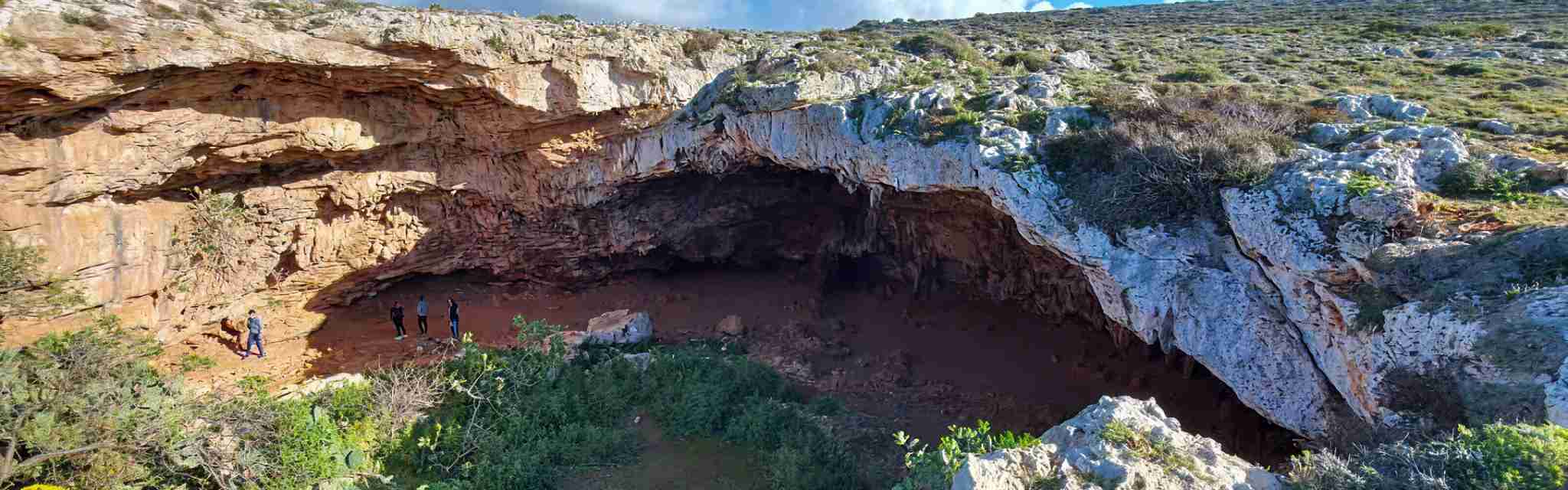
If you love Malta's wilder corners, Għar Tuta is the kind of place that feels almost unreal the first time you see it. Known academically as Latnija Cave, and commonly referred to as Għar Tuta, it sits in Mellieħa's northern countryside and looks less like a neat cave entrance and more like a collapsed limestone chamber, a doline or sinkhole, with a vast open top and steep rock walls.
It's also a location that deserves extra care. In recent years it has become internationally significant for archaeology, and parts of the site have been treated as protected heritage, with access and activity restricted at times. This guide focuses on what makes Għar Tuta special, what you can realistically expect, and how to enjoy the area responsibly.
What is Għar Tuta, exactly?
Għar Tuta, also known as Latnija Cave, seen from the Mellieħa countryside. A striking limestone formation that highlights Malta's rugged landscape and deep archaeological significance.

Għar Tuta is often described as a cave, but the best mental picture is a giant natural bowl in the landscape: a collapsed cavern creating a wide, open depression, with rocky slopes leading down and smaller sheltered recesses around its edges.
That combination of scale, light, and geology is what makes it so striking. Depending on the time of day, you can get strong contrast between bright sky above and warm limestone tones below.
Latnija Cave has been central to research that pushes Malta's known human story back to at least 8,500 years ago, reshaping long-held assumptions about when and how the islands were first reached. Earlier than the first farmers traditionally linked to Malta's earliest settlement narrative. The findings were published in Nature and discussed by researchers working with the University of Malta and the Max Planck Institute of Geoanthropology.
One of the headline implications is seafaring: researchers report that hunter-gatherers reached Malta by crossing around 100 km of open water from Sicily, an achievement that challenges older assumptions about what Mesolithic groups could do at sea.
In practical terms, it means Għar Tuta is not only a scenic stop. It is part of a sensitive archaeological landscape that is still being studied.
Is Għar Tuta Open to the Public to Visit?
Authorities have treated Latnija Cave as protected heritage, with safeguarding works underway at points, and public messaging warning that unpermitted interference at archaeological sites is prohibited. Media reporting has also described the site as classified at a high level of protection and fenced to prevent activity inside.

If you want to include it in a walk, a responsible approach is to enjoy the wider countryside setting and viewpoints, and only approach as far as clearly permitted.
What to Expect When Visiting Għar Tuta
A visit to Għar Tuta is best approached as a countryside experience rather than a conventional attraction. There is no visitor centre, lighting, or managed pathway system, and there should be no expectation of entering a cave space. The reward lies in observing the scale of the formation from permitted viewpoints and appreciating the surrounding rural landscape of Mellieħa.
The site is particularly striking in softer light during early morning or late afternoon, when shadows emphasise the contours of the limestone walls. Even from a distance, the sheer size of the collapsed chamber is enough to convey why the location has attracted scientific interest.
Responsible visiting is essential. Sturdy footwear is advisable due to uneven terrain, and visits should be avoided during or after heavy rain when limestone surfaces can become slippery. Children and pets should be kept close, as the landscape includes sudden drops and rough ground.
Għar Tuta in the Wider Context of Malta's heritage
Latnija Cave forms part of a broader picture of Malta as a landscape shaped by both natural forces and deep human history. While sites like Għar Dalam offer a managed introduction to Malta's prehistoric past, Għar Tuta represents a rawer and more fragile chapter of that story.
Its growing importance is also a reminder that not all heritage sites are suited to heavy visitation. Some places are valuable precisely because they are left largely untouched, studied carefully, and protected for future generations rather than opened for mass access.
What makes Għar Tuta special is not just what has been discovered there, but how little it has been altered. It remains a quiet, imposing presence in Mellieħa's countryside, offering a glimpse into both Malta's geological past and a newly understood chapter of its human history.
As research continues, our understanding of Latnija Cave may evolve further. For now, it stands as a powerful example of why careful conservation matters, and why some of Malta's most important places are those that ask us to observe, rather than explore.
Have you ever come across Għar Tuta while walking in Mellieħa, and how do you feel about protecting places like this, even when it means they remain largely off-limits?

About Matthew Gollcher
Hi, I'm Matthew, an SEO Specialist and Content Writer at Yellow Pages Malta. I'm passionate about creating meaningful content and exploring AI's creative possibilities. When I'm not working, I enjoy the gym, time with friends, watching series and reading, and playing guitar. I'm always eager to learn and grow both personally and professionally.