The Royal Opera House: The Valletta Theatre That Was Bombed and Never Rebuilt


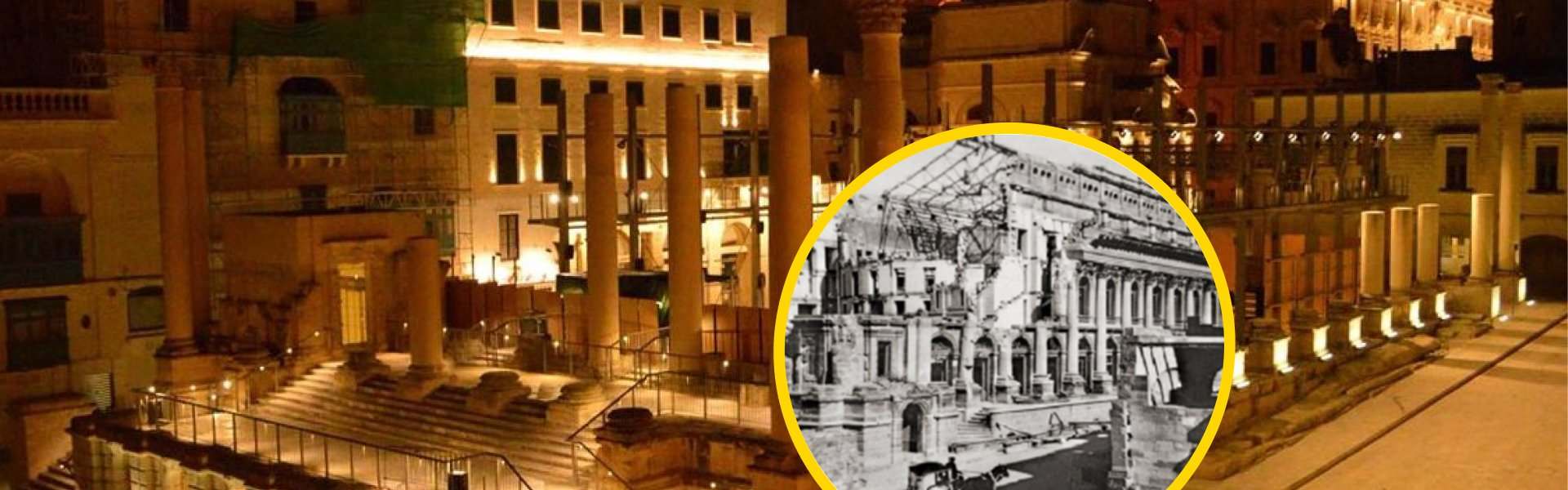
Just inside the gate of Valletta, a short walk from the new Parliament House, stands one of the most poignant sights in Malta: a set of broken columns and roofless walls, the ruins of a grand nineteenth-century theatre, now sheltering a modern open-air stage. This is what remains of the Royal Opera House, in Maltese, It-Teatru Rjal, once one of the most beautiful buildings on the island, and for seventy years one of its most haunting ruins.
Its story is one of repeated tragedy and eventual, controversial rebirth. Built in the 1860s as the glittering centre of Maltese cultural life, gutted by fire within a decade, lovingly restored, and then destroyed by a German bomb at the height of the Second World War, the Royal Opera House was never rebuilt. For two generations its shattered shell stood at the threshold of the capital. Only in 2013 did the ruins find a new purpose, not as a restored opera house, but as something else entirely.
This is the story of Malta's lost opera house: how it rose, how it burned, how it fell, and how its ruins were finally, divisively, brought back to life. Every fact below has been checked against the historical record.
A Grand Design: Barry, Bellini, and the Opening of 1866
By the middle of the nineteenth century, Malta, then a British Crown Colony, had a flourishing appetite for opera, and the existing Manoel Theatre, which had opened in 1732 and still operates today as one of the oldest working theatres in Europe, was no longer big enough for the growing audiences. In 1860, the Governor of Malta, Sir John Gaspard Le Marchant, formally approved the construction of a grand new theatre at the very entrance to Valletta, on Strada Reale (today's Republic Street).
The design was entrusted to a distinguished English architect: Edward Middleton Barry, who had designed the Covent Garden Theatre in London and was associated with other major London buildings including the National Gallery. Barry's neoclassical design, a grand colonnaded structure, richly ornamented, was completed by 1861. Construction was supervised on the ground by the Maltese architect Salvatore Fenech, who had previously overseen the building of the Valletta Market.
Building began in 1862, on a site previously occupied by a building known as the Casa della Giornata, which was demolished to make way for it. The theatre occupied a substantial plot of about 63 by 34 metres (206 by 112 feet). It was an expensive undertaking, and a controversial one: the cost, originally estimated at around £30,000, eventually ran to somewhere between £44,000 and £60,000, an enormous sum that drew sharp public criticism.
After four years of work, the Royal Opera House was ready. It had a capacity of around 1,095 seated and room for some 200 standing. It was officially inaugurated on the 9th of October 1866, with a performance of Vincenzo Bellini's opera I Puritani. It is almost impossible now to imagine the glamour of that opening night, the local and foreign dignitaries, the glitter of the auditorium, the sense that Malta had acquired a cultural monument worthy of any European capital. The Royal Opera House had arrived as the centre of elite cultural life in Valletta.
The Fire of 1873

The opera house's first catastrophe came with cruel speed. On the 25th of May 1873, a mere six and a half years after it opened, a fire broke out during a rehearsal (of an opera by the composer Giuseppe Privitera) and tore through the building.
The damage was severe but uneven. The exterior of the theatre survived largely intact, but the interior was devastated: the intense heat calcified and ruined the stonework inside, leaving the auditorium unusable. The loss of so new and so costly a building was a serious blow.
It was decided to rebuild. After the issuing of tenders and a good deal of argument, including over whether the front of the building should be altered, restoration work proceeded under the supervision of the architect Webster Poulson, at an additional cost of around £4,000. After nearly four and a half years, the theatre was ready again. On the 11th of October 1877, the Royal Opera House reopened in triumph, with a performance of Giuseppe Verdi's Aida.
For the next six and a half decades, the restored opera house resumed its place at the heart of Maltese cultural life. It hosted the great operas of the age; Verdi, Bellini, Massenet, Petrella and welcomed celebrated international singers to its stage, among them figures such as Antonio Scotti, Gianna Pederzini, Licia Albanese and Aureliano Pertile. For the well-to-do of Valletta and beyond, a night at the Teatru Rjal was one of the social and cultural high points of the calendar.
7th April 1942: The Night the Opera House Fell

The second catastrophe was final. By 1942, Malta was enduring one of the most intense and sustained aerial bombardments of the entire Second World War, as German and Italian aircraft tried to bomb the strategically vital island into submission. Valletta and the Grand Harbour area, packed with military and naval targets, were hit again and again.
On the evening of Tuesday, the 7th of April 1942, during weeks of ferocious raids by the German Luftwaffe, the Royal Opera House was struck. Accounts describe the building being bombed until part of the ceiling and a corner collapsed inward, leaving behind a huge mound of smoking rubble. The direct hit effectively destroyed one of the most beautiful and iconic buildings in Valletta. The next morning, a population by then hardened to aerial bombing came to inspect the remains of their national theatre.
The Royal Opera House, which had survived a devastating fire and risen again, did not rise from this. It was never rebuilt. And so, for the next seventy years, the ruins remained, the broken colonnade and shattered walls standing at the very entrance to Valletta, one of the first things a visitor saw on passing through the city gate, and one of the most powerful physical reminders anywhere in Malta of what the island had endured in the war.
Seventy Years of Ruins, and a Long Argument
What to do with the ruins became one of the longest-running debates in modern Maltese public life.
In the decades after the war, the question of the Royal Opera House site, so prominent, so central, so laden with meaning, came up again and again, without resolution. Should the opera house be faithfully reconstructed, restoring to Valletta the grand building it had lost? Should the site be cleared and given an entirely modern building? Or should the ruins themselves be preserved, as a war memorial and a monument to Maltese suffering and survival? Each option had passionate advocates, and for decades no government managed to settle the matter. Several plans to rebuild the theatre were drawn up and then abandoned. The ruins stayed.
The deadlock finally broke in the 2000s. In 2006, and with renewed momentum after Prime Minister Lawrence Gonzi backed the project in 2008, the Maltese government commissioned the celebrated Italian architect Renzo Piano, one of the most famous architects in the world, to redesign the entire entrance to Valletta, in what became known as the City Gate Project. The project had three main components: a new City Gate, a new Parliament House, and the redevelopment of the Royal Opera House site.
Crucially, Piano dissuaded the government from building the new Parliament on the opera house site itself. Instead, Parliament House was built nearby (on the former Freedom Square), and for the opera house ruins Piano proposed something quite different: an open-air theatre, built within the surviving ruins, deliberately leaving the broken walls and columns standing.
Pjazza Teatru Rjal: The Ruins Reborn and the New Controversy

Renzo Piano's solution was, by design, neither a reconstruction nor a clearance. Rather than rebuild the opera house, or sweep the ruins away, he chose to leave the ruins in place and insert a modern steel structure inside the surviving shell, banked seating, a stage, lighting; to create an open-air performance space. The broken columns and walls would frame the stage, making the wartime scar permanently visible, while the space itself returned to its original purpose: live performance.
Piano defended the approach in strong terms, declaring that 'after more than 60 years of controversy, the ruins of the demolished opera have undeniably reached the status of monument, irrevocable witness of history and the dignity of collective memory'. The open-air theatre, named Pjazza Teatru Rjal ('Royal Theatre Square') after the original building, was officially inaugurated on the 8th of August 2013.
If the Maltese had argued for seventy years about the ruins, they now argued about the solution. The Piano design was intensely controversial. Because it included no roof or shelter, critics dubbed it 'Renzo Piano's Roofless Theatre' and complained that an open-air venue in a dense city centre was impractical, vulnerable to Malta's weather, restricted by noise considerations (the new Parliament sits just metres away), and usable mainly in the summer months. Others objected to Piano's very framing of the project: many Maltese felt that it was not for an Italian architect to declare what should constitute their nation's collective memory. Some still wanted the opera house fully rebuilt; others wanted a fully enclosed modern theatre. The Pjazza, in trying to honour the ruins, managed to satisfy almost none of the competing camps completely.
And yet, more than a decade on, the Pjazza Teatru Rjal has established itself as a genuine Valletta landmark and a working cultural venue. It hosts concerts, dance and theatrical performances, including events of the Malta International Arts Festival and performances by the Malta Concert Orchestra, and audiences have praised its atmosphere, its acoustics and the haunting beauty of performing among the floodlit ruins at night. The debate about whether it should have a roof, and whether the original opera house should have been rebuilt instead, has never entirely gone away. But the space is, once again, full of music.
A Ghost at the Gate of Valletta

The Royal Opera House occupies a peculiar and powerful place in the Maltese imagination. Few buildings have been so loved, so unlucky, and so contested. It was a symbol of Malta's nineteenth-century cultural confidence; then, in ruins, a symbol of the island's wartime suffering; and finally, in its reincarnation, a symbol of the endless Maltese argument about how to honour the past while living in the present.
There is something fitting in the fact that it was never simply rebuilt. A faithful reconstruction would have erased the most important thing that ever happened to the building, its destruction in the siege of Malta, the ordeal that earned the island the George Cross. By keeping the ruins, however controversially, Malta kept the memory visible. The broken columns at the gate of Valletta are not just the remains of a beautiful theatre. They are a monument to a nation that was bombed almost beyond endurance and survived.
Today, as audiences take their seats under the open sky, surrounded by the walls that Edward Middleton Barry designed, that Salvatore Fenech built, that fire gutted in 1873 and a German bomb destroyed in 1942, the Royal Opera House does something rather remarkable. It is, at the same time, a ruin and a working theatre; a war memorial and a concert hall; a thing that was lost and a thing that endures. The opera house was never rebuilt, but the music, in the end, came back to the ruins.

About Matthew Gollcher
Hi, I'm Matthew, an SEO Specialist and Content Writer at Yellow Pages Malta. I'm passionate about creating meaningful content and exploring AI's creative possibilities. When I'm not working, I enjoy the gym, time with friends, watching series and reading, and playing guitar. I'm always eager to learn and grow both personally and professionally.