The Cold War Ended in a Maltese Harbour: The Storm Summit of December 1989


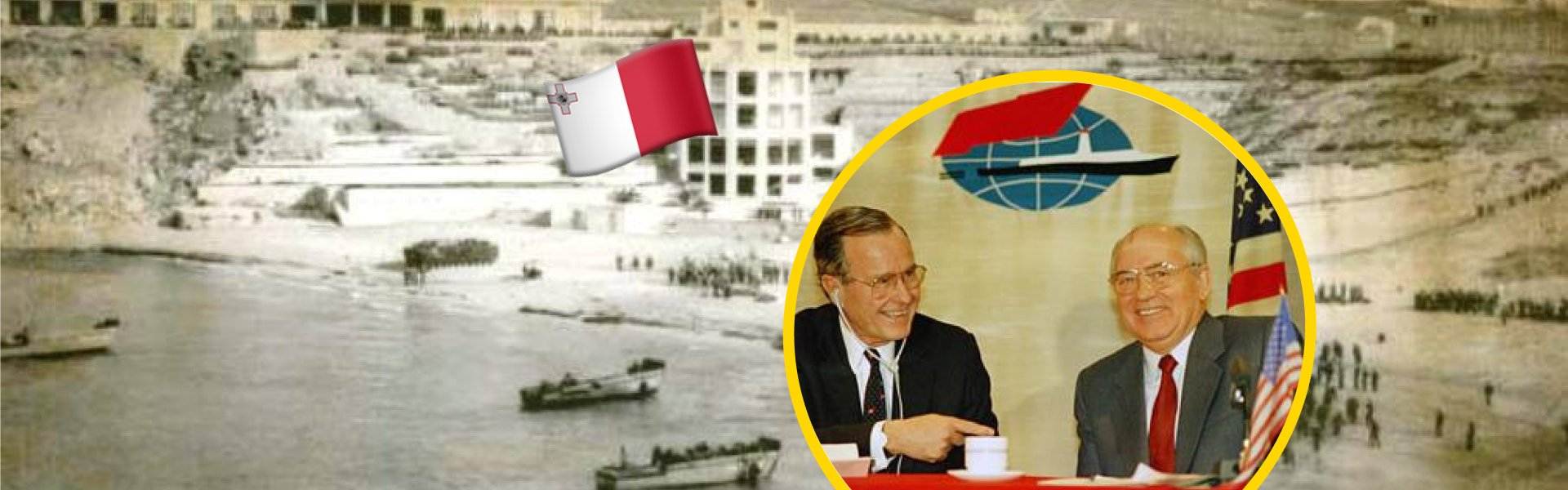
On the first weekend of December 1989, the two most powerful men on earth came to Malta.
US President George H. W. Bush and Soviet leader Mikhail Gorbachev met on the 2nd and 3rd of December 1989 off the coast of Birżebbuġa, in the sheltered waters of Marsaxlokk Bay in the south of Malta, for a summit that has gone down in history as the moment the Cold War effectively came to an end. It was the first meeting between the two men since Bush had become president in January of that year. The Berlin Wall had fallen just three weeks earlier, on 9 November 1989. Communist governments across Eastern Europe were collapsing one after another. And on the neutral ground of a small Mediterranean island, the leaders of the two superpowers sat down together to agree that the forty-year confrontation between their nations was over.
There was, however, one thing nobody had planned for: the weather. A ferocious storm blew up over the bay, with gale-force winds and heavy seas that made it almost impossible to move the leaders between their ships. Meetings were cancelled. Officials and journalists were stranded. The world's press, watching the chaos from Valletta, dubbed it the 'Seasick Summit', and the storm itself has given the meeting its other enduring nickname, the 'Storm Summit'.
This is the story of how it happened, and why it happened in Malta. It is drawn from primary sources, the official transcript of the leaders' press conference held by the George H. W. Bush Presidential Library, the declassified Soviet and American documents collected by the National Security Archive and the Wilson Center, and contemporary reporting, alongside the recollections of the man who welcomed both leaders to the island, Malta's then Prime Minister Eddie Fenech Adami.
Why Malta? Neutral Ground at the Centre of the World

By the autumn of 1989, the world was changing faster than anyone could keep up with. Hungary had opened its border with the West. Poland had a non-communist prime minister. And on the 9th of November 1989, the Berlin Wall, the single most potent symbol of the division of Europe, was breached, and East Germans walked freely into West Berlin for the first time in 28 years.
Bush had first proposed an informal meeting with Gorbachev after his own trip to Europe in July 1989. As he himself put it at the summit's close: 'I first approached Chairman Gorbachev about an informal meeting of this kind after my trip to Europe last July.' The idea was for the two men to 'put up their feet and talk', without the pressure to produce a formal treaty. The question was where.
Malta was chosen as neutral ground, and the choice was rich with symbolism. Malta sits at the geographic centre of the Mediterranean, the point where, as the cliche has it, East meets West and North meets South. More importantly, Malta was, and remains, a constitutionally neutral state. Malta had declared its neutrality in 1980, following the departure of the last British forces, and that neutrality was entrenched in its Constitution: Malta is described there as 'a neutral state actively pursuing peace, security and social progress among all nations by adhering to a policy of non-alignment and refusing to participate in any military alliance'. For a meeting between the two superpower blocs, no more fitting venue could have been found.
There was also a deep historical resonance. In February 1945, US President Franklin D. Roosevelt and British Prime Minister Winston Churchill had met in Malta before travelling on to the Yalta Conference, where they and Soviet leader Joseph Stalin drew the lines that would divide post-war Europe, and, in effect, set the stage for the Cold War. Now, 44 years later, the two superpowers were meeting in Malta again, this time to bring that confrontation to an end. 'From Yalta to Malta' became the phrase of the weekend. History had, quite literally, come full circle in the same small archipelago.
Malta's then Prime Minister, Eddie Fenech Adami, later recalled how he learned that his country had been chosen. In around mid-November 1989, he received a request for an urgent meeting from the US Ambassador to Malta. 'I did not know what had prompted it,' he recounted, 'but when the Soviet Ambassador turned up as well and they explained that Malta had been chosen as the neutral venue for the summit, I remember the exact words I said to them: "With open arms, they will be welcome."'
A Summit at Sea: The Warships and the Cruise Liner

The decision to hold the summit at sea, rather than on land, was reportedly inspired in part by Bush's admiration for Franklin D. Roosevelt, who had famously met foreign leaders aboard naval vessels during the Second World War. The plan was for the two leaders to hold talks on alternate days aboard their respective ships.
Three vessels were central to the summit. President Bush and the American delegation were based aboard the USS Belknap, a US Navy guided-missile cruiser that served as flagship of the US Sixth Fleet. Gorbachev and the Soviet delegation were based aboard the Slava, a Soviet missile cruiser. And the formal talks were to be held aboard the Maksim Gorky (also transliterated 'Maxim Gorky'), a Soviet cruise liner moored in the harbour near Birżebbuġa, which served as the floating conference centre and accommodation for much of the Soviet side.
The leaders' first meeting, on the morning of Saturday the 2nd of December, went ahead aboard the Maksim Gorky. Bush opened with a presentation of some twenty specific proposals, on trade normalisation, arms control, and economic cooperation, signalling that the United States wanted to move the relationship onto a new footing. According to the Soviet transcript of the talks, later declassified, Gorbachev told Bush that the Soviet Union was 'ready no longer to regard the United States as an adversary'. For two nations that had spent four decades preparing to fight each other, this was an extraordinary thing to say across a table.
The Storm: The 'Seasick Summit'
Then the weather intervened.
A powerful winter storm swept into Marsaxlokk Bay, with gale-force winds and waves that, by some accounts, reached several metres. The small launches used to ferry the leaders and their officials between the anchored ships suddenly faced seas that ranged from dangerous to impossible. The carefully choreographed plan, talks alternating between the American and Soviet ships, collapsed.
The scenes, as reported at the time, verged on farce. A scheduled evening meeting on Saturday was cancelled outright. Soviet officials abandoned an attempt to reach the Slava, which was anchored in rougher water than the Belknap. The Slava itself; a 600-foot warship bristling with missile systems, was reportedly dragging its anchor and had to be held in place by two Maltese tugs. A television camera crew was marooned on top of an oil derrick overlooking the harbour. White House and State Department officials were stranded aboard the Maksim Gorky, unable to reach the Belknap or even to talk to their superiors on secure phone lines.
Faced with the impossibility of moving people safely around the bay, the organisers made the sensible decision: consolidate everything aboard the Maksim Gorky, the one vessel that, moored securely in the harbour, the storm could not toss around. The cruise liner that had been intended as the Soviet base became the venue for the whole summit.
The American side kept its sense of humour. White House Press Secretary Marlin Fitzwater, briefing in Valletta, offered 'an exclusive presidential interview to any reporter who can get to the Belknap in the next 15 minutes', raising the prize to three interviews 'for any reporter who swims'. When the leaders finally appeared together, both sides joked about the 'wimp factor' in not braving the seas. Bush himself, opening the closing press conference, captured the mood perfectly: 'I don't think anyone can say that the saltwater get-together was anything other than adventure, at least out in the harbour here.'
Behind the comedy, the storm had a real effect: it forced the two delegations into closer and more sustained contact aboard a single ship than the original plan would have allowed. Some who were there felt that the enforced intimacy of being storm-bound together actually helped the talks.
What was Actually Agreed

It is important to be precise about what the Malta Summit did and did not produce, because the popular memory of it ('the summit that ended the Cold War') is both true and, in the narrow sense, slightly misleading.
No treaty was signed at Malta. No arms-control agreement was concluded; no specific timetables for treaty-signings were set. Bush had said in advance that he did not anticipate that 'substantial decisions or agreements' would emerge. In that strict sense, Malta was a 'getting-to-know-you' summit, the first proper meeting between Bush and Gorbachev as leaders.
But what Malta produced was more important than any single treaty: a declaration of intent that the adversarial relationship of the Cold War was over, and a commitment to work together on the agreements that would follow. The two leaders agreed to accelerate arms-reduction negotiations, with a view to concluding agreements on strategic and conventional weapons; they scheduled a further, formal summit for June 1990; and they discussed, with remarkable candour, the most sensitive issue of all, the reunification of Germany, which was now clearly coming, and which Bush handled by insisting that the peoples of Eastern Europe must be allowed to determine their own futures.
Above all, Malta produced the first joint press conference ever given by an American president and a Soviet leader, itself a historic act, a public demonstration that the two men were now partners in managing the end of an era rather than enemies. The words spoken there were carefully chosen and have echoed ever since.
'We are at the very beginning of a long road to a lasting peace'

At the closing press conference on Sunday the 3rd of December 1989, a reporter asked Gorbachev directly whether the Cold War had been ended. His reply, preserved in the official transcript, was measured but unmistakable:
'In the first place, I assured the President of the United States that the Soviet Union would never start a hot war against the United States of America, and we would like our relations to develop in such a way that they would open greater possibilities for cooperation… We stated, both of us, that the world leaves one epoch of cold war and enters another epoch. This is just the beginning. We're just at the very beginning of our long road to a long-lasting peaceful period.'
Gorbachev also called for the very characteristics of the Cold War to be set aside: 'the arms race, mistrust, psychological and ideological struggle, all those should be things of the past'. Bush, for his part, spoke of enormous American support for what Gorbachev was attempting inside the Soviet Union, and of the two nations' shared interest in a peaceful, cooperative future.
Neither man used the precise words 'the Cold War is over' as a formal declaration, which is why historians sometimes quibble about whether Malta 'ended' the Cold War, or merely marked the moment when both sides openly acknowledged that it was ending. But the distinction is academic. To the people who were there, to the press who reported it, and to the wider world watching, the message from Marsaxlokk Bay was clear: the long confrontation was finished. As Gorbachev would later write of the summit, 'we had finally crossed the Rubicon'.
The Aftermath: from Malta to a New World
The events that followed came at breathtaking speed. Even as Bush and Gorbachev were concluding their talks, the entire Politburo and Central Committee of the East German Communist Party resigned. Within a year, on the 3rd of October 1990, Germany was formally reunified. Arms-control agreements followed: the Conventional Armed Forces in Europe Treaty in November 1990, and the START I strategic-arms treaty in July 1991. The Warsaw Pact dissolved in 1991. And on the 26th of December 1991, just over two years after Malta, the Soviet Union itself ceased to exist, and Mikhail Gorbachev, the man who had come to Malta as the leader of a superpower, resigned as president of a country that no longer existed.
Historians continue to debate the precise weight to give the Malta Summit in this cascade of events. Some treat it as the symbolic end of the Cold War; others reserve that status for the fall of the Berlin Wall a few weeks earlier, or for the dissolution of the USSR two years later. What is not in doubt is that Malta was the moment the two superpowers, face to face, chose cooperation over confrontation, and said so, publicly, to the world.
For Malta itself, the summit was a moment of extraordinary international prominence: a country of then around 350,000 people, hosting the two most powerful leaders on earth and the eyes of the world's media, and providing quite literally, with its tugboats and its sheltered harbour, the stable ground on which history could be made. It was the fullest possible vindication of the idea, expressed by Fenech Adami at the United Nations earlier that same year, that even a micro-state can serve the global interest precisely because its smallness gives it no stake in domination, only in peace.
Today the summit is commemorated in Malta, and the phrase 'from Yalta to Malta' has entered the historical shorthand of the twentieth century. The storm that nearly wrecked the meeting has become part of its legend, a reminder that the end of the Cold War, for all its world-historical weight, came down to two men, three ships, a Mediterranean gale, and a small neutral island willing to open its arms.
The Cold War did not end with a battle, or a treaty, or a surrender. In the most immediate sense, it ended in a Maltese harbour, in a storm, aboard a Soviet cruise liner moored off Birżebbuġa, on the neutral ground of an island that has spent its whole history at the meeting point of worlds.

About Dr Hillary Hopkins
Dr Hopkins is a Maltese lawyer, with a love for Malta's historic stories, forgotten corners, and little cultural rabbit holes.