Fort St Elmo: The 600 Men Who Held Out for 31 Days


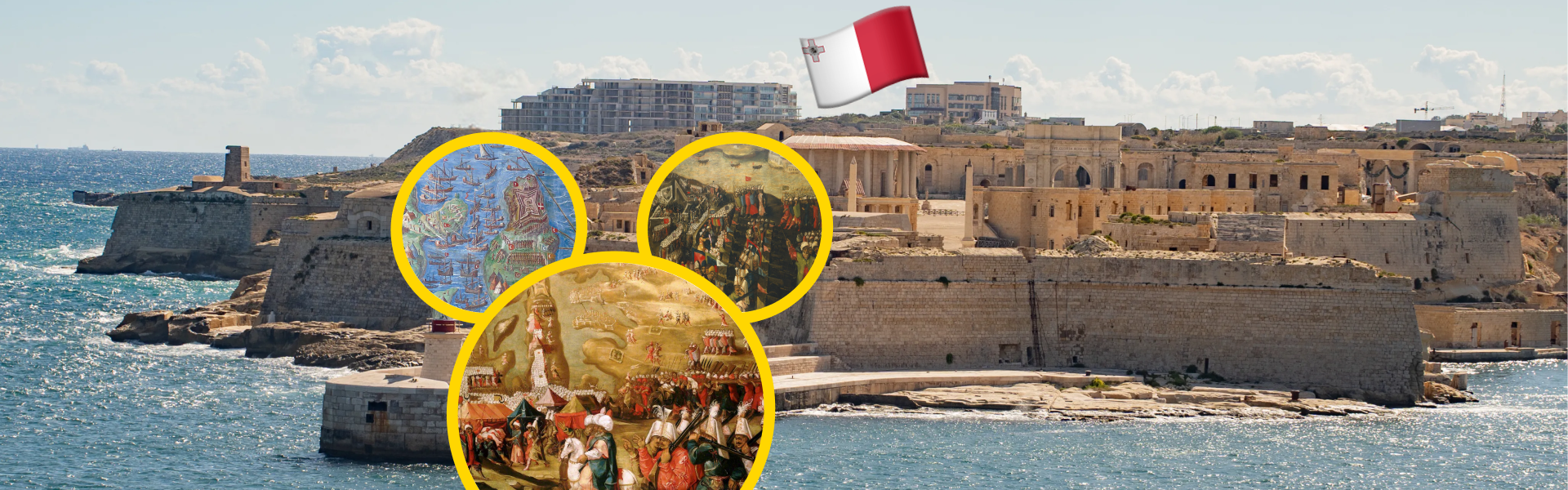
Voltaire, who had seen a great deal of history, called the Great Siege of Malta of 1565 'the most celebrated event of the age.' What he meant was Fort St Elmo.
In May 1565, the Ottoman Empire, at the absolute height of its power, ruled by Suleiman the Magnificent, the finest sultan it had ever produced, landed approximately 40,000 men on Malta with orders to destroy the Knights of St John and clear the way for the invasion of Europe. Their first target was a small star-shaped fort at the tip of the Sciberras Peninsula, barely larger than a football pitch, built on the ruins of an old watchtower and garrisoned by a few hundred men.
Ottoman military engineers surveyed the fort, calculated its walls, estimated the resources of its defenders, and concluded that Fort St Elmo would fall in three to five days.
It held for 31 days.
When it finally fell on the 23rd of June 1565, approximately 1,500 defenders were dead, almost everyone who had been inside those walls. The Ottomans had lost at least 6,000 men, including half of their elite Janissaries and their most capable commander, taking a fort that had contained a few hundred people. Mustafa Pasha, the Ottoman general, looked across the Grand Harbour at Fort St Angelo and said: 'If so small a son has cost us so dear, what price shall we have to pay for so large a father?'
This is the story of those 31 days. What happened inside Fort St Elmo, who was there, what they used to fight with, what decisions were made, and why the men who chose to stay and die in a crumbling fort on the tip of a limestone peninsula may have saved the rest of Malta, and possibly much of Europe.
Why Fort St Elmo mattered: the key to both harbours

The fort that stood at the tip of the Sciberras Peninsula in 1565 had been built only 13 years earlier. The Aragonese had maintained a watchtower on the point since 1488. In 1551, the Ottoman corsair Dragut had sailed his entire fleet into Marsamxett Harbour unopposed, there was nothing to stop him. The shock of that raid convinced the Order that the harbour entrance needed permanent fortification. In 1552 the watchtower was demolished and a star fort began to be built in its place, completed within six months to a design by Italian engineers.
Its strategic logic was simple and absolute. The Sciberras Peninsula divided the Grand Harbour, the deep, sheltered water where Fort St Angelo and Birgu and Senglea guarded the Order's main positions, from Marsamxett Harbour to the north. Whoever controlled the fort at the tip of the peninsula controlled both harbour entrances. No fleet could safely anchor in either without first taking St Elmo. And without a safe anchorage, an Ottoman fleet of hundreds of ships was exposed to the summer weather and to attack.
This is why the argument between the two Ottoman commanders mattered so much. Mustafa Pasha, commanding the land forces, wanted to bypass St Elmo entirely, march on the poorly defended capital of Mdina, and attack the Knights' main positions at Birgu and Senglea by land. Piyale Pasha, commanding the fleet, refused to anchor the Ottoman ships in the open sea while the campaign continued. He needed Marsamxett. He needed St Elmo first. Mustafa relented, apparently believing the fort would fall in days.
He was catastrophically wrong. And that error, the decision to attack Fort St Elmo before Mdina, made because a naval commander wanted his fleet in harbour, was the mistake from which the entire Ottoman campaign never recovered.
18th May to the 26th of May 1565: The Fleet Arrives and the Choice is Made

At dawn on the 18th of May 1565, the Ottoman fleet appeared off the eastern coast of Malta. By the following day, troops were coming ashore at Marsaxlokk Bay. Contemporary accounts describe the scale of the force with something approaching awe: Francisco Balbi di Correggio, a Spanish soldier who kept a diary throughout the siege and remains the most detailed eyewitness, counted the fleet and reported over 300 ships and an army he placed at around 40,000. More recent scholarship using Ottoman campaign registers suggests the regular army numbered closer to 25,000–30,000, with corsair reinforcements pushing the total toward 40,000. The exact figure matters less than the ratio: defending Malta, Grand Master Jean Parisot de Valette had around 500 to 600 Knights of the Order, approximately 1,000 Spanish professional soldiers, several thousand Maltese militia and perhaps 2,000 hired soldiers and volunteers. He was outnumbered by at least four to one.
De Valette was 71 years old in 1565. He had been a galley slave of the Ottomans in his youth, having been captured during the fall of Rhodes in 1522 and spending a year chained to an oar before being ransomed. He spoke Italian, Spanish, Greek, Latin, Arabic and Turkish. He had spent eight years as Grand Master preparing for the day he knew was coming, poisoning the island's wells with bitter herbs and dead animals, stockpiling food and ammunition, evacuating non-combatants to Sicily, reinforcing the forts. He was, by any measure, precisely the leader a desperate defence required.
His dispositions were clear. Fort St Angelo, the Order's main headquarters, at the tip of Birgu. Fort St Michael at Senglea. Fort St Elmo at the tip of Sciberras, guarding the mouth of the Grand Harbour and the entrance to Marsamxett. He had placed heavy artillery in St Elmo and sent reinforcements. He had no illusions about what was coming. He had calculated that St Elmo could hold long enough to buy time for the relief force he expected from the Viceroy of Sicily, Don Garcia de Toledo. Everything would now depend on how long the fort could resist.
27th May to Early June: The Bombardment Begins

On the 27th of May 1565, the Ottoman artillery opened fire on Fort St Elmo. The guns were positioned on the high ground of Mount Sciberras, the ridge directly above and behind the fort, as well as on batteries to the south. The fort, built on a flat peninsula tip, was lower than the ground the Ottomans occupied. The gunners were firing downward into it. The stout limestone walls began to crack and crumble almost immediately.
The initial garrison was approximately 150 Knights and 600 soldiers, the majority Spanish and Italian, along with 60 armed galley slaves whose freedom had been promised if they fought. The fort was originally designed to hold far fewer men. As the siege developed, de Valette reinforced it nightly, ferrying fresh troops and supplies across the Grand Harbour from Fort St Angelo under cover of darkness, and evacuating the wounded on the return crossing. The boats moved in near-total silence, hoping not to attract Ottoman fire.
The first week destroyed the outer defences. Janissary soldiers, the Ottoman elite infantry, stormed the breaches and were driven back by the defenders using every weapon available: cannon, arquebus, pike, sword, and the incendiary weapons that became the most feared innovation of the siege. The defenders used Greek fire, an ancient incendiary compound that burned on water, and primitive flamethrowers called 'trumps', essentially tubes of fire that could be directed at infantry trying to scale a breach. They also threw clay pots filled with burning material directly into the packed Janissary formations pressing against the walls. The assaults were repelled. The walls kept crumbling. The defenders kept repairing them through the night, using mattresses, rope, sails and fascines to plug the holes until proper masonry could be applied.
By the 3rd of June, a party of Janissaries had managed to seize the fort's ravelin and ditch, the forward outworks that provided the first line of defence against assault. This was serious: with the ravelin gone, the attackers had a platform from which to fire directly into the fort at close range. The defenders were now under fire from in front, from above on the ridge, and shortly from both sides.
Dragut Arrives: The Supply Line is Cut
In late May, the man who had identified Fort St Elmo's weakness arrived from North Africa. Dragut Reis (Turgut Reis in Turkish) had been born around 1485, had commanded the Ottoman fleet, had enslaved the entire population of Gozo in 1551 and had spent four years as a galley slave himself after his capture in 1540, only to be ransomed and rise again to become what contemporaries called 'the greatest pirate warrior of his age' and 'the uncrowned king of the Mediterranean.' Suleiman had sent him to Malta as a de facto supreme commander, instructing Mustafa and Piyale to defer to his judgment.
Dragut was furious with what he found. The attack on Fort St Elmo had been, in his view, a mistake, Mustafa should have taken Mdina first. But the campaign was too far developed to reverse course now. Rather than abandon the attack, Dragut immediately improved it. He ordered new artillery batteries on Tigńé Point, the north shore of Marsamxett Harbour, bringing the fort under fire from a third direction simultaneously. Fort St Elmo was now taking cannon fire from its front, from above and from its flank. No part of its walls was safe.
More critically, Dragut identified the reason the fort had not yet fallen: the supply boats. Each night, small boats were crossing the Grand Harbour from Fort St Angelo to Fort St Elmo, bringing fresh troops and ammunition and taking the wounded back. As long as that lifeline existed, the fort could continue to bleed the Ottoman army indefinitely. Dragut ordered Ottoman patrol galleys to scour the harbour at night, blocking the crossing. The lifeline began to close.
8th of June: The Crisis of conscience inside the fort
By the 8th of June, the situation inside Fort St Elmo had become desperate enough that the garrison did something almost unprecedented. They sent a letter to the Grand Master.
The message, carried by a swimmer across the harbour, asked de Valette's permission for a sortie, a fighting breakout from the fort. The garrison knew the fort could not ultimately hold. They had watched the walls crumble and been repaired and crumble again. They had fought off assault after assault. They were exhausted and diminishing. They did not ask to be evacuated. They asked for permission to die with their swords in their hands, in the open, in a final charge against the Ottoman lines.
De Valette's response is one of the most remarkable decisions of the entire siege. He refused the sortie. A heroic breakout would be militarily useless, it would cost the garrison their lives in minutes and give the Ottomans the fort for free. What de Valette needed was time. Every day Fort St Elmo held was a day the relief force from Sicily was closer, a day the Ottoman army's losses mounted, a day Birgu and Senglea's walls grew stronger. He sent a commission across the harbour to investigate the fort's condition.
The commissioners returned with divided reports. Some said the fort could still hold; others agreed with the garrison that it was finished. De Valette, who had received conflicting assessments, delivered what can only be described as a brutal rebuke. He said he would send replacements to take over the defence if the current garrison felt unable to continue. In other words: if you are too afraid to hold and die in St Elmo, I will find men who are not afraid.
Shamed, the garrison sent back word that they would hold. A swimmer was sent across the harbour begging de Valette not to send the replacements. The fort's defenders would stay.
It is worth understanding what this meant. These men knew, by this point, that the fort could not be saved. They were not choosing to hold a position that had a reasonable chance of survival. They were choosing to stay in a fort that was being reduced to rubble around them, in the certain knowledge that they would die there, because their Grand Master had told them that was what was required of them. Some of them subsequently wrote letters home. Those letters have not survived. What has survived is the fact that they stayed.
10th to the 22nd of June: The Final Three Weeks

On the night of the 10th of June, Mustafa ordered a mass assault. The Ottomans used their own flame weapons, pots of burning material, fire arrows, all the incendiary technology of the age, and the night attack turned the darkness orange across the Grand Harbour. Wave after wave of Janissaries and volunteers crashed against the walls. They were driven back each time. The defenders were fighting on rubble by this point, their walls so reduced that the distinction between 'inside the fort' and 'on the remains of the walls' was becoming meaningless. And yet the Ottoman flags did not go up.
The day of the 16th of June produced one of the most remarkable images of the entire battle. The assault that day was so overwhelming that the Ottomans swept even the galley slaves and hired oarsmen housed in the fort into the fighting. These were not soldiers. They were men who had been conscripted or captured into galley service, armed and thrown at the walls alongside the garrison. They fought, according to the contemporary chronicler Balbi di Correggio, 'almost as bravely as the Knights themselves.' The assault was repelled.
Two days later, on the the 18th of June, came the event that would change the entire subsequent history of the siege. Dragut was in a forward trench emplacement, personally supervising the repositioning of artillery, still trying, at the age of 80, to find the angle that would finally break through the defenders' fire. A cannonball struck close to his position. The exact circumstances are disputed: some accounts say a Turkish cannon misfired and the ball detached part of the trench; Giacomo Bosio, the Order's historian, says it was a lucky shot from Fort St Angelo across the Grand Harbour. What is not disputed is the result: Dragut was struck in the head by stone splinters and fell senseless. He was carried behind the lines and treated in a tent. He would die on the 23rd of June 1565, the same day Fort St Elmo finally fell.
Dragut's wounding was kept secret from the Ottoman troops to prevent a collapse in morale. But his judgment was gone from the campaign at its most critical moment. The fractious relationship between Mustafa and Piyale, which Dragut had been holding in check, immediately reasserted itself. The strategic coherence of the Ottoman operation began to fray.
Inside Fort St Elmo, the last days were a matter of holding metre by metre. Two Spanish captains, Juan de Guaras and Juan de Miranda, had been so badly wounded they could no longer walk. They had themselves strapped into chairs and carried to the breach so that they could face the enemy. They died there. The fort's governor, Chevalier Melchior de Montserrat, ordered a cannon brought to bear on the cavalier, the raised artillery platform that the Ottomans had captured and from which they were now firing into the fort from behind — to clear the snipers. Captain Gonzalo de Medrano pulled down an Ottoman standard that had been planted on the rampart, cut down the soldier who had raised it, and was immediately struck in the head by an arquebus shot. He died on the wall.
On the 21st of June, the Feast of Corpus Christi, the Grand Master led every available Knight in Birgu through the streets in ceremonial procession, in their full regalia of red robes with the white Maltese cross, in open view of the Ottoman lines across the harbour. They offered prayers for St Elmo's defenders in the Order's church. While the procession moved through Birgu, the Ottomans captured the outer defences of Fort St Elmo. The cavalier had fallen. The snipers were now firing into the fort from inside its own walls.
23rd of June 1565: The Last Day
On the morning of the 23rd of June 1565, the eve of the Feast of St John the Baptist, the patron saint of the Order of St John, what remained of Fort St Elmo was no longer a fort. It was a pile of broken stone with a small number of men on it.
The final Ottoman assault came in the form of a massed charge of Janissaries, Iayalars and Dervishes sweeping across the ground between the Turkish camp and the ruins of the fort. The defenders made their last stand in two groups. They had no walls to fight behind any more. They fought in the rubble and on the remnants of the parapets, with whatever weapons remained functional. The outcome was never in doubt. The Ottomans poured through the gaps in the masonry and the last defence collapsed.
Approximately 1,500 defenders died in Fort St Elmo during the 31-day siege. No defending Knight survived. A small number of Maltese managed to escape by swimming across the Grand Harbour to Fort St Angelo in the chaos of the final assault. Nine were captured, taken alive by corsairs who preferred the profit of a ransom to the satisfaction of a killing. Almost everyone else was dead.
Mustafa Pasha ordered the bodies of the Knights decapitated. Their torsos were crucified on wooden crosses and pushed into the Grand Harbour to drift across the water toward Fort St Angelo and the watching eyes of de Valette.
The Grand Master looked at what was floating toward him across the harbour. Then he gave an order. All Ottoman prisoners held at Fort St Angelo, captured in earlier skirmishes during the siege, were to be executed immediately. Their heads were loaded into cannon. The cannon were fired into the Ottoman camp.
The message was explicit and deliberate. There would be no quarter. There would be no negotiation. The siege would be fought to the last man on both sides. Every soldier in Fort St Angelo and Fort St Michael now understood what surrender meant and what defeat meant. There was, in the most precise military sense, no alternative to fighting.
'If so small a son has cost us so dear...'
Mustafa Pasha surveyed the ruins of Fort St Elmo. Then he looked across the Grand Harbour at Fort St Angelo — the massive, centuries-old fortress that was the Order's main headquarters, orders of magnitude larger than the broken star fort he had just taken.
He said: 'If so small a son has cost us so dear, what price shall we have to pay for so large a father?'
He was right to be alarmed. Taking Fort St Elmo had cost the Ottoman army at least 6,000 men dead, including half of their elite Janissary corps. It had taken 31 days instead of three to five. It had cost them Dragut — the one commander who might have held the fractious Ottoman leadership together. It had consumed ammunition on a scale nobody had anticipated. And it had given de Valette seven weeks in which to repair and strengthen Fort St Angelo and Fort St Michael, prepare the civilian population, and wait for the relief from Sicily that he knew was coming.
The Ottoman army now turned to Birgu and Senglea. The Great Siege continued through July and August, with the Ottomans launching wave after wave of assaults, mining the walls, bringing siege towers, and fighting knife-to-knife in the breaches. De Valette himself was wounded in the leg by a grenade fragment during one assault and refused to leave the walls. On 15 July, a massive seaborne assault was destroyed when guns from Fort St Angelo struck the Ottoman boats in the harbour, killing or drowning around 800 men. In August, a detonation under the walls blew a breach wide enough that the defence should have collapsed; de Valette led the counter-charge in person, sword in hand, into the gap. The defenders held.
On 7 September 1565, the long-delayed relief force from Sicily — approximately 8,000 men under Don Garcia de Toledo — landed on the north end of the island. The Ottoman army, exhausted, depleted by disease, its morale broken after months of failures, began to withdraw. On 8 September 1565 — the Feast of the Nativity of the Blessed Virgin Mary — the Ottomans called off the siege. The siege had lasted nearly four months. When it was over, fewer than 600 of the original defenders were still capable of bearing arms.
What Fort St Elmo's 31 days actually achieved

What did the 31-day defence of Fort St Elmo actually achieve? The military calculus is clear.
It gave the defenders of Birgu and Senglea seven additional weeks to repair their fortifications, train their militia, and receive a small preliminary relief. It bled the Ottoman army of 6,000 irreplaceable soldiers, including half its elite Janissary corps, at the very beginning of a campaign that was supposed to last weeks. It killed Dragut, the one commander who might have provided unified strategic direction to the fractious Ottoman leadership. It forced the Ottomans to spend their best ammunition and energy on a secondary objective before they had even reached the primary one.
There is a direct line from the 31-day defence of Fort St Elmo to the Ottoman withdrawal on 8 September. The men who stayed in the fort — who were shamed into staying by de Valette's message, who chose to die where they were rather than break out — bought every day of that line.
Voltaire, writing two centuries later, described the siege of Malta as 'the most celebrated event of the age.' He was describing a siege that lasted four months. But the hinge of that siege, the decision that determined everything that followed, was taken in a ruined fort by a few hundred men who knew they were going to die and decided to take as long as possible doing it.
Fort St Elmo fell on 23 June 1565. That same night, in Suleiman's court at Constantinople, Dragut died in his tent. His last conscious act was to receive the news of the fort's fall with satisfaction. He had, in the judgement of most historians, been the only commander who could have won the siege of Malta. He died without knowing what his death would cost.
The peninsula on which Fort St Elmo stood, from which the Ottomans had bombarded it from above, on which their soldiers had camped and their artillery had been positioned — that same peninsula became, the following year, the site of Valletta. The city was built on the bones and the memory of what had happened there. You can walk the streets of the Maltese capital and understand that you are walking where the Ottoman guns stood, looking down at the place where 1,500 men refused to give up.
For more on Malta's history and culture, visit Yellow.com.mt.

About Matthew Gollcher
Hi, I'm Matthew, an SEO Specialist and Content Writer at Yellow Pages Malta. I'm passionate about creating meaningful content and exploring AI's creative possibilities. When I'm not working, I enjoy the gym, time with friends, watching series and reading, and playing guitar. I'm always eager to learn and grow both personally and professionally.