Dragut Reis: The Corsair Who Terrorised Malta and Died Beneath Its Walls


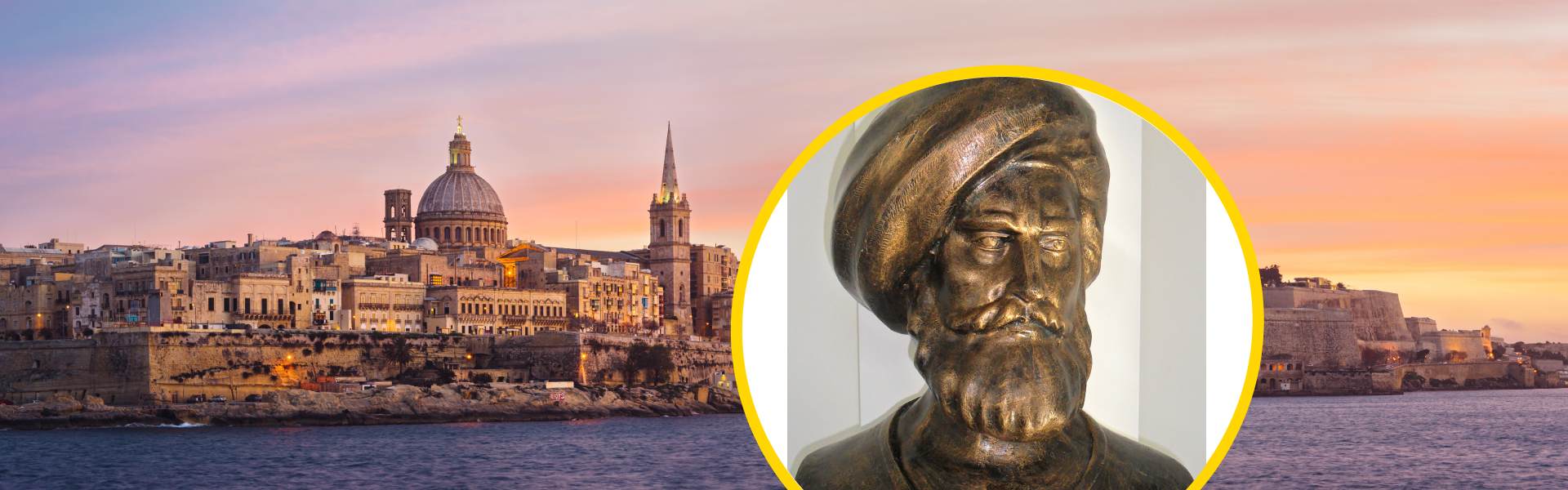
In the history of Malta there are heroes and there are villains, and few figures are cast more firmly as the villain than Dragut Reis. To his own people he was a legend known across the Ottoman world as Turgut Reis, 'The Drawn Sword of Islam', and the 'uncrowned king of the Mediterranean', perhaps the most brilliant corsair-admiral who ever lived. But to the Maltese, and above all to the people of Gozo, his name meant terror, fire and slavery.
For a quarter of a century, Dragut raided the Maltese islands again and again. In 1551 he inflicted on Gozo the single greatest catastrophe in its history, carrying almost the entire population away into slavery in a single stroke. And in 1565, at the Great Siege of Malta, the climactic battle between the Ottoman Empire and the Knights of St John, his own extraordinary life ended beneath the walls of Fort St Elmo, mortally wounded, on the very islands he had terrorised for so long.
This is the story of Dragut Reis: how he rose from a village on the Aegean coast to become the most feared corsair in the Mediterranean, what he did to Malta and Gozo, and how he met his death here in 1565. As always, we have checked the record carefully and where the sources genuinely disagree, most importantly about exactly how he died, we say so rather than pick a tidy answer.
From an Aegean village to the Drawn Sword of Islam

Dragut was born around 1485 in a small place on the Aegean coast of Asia Minor, the village near Bodrum that today bears his Turkish name, Turgutreis, renamed in his honour in 1972. His origins are debated: several historians record that his family were Greek Christians, while others hold that they were Turkish Muslims. Whatever the truth, the boy showed an extraordinary talent for weapons and, above all, for artillery. Talent-spotted young, he trained as a cannoneer, a master of siege guns, a skill that would define his whole career and make him as dangerous on land as at sea.
After serving as a gunner in the Ottoman conquest of Egypt, he went to sea, rising quickly from the captain of a single brigantine to a feared corsair commander. Around 1520 he joined the fleet of the legendary Hayreddin Barbarossa, who became his mentor, protector and friend, and who once paid Dragut the ultimate compliment, admitting that his protégé was ahead of him 'both in fishing and bravery'. Under Barbarossa, and then in his own right, Dragut carved a path of astonishing success across the Mediterranean, capturing fortresses and fleets from the Aegean to the coasts of Italy, Spain and North Africa.

His career was not one of unbroken triumph. In 1540, caught by surprise while repairing his ships at Girolata in Corsica, Dragut was captured by the forces of Giannettino Doria; nephew of the great Genoese admiral Andrea Doria and forced to serve as a galley slave, chained to the oar, for nearly four years. It was Barbarossa who eventually secured his release, in 1544, laying siege to Genoa until the city agreed to ransom him for 3,500 gold ducats. The years at the oar seem only to have hardened him. When Barbarossa died in 1546, Dragut succeeded him as the supreme commander of Ottoman naval forces in the Mediterranean and became the most feared man at sea in the entire 16th-century Mediterranean world.
Malta in his Sights: Decades of Raids

Malta, the fortress-island of the Knights of St John, the Ottomans' great Christian enemy at sea was in Dragut's sights for decades. He knew the archipelago intimately, having raided it, by one reckoning, on numerous occasions between 1540 and 1565. His attacks on Gozo alone came again and again: he sacked the island in 1540, assaulted it in 1544, and returned repeatedly through the 1540s, 1550s and early 1560s, often stopping to raid or simply to take on water and gather intelligence on the Knights' activities.
His raids formed part of the wider, brutal war of the 16th-century Mediterranean, a war of corsairs and counter-corsairs, of slave-taking on both sides, in which the Knights of Malta preyed on Muslim shipping just as Dragut preyed on Christian coasts. But for the ordinary people of Malta and especially Gozo; farmers, fishermen, villagers, largely undefended, the appearance of Dragut's sails on the horizon meant the very real prospect of death or a lifetime of slavery. And in 1551, that prospect became a catastrophe.
1551: The Emptying of Gozo

In the summer of 1551, a great Ottoman fleet under the admiral Sinan Pasha, with Dragut as its driving force, swept into the central Mediterranean. After bombarding the coasts of Sicily, the fleet turned on Malta, landing around 10,000 men. The Ottomans probed the island laying siege briefly to the fortified towns of Birgu and Senglea, then marching north to assault Mdina but, realising they lacked the numbers to take the well-defended main island, they lifted the siege.
Instead, they turned on Gozo smaller, poorer, and far more vulnerable. The Ottoman guns bombarded the Cittadella, the fortified hilltop citadel that was the island's only real refuge, for several days. The Knights' governor of Gozo, Galatian de Sesse, judging further resistance hopeless and wishing to spare his people a massacre, surrendered the citadel. What followed was devastating. Dragut and Sinan took virtually the entire population of Gozo approximately 5,000 people into captivity, herding them down to the inlet of Mġarr ix-Xini and shipping them across the sea to Tarhuna, in what is now Libya.
In a single episode, Gozo was almost emptied of its people. The island's recovery would take generations by some accounts the better part of a century as it was slowly and painfully repopulated. To this day, the 1551 raid is remembered as the single greatest catastrophe in the history of Gozo, a wound in the island's collective memory. And the man most associated with it, then and now, is Dragut. From Gozo the fleet sailed on to capture Tripoli from the Knights that same August a city Dragut would later govern and adorn, and where, fourteen years later, his own body would finally be laid to rest.
1565: The Great Siege, and the Mistake at Fort St Elmo

By 1565, the aged Sultan Suleiman the Magnificent resolved to destroy the Knights of Malta once and for all, and launched the enormous invasion that history remembers as the Great Siege of Malta. Dragut by now around eighty years old, and Pasha of Tripoli was not initially with the main fleet, but Suleiman regarded him as indispensable. So highly did the Sultan rate his experience that he reportedly instructed the expedition's commanders to defer to Dragut's judgement on his arrival.
Those commanders were divided, and it mattered. The Ottoman land forces were led by Mustafa Pasha and the fleet by the younger Piyale Pasha, and the two did not work well together. Crucially, before Dragut arrived, they had already made a fateful decision: to concentrate their first great assault on Fort St Elmo, the star-shaped fort guarding the entrance to the harbours, rather than striking first at the more vulnerable targets inland.
Dragut reached Malta on the 31st of May 1565, landing with around 1,600 men (some sources say 3,000) and fifteen ships at the tip of the promontory that has borne his name ever since Dragut Point (il-Ponta ta' Dragut), at the end of the Tigné headland in what is now Sliema, at the entrance to Marsamxett Harbour. When he surveyed the situation, he is said to have disagreed with the decision to throw everything at Fort St Elmo first; in his judgement, the Ottomans should have secured the weakly-defended Cittadella in Gozo and Mdina before committing to a bloody assault on the fort. But the attack on St Elmo had already begun and Dragut, ever the professional, threw himself into prosecuting it as effectively as possible.
And here his genius as an artilleryman came to the fore. He personally directed the placing of the Ottoman batteries, established his own guns on Dragut Point, and realising that Fort St Elmo could still communicate across the water with the Knights' headquarters at Fort St Angelo ordered a complete encirclement of St Elmo to cut it off entirely. Under his direction the bombardment became merciless. Fort St Elmo held out with astonishing, agonising courage, but it was being pounded to rubble.
Death Beneath the Walls
It was in the midst of this bombardment, on or around the 17th–18th of June 1565, that Dragut was struck down and here the historical record, honestly read, contains a genuine uncertainty that is worth setting out plainly.
What the sources agree on is this: Dragut was hit in the head by a fragment of rock, thrown up when a cannonball struck the ground close to where he was standing among the batteries near Fort St Elmo. He did not die instantly by one account, his thick turban saved him from being killed on the spot but the wound was mortal.
What the sources do not agree on is whose cannonball it was. According to some accounts, the shot was fired by the Christian defender sa lucky or well-aimed ball from the Knights' guns at Fort St Angelo across the harbour, striking near Dragut and spraying him with rock splinters. But according to other accounts, the shot came from Dragut's own side a case of friendly fire, an Ottoman gun whose ball fell short or struck the rocks of his own trench, sending the fatal fragment into his head. The standard modern reference works state candidly that it is not clear which version is true. It is one of those points where the honest historian has to hold two possibilities open rather than collapse them into a single dramatic story. Either way, the essential facts are the same: struck in the head by rock debris near Fort St Elmo, the greatest corsair of the age was carried, dying, from the field.
Dragut lingered for several days, and then died on the 23rd of June 1565, at roughly eighty years of age. There is a terrible symmetry in the timing: he died on the very day that Fort St Elmo, which he had battered so relentlessly, at last fell to the Ottomans. He is said to have lived just long enough to receive the news that the fort had been taken.
The Siege without Him
Dragut's death may well have saved Malta.
Fort St Elmo fell, but at a catastrophic cost in Ottoman lives and time so much so that Mustafa Pasha, surveying the ruin, is famously said to have wondered what the price of the father (the far larger forts of Birgu and Senglea) would be, if this was the price of the son. And with Dragut gone, there was no longer any figure of sufficient authority and brilliance to hold the rival commanders together. The squabbling between Mustafa Pasha and Piyale Pasha, which Dragut's presence had kept in check, now ran unchecked, contributing to a series of poor decisions. The Ottomans besieged Birgu and Senglea through the blistering summer, but the Knights under Grand Master Jean Parisot de Valette held on with legendary tenacity until a relief force from Sicily finally arrived, and the great siege was lifted on the 8th of September 1565; a date still celebrated in Malta as Victory Day.
Many historians have concluded that, had Dragut lived, the siege might well have ended differently that his tactical genius, and above all his ability to command the respect of the fractious Ottoman leadership, might have delivered the victory that eluded them. It is one of the great 'what ifs' of Maltese history. The man who had terrorised the islands for a quarter of a century might, in the end, have been the one to conquer them and it was his death beneath the walls of St Elmo that helped ensure he did not.
The Memory of Dragut in Malta

Dragut's body did not stay in Malta. It was taken by his lieutenant Uluç Ali Reis to Tripoli the city Dragut had captured and ruled and buried in the mosque that still bears his name, the Sidi Darghut Mosque, which remains in use to this day.
But his memory is woven permanently into the Maltese landscape and the Maltese mind. The promontory where he set his guns is still called Dragut Point, il-Ponta ta' Dragut, and stands as a kind of memorial to the great battles fought there and to his ultimate defeat. He remains, in Maltese memory, the archetypal nemesis: the corsair whose name meant terror, the man who emptied Gozo, the enemy who came within a rock's throw of taking the island.
Perhaps the most striking testament to his hold on the Maltese imagination is a painting. In 1865, three centuries after the siege, the young Maltese artist Giuseppe Calì, then only twenty-one, and destined to become one of Malta's greatest painters, produced a dramatic canvas titled The Death of Dragut, depicting the corsair's dying moments. That a Maltese master should choose, centuries later, to paint not a Maltese hero but the death of Malta's greatest enemy says something about the strange, dark fascination Dragut still exerts. He was the villain of the piece but he was a villain on an epic scale, and his death beneath the walls of Fort St Elmo is one of the pivotal moments in the story of Malta's survival.
The corsair who terrorised Malta for a quarter of a century died, in the end, on Maltese soil, and in dying, helped to save the very islands he had come to conquer.

About Matthew Gollcher
Hi, I'm Matthew, an SEO Specialist and Content Writer at Yellow Pages Malta. I'm passionate about creating meaningful content and exploring AI's creative possibilities. When I'm not working, I enjoy the gym, time with friends, watching series and reading, and playing guitar. I'm always eager to learn and grow both personally and professionally.